
阐明对 SARS-CoV-2 的免疫反应:在印度南部人群中,自然感染与 Covaxin/Covishield 疫苗接种的比较。
Elucidating the Immune Response to SARS-CoV-2: Natural Infection versus Covaxin/Covishield Vaccination in a South Indian Population.
机构信息
Department of Immunology, ICMR, National Institute for Research in Tuberculosis, Chennai 600031, India.
National Institutes of Health, National Institute for Research in Tuberculosis, International Center for Excellence in Research, Chennai 600031, India.
出版信息
Viruses. 2024 Jul 23;16(8):1178. doi: 10.3390/v16081178.
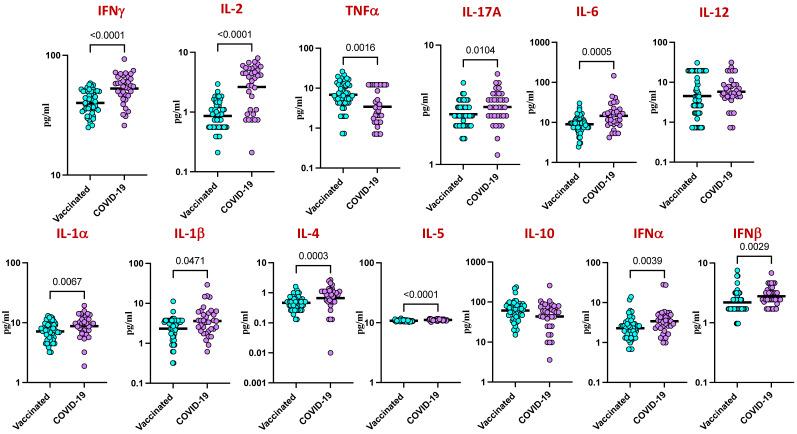
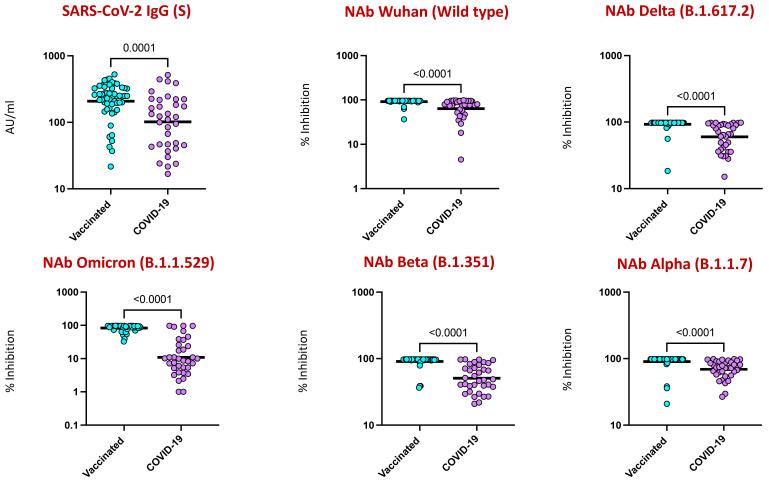
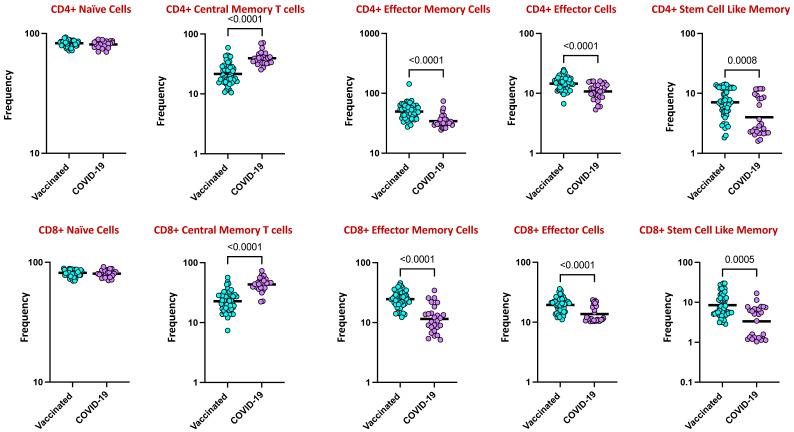
A natural infection or a vaccination can initially prime the immune system to form immunological memory. The immunity engendered by vaccination against COVID-19 versus natural infection with SARS-CoV-2 has not been well studied in the Indian population. In this study, we compared the immunity conferred by COVID-19 vaccines to naturally acquired immunity to SARS-CoV-2 in a South Indian population. We examined binding and neutralizing antibody (NAb) levels against the ancestral and variant lineages and assessed the ex vivo cellular parameters of memory T cells, memory B cells, and monocytes and finally measured the circulating cytokine response. COVID-19 vaccination stimulates heightened levels of IgG antibodies against the original strain of SARS-CoV-2, as well as increased binding to the spike protein and neutralizing antibody levels. This enhanced response extends to variant lineages such as B.1.617.2 (Delta, India), B.1.1.529 (Omicron, India), B.1.351 (Beta, South Africa), and B.1.1.7 (Alpha, UK). COVID-19 vaccination differs from SARS-CoV-2 infection by having increased frequencies of classical memory B cells, activated memory B and plasma cells, CD4/CD8 T cells of effector memory, effector cells, stem cell-like memory T cells, and classical and intermediate monocytes and diminished frequencies of CD4/CD8 T cells of central memory and non-classical monocytes in vaccinated individuals in comparison to those with natural infection. Thus, COVID-19 vaccination is characterized by enhanced humoral responses and robust activation of innate and memory T cell responses in comparison to natural infection in a South Indian population.
自然感染或接种疫苗最初可以使免疫系统产生免疫记忆。在印度人群中,尚未很好地研究针对 COVID-19 的疫苗接种与 SARS-CoV-2 自然感染所产生的免疫力。在这项研究中,我们比较了 COVID-19 疫苗在印度南部人群中产生的免疫与 SARS-CoV-2 的自然获得性免疫力。我们检测了针对原始和变异谱系的结合和中和抗体(NAb)水平,并评估了记忆 T 细胞、记忆 B 细胞和单核细胞的体外细胞参数,最后测量了循环细胞因子反应。COVID-19 疫苗接种会刺激针对 SARS-CoV-2 原始株的 IgG 抗体水平升高,以及对刺突蛋白的结合和中和抗体水平升高。这种增强的反应扩展到 B.1.617.2(Delta,印度)、B.1.1.529(Omicron,印度)、B.1.351(Beta,南非)和 B.1.1.7(Alpha,英国)等变异谱系。与 SARS-CoV-2 感染不同,COVID-19 疫苗接种会导致经典记忆 B 细胞、活化的记忆 B 和浆细胞、效应记忆 CD4/CD8 T 细胞、效应细胞、干细胞样记忆 T 细胞以及经典和中间单核细胞的频率增加,而中央记忆 CD4/CD8 T 细胞和非经典单核细胞的频率降低在接种疫苗的个体中与自然感染相比。因此,与自然感染相比,COVID-19 疫苗接种的特点是在印度南部人群中产生了增强的体液反应和强大的先天和记忆 T 细胞反应。



 Zotero 插件