
对糖尿病前期患者参与健康计划情况的混合方法评估:与转介及参与生活方式健康计划相关的因素
A mixed-methods assessment of engagement in wellness programs for patients with prediabetes: Factors associated with referral and participation in lifestyle wellness programs.
作者信息
Thomas Tainayah W, Finertie Holly, Sanchez Perla, Rodriguez Luis A, Schmittdiel Julie
机构信息
Stanford University School of Medicine, Department of Epidemiology and Population Health, Stanford, CA, USA.
Kaiser Permanente Northern California, Division of Research, Oakland, CA, USA.
出版信息
Prev Med Rep. 2024 Aug 7;45:102850. doi: 10.1016/j.pmedr.2024.102850. eCollection 2024 Sep.
OBJECTIVE
We assessed factors associated with engagement in lifestyle wellness programs for patients with prediabetes.
METHODS
This mixed-methods study, conducted between March 2018 and April of 2021, combined a retrospective cohort study and semi-structured interviews in a Northern California cohort of patients from a randomized controlled pragmatic clinical trial aged 18-75 with body mass index 25 and at least one HbA1c between 5.7-6.4 % in the previous 3 months. Patients were assigned to a peer support, enhanced usual care, or control arm. We used generalized linear mixed models to analyze the association between clinical, demographic, and study-related factors and referral to and participation in wellness programs within 12 months. We conducted semi-structured interviews with intervention participants and analyzed them using thematic analysis. We integrated qualitative and quantitative findings using the "following a thread" method.
RESULTS
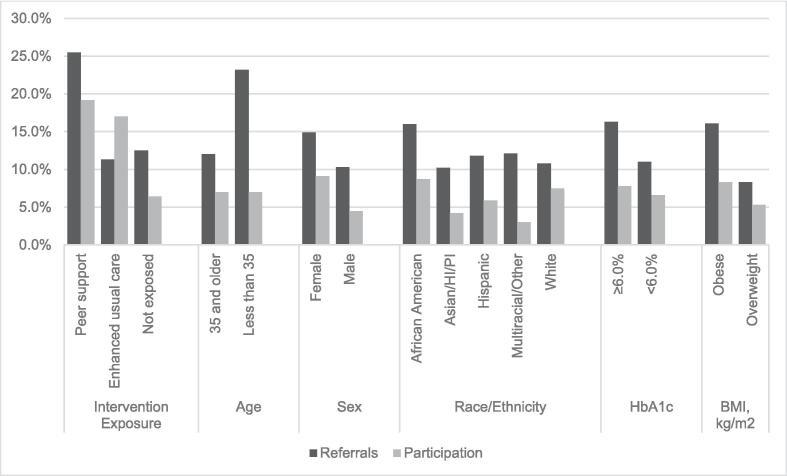
We identified 2,164 eligible patients; 12.8% were referred to a wellness program and 7% attended a wellness program. Patients not exposed to peer support, males, and Asian-American participants had the lowest odds of participation in wellness programs. Qualitative interviews with 30 intervention participants provided contextual information on quantitative findings including the importance of physician referrals and formal recruitment, a need for social support and accountability, and matching patient needs to wellness program descriptions as facilitators of engaging in wellness programs.
CONCLUSION
Given the low percentage of patients with prediabetes referred to and participating in wellness programs, there is a need to develop health system strategies to improve wellness program engagement for patients at-risk for diabetes.
目的
我们评估了与糖尿病前期患者参与生活方式健康计划相关的因素。
方法
这项混合方法研究于2018年3月至2021年4月进行,结合了一项回顾性队列研究和对北加利福尼亚一组患者的半结构化访谈,这些患者来自一项随机对照实用临床试验,年龄在18 - 75岁之间,体重指数≥25,且在过去3个月内糖化血红蛋白(HbA1c)至少有一次在5.7% - 6.4%之间。患者被分配到同伴支持组、强化常规护理组或对照组。我们使用广义线性混合模型来分析临床、人口统计学和研究相关因素与12个月内转介至健康计划并参与该计划之间的关联。我们对干预参与者进行了半结构化访谈,并使用主题分析对其进行分析。我们采用“追踪线索”方法整合了定性和定量研究结果。
结果
我们确定了2164名符合条件的患者;12.8%的患者被转介至健康计划,7%的患者参加了健康计划。未接受同伴支持的患者、男性和亚裔美国参与者参与健康计划的几率最低。对30名干预参与者的定性访谈提供了与定量研究结果相关的背景信息,包括医生转介和正式招募的重要性、对社会支持和问责制的需求,以及将患者需求与健康计划描述相匹配作为参与健康计划的促进因素。
结论
鉴于糖尿病前期患者被转介至并参与健康计划的比例较低,有必要制定卫生系统策略,以提高糖尿病高危患者对健康计划的参与度。
 Zotero 插件