
埃塞俄比亚热点地区重点和脆弱人群中的肺结核患病率。系统评价和荟萃分析。
Prevalence of pulmonary tuberculosis among key and vulnerable populations in hotspot settings of Ethiopia. A systematic review and meta-analysis.
机构信息
Department of Medical Laboratory Science, College of Health Sciences, Woldia University, Woldia, Ethiopia.
Research Centre for Tuberculosis and Department of Medical Microbiology, Faculty of Health Sciences, University of Pretoria, Pretoria, South Africa.
出版信息
PLoS One. 2024 Aug 29;19(8):e0309445. doi: 10.1371/journal.pone.0309445. eCollection 2024.
BACKGROUND
Despite the decline in tuberculosis (TB) incidence across many regions worldwide, including Ethiopia, the disease remains highly concentrated among vulnerable or socially marginalized populations and in high-risk settings. This systematic review and meta-analysis aims to estimate the pooled prevalence of pulmonary tuberculosis (PTB) among key and vulnerable populations (KVPs) residing in hotspot settings in Ethiopia.
METHODS
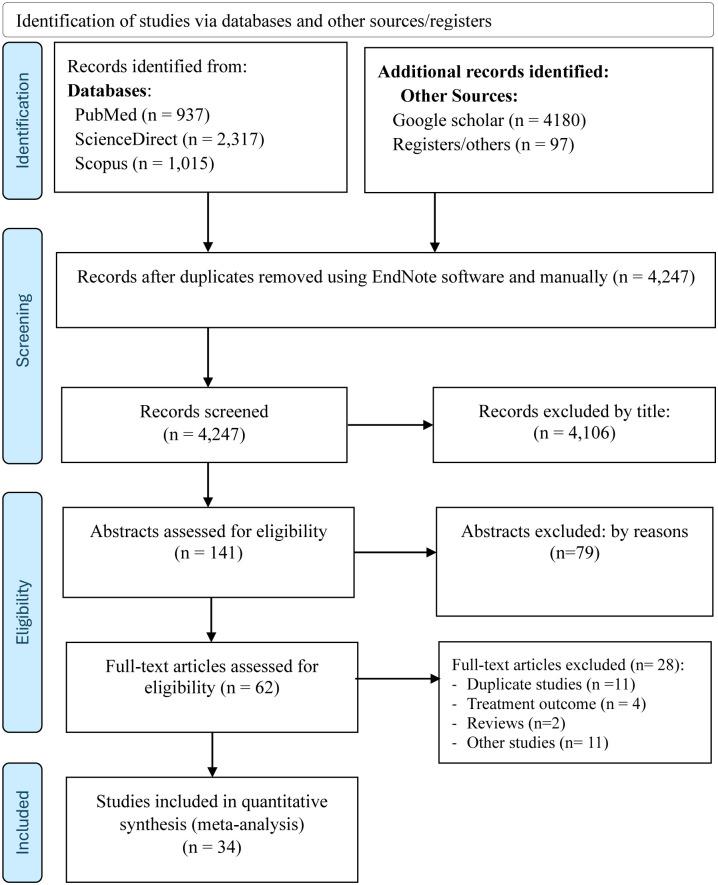
Potential papers were searched systematically in PubMed, Scopus, ScienceDirect databases, Google Scholar search engine, and institutional electronic repositories/registrars. A total of 34 potential articles that provide necessary information on the prevalence of PTB were reviewed and data were analyzed to determine the pooled prevalence of PTB among KVPs. The relevant data were recorded and analyzed using STATA 17.0. Cohen's kappa was computed to determine the agreement between reviewers, the Inverse of variance (I2) to evaluate heterogeneity across studies, and Egger's test to identify publication bias. A random effect model was used to determine the pooled prevalence of PTB, subgroup analysis was computed by types of hotspot settings and year of publication.
RESULTS
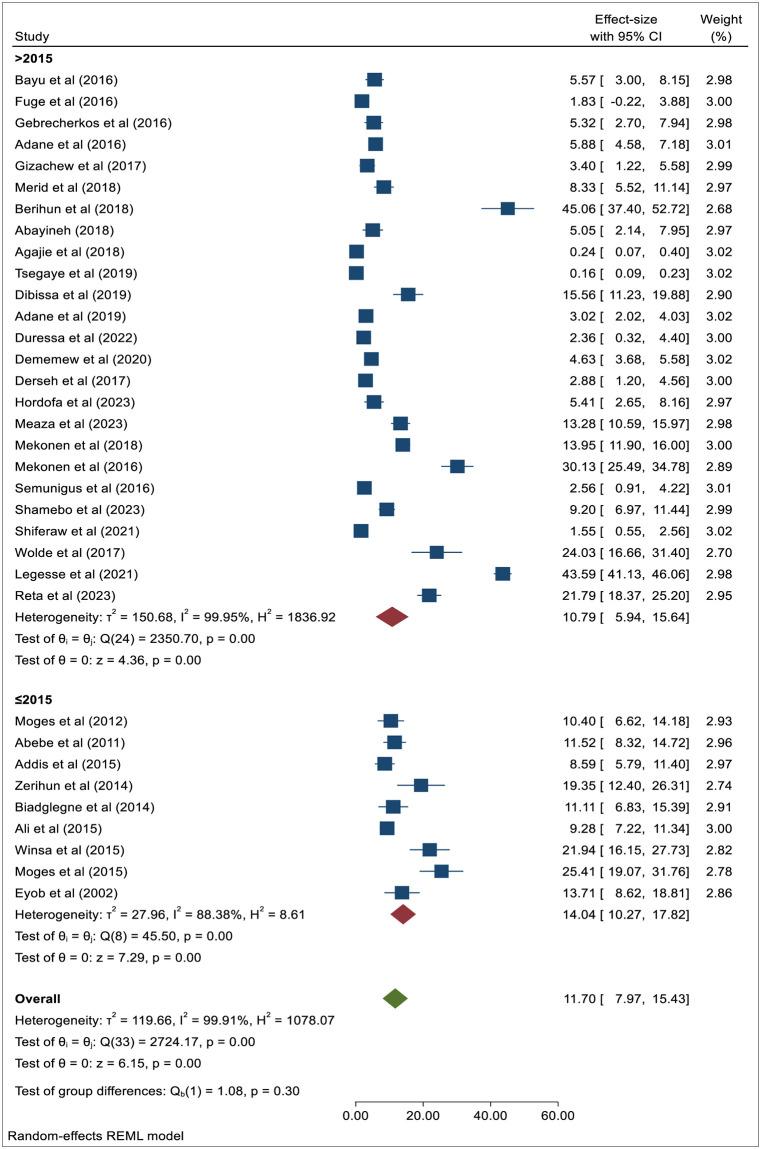
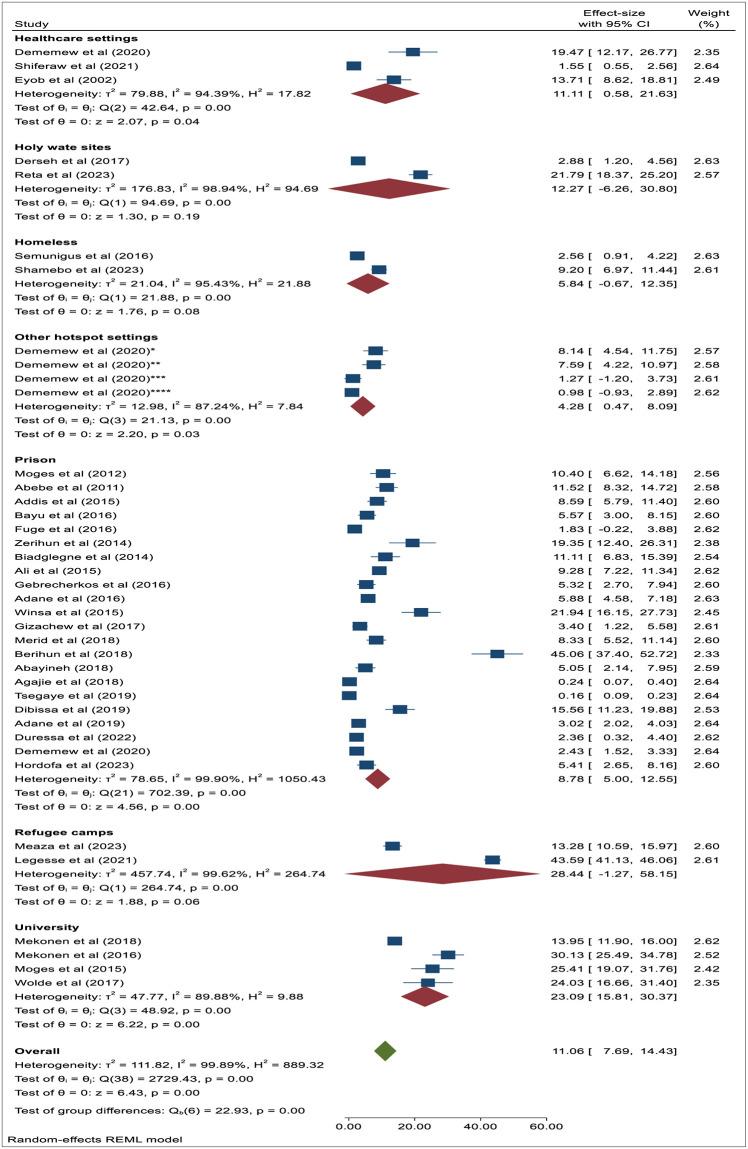
This meta-analysis demonstrates that the pooled prevalence of PTB among populations residing in hotspot settings in Ethiopia was 11.7% (95% confidence interval (95CI): 7.97-15.43) with an I2 of 99.91% and a p< 0.001. Furthermore, the subgroup analysis unveiled the pooled prevalence of PTB among KVPs residing in different hotspot settings as follows: Prison inmates 8.8% (95CI: 5.00-12.55%), University students 23.1% (95CI: 15.81-30.37%), Refugees 28.4% (95CI: -1.27-58.15%), Homeless peoples 5.8% (95CI: -0.67-12.35%), Healthcare settings 11.1% (95CI: 0.58-21.63%), Spiritual holy water sites attendees 12.3% (95CI: -6.26-30.80%), and other high-risk settings 4.3% (95CI: 0.47-8.09%). Besides, the subgroup analysis revealed that the pooled prevalence of PTB post-2015 was 10.79% (95CI: 5.94-15.64%), whereas it stood at 14.04% (95CI: 10.27-17.82%) before 2015.
CONCLUSION
The prevalence of PTB among KVPs residing in the hotspot settings in Ethiopia remains significant, with a weighted pooled prevalence of 11.7%. Thus, the national TB control programs should give due attention and appropriate control measures should be instituted that include regular systematic TB screening, compulsory TB testing for presumptive TB cases among KVPs, and tightened infection control at hotspot settings.
背景
尽管结核病(TB)的发病率在世界许多地区(包括埃塞俄比亚)有所下降,但该疾病在弱势群体或社会边缘人群以及高危环境中仍然高度集中。本系统评价和荟萃分析旨在估计埃塞俄比亚热点环境中关键和弱势群体(KVPs)中肺结核(PTB)的总患病率。
方法
系统地在 PubMed、Scopus、ScienceDirect 数据库、Google Scholar 搜索引擎和机构电子资源库/登记处搜索潜在文献。综述了 34 篇可能提供 PTB 患病率相关信息的潜在文章,并对数据进行了分析,以确定 KVPs 中 PTB 的总患病率。使用 STATA 17.0 记录和分析相关数据。计算 Cohen's kappa 以确定审稿人之间的一致性,Inverse of variance (I2) 以评估研究之间的异质性,Egger 检验以识别发表偏倚。使用随机效应模型确定 PTB 的总患病率,通过热点环境的类型和发布年份进行亚组分析。
结果
本荟萃分析表明,埃塞俄比亚热点环境中居住的人群中 PTB 的总患病率为 11.7%(95%置信区间(95CI):7.97-15.43),I2 为 99.91%,p<0.001。此外,亚组分析揭示了居住在不同热点环境中的 KVPs 中 PTB 的总患病率如下:囚犯 8.8%(95CI:5.00-12.55%)、大学生 23.1%(95CI:15.81-30.37%)、难民 28.4%(95CI:-1.27-58.15%)、无家可归者 5.8%(95CI:-0.67-12.35%)、医疗保健环境 11.1%(95CI:0.58-21.63%)、圣水源朝圣者 12.3%(95CI:-6.26-30.80%)和其他高危环境 4.3%(95CI:0.47-8.09%)。此外,亚组分析显示,2015 年后 PTB 的总患病率为 10.79%(95CI:5.94-15.64%),而 2015 年前为 14.04%(95CI:10.27-17.82%)。
结论
埃塞俄比亚热点环境中 KVPs 中 PTB 的患病率仍然很高,加权总患病率为 11.7%。因此,国家结核病控制规划应予以重视,并应采取适当的控制措施,包括定期进行系统的结核病筛查、对 KVPs 中的疑似结核病病例进行强制性结核病检测以及加强热点环境的感染控制。

 Zotero 插件