
自评健康状况与 2 型糖尿病发病风险:一项对中国中老年人群的前瞻性队列研究。
Self-Rated Health Status and the Risk of Incident Type 2 Diabetes: A Prospective Cohort Study of Middle-Aged and Older Chinese.
机构信息
School of Medicine, Jinhua University of Vocational Technology, Jinhua, Zhejiang, China.
Public Health, Peking University, Beijing, China.
出版信息
Int J Public Health. 2024 Aug 15;69:1606401. doi: 10.3389/ijph.2024.1606401. eCollection 2024.
OBJECTIVES
Evidence on the relationship between self-rated health status and incident type 2 diabetes (T2DM) in China is scarce. This study aims to examine the prospective association of self-rated health status with the subsequent risk of T2DM among middle-aged and older Chinese subjects.
METHODS
Data were obtained from the China Health and Retirement Longitudinal Study of 9844 Chinese individuals aged 45 years or older. Cox proportional hazards models were used to yield hazard ratios (HRs) relating self-rated health status to the 7-year incidence of T2DM, adjusting for conventional risk factors.
RESULTS
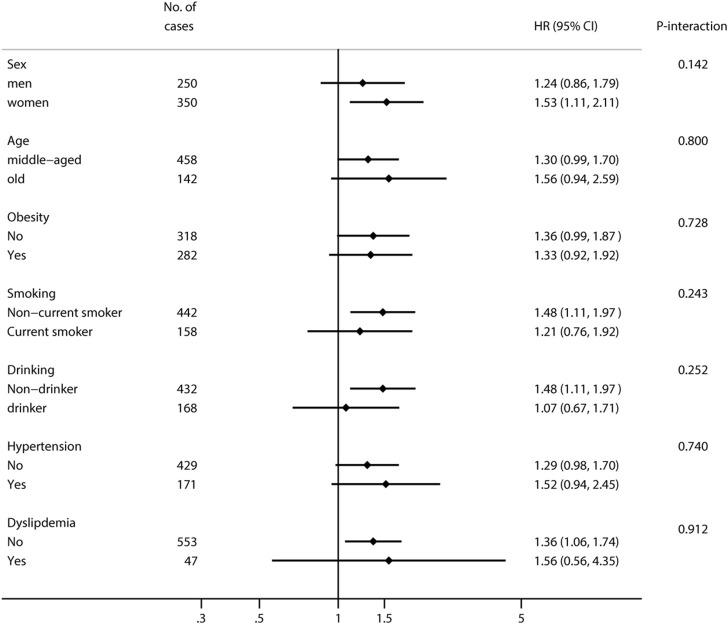
Compared to those with very good or good self-rated health, individuals with poor health had a significantly higher risk of developing T2DM in the multivariable-adjusted model [HR = 1.36 (1.07, 1.73)]. Subgroup analysis by sex showed stronger associations in women [HR = 1.53 (1.11, 2.12)]. Interaction analyses indicated that factors such as age, sex, obesity, smoking status, drinking status, history of hypertension and history of dyslipidemia did not modify the association (all -interaction >0.05).
CONCLUSION
Poor self-rated health status is associated with a higher risk of developing T2DM in middle-aged and older Chinese people.
目的
关于自评健康状况与中国 2 型糖尿病(T2DM)发病类型之间关系的证据较少。本研究旨在探讨自评健康状况与中国中老年人群 T2DM 发病风险的前瞻性关联。
方法
数据来自中国健康与退休纵向研究,该研究共纳入 9844 名年龄在 45 岁及以上的中国个体。采用 Cox 比例风险模型得出与自评健康状况相关的风险比(HRs),以调整传统风险因素后预测 7 年内 T2DM 的发病风险。
结果
与自评健康状况极好或良好的个体相比,自评健康状况差的个体在多变量调整模型中发生 T2DM 的风险显著更高[HR=1.36(1.07,1.73)]。按性别进行的亚组分析显示,女性的相关性更强[HR=1.53(1.11,2.12)]。交互分析表明,年龄、性别、肥胖、吸烟状况、饮酒状况、高血压史和血脂异常史等因素并未改变这种关联(所有交互作用值均>0.05)。
结论
自评健康状况较差与中国中老年人群发生 T2DM 的风险增加相关。

 Zotero 插件