
法布雷单抗双通道抑制治疗既往治疗的新生血管性年龄相关性黄斑变性和糖尿病性黄斑水肿:来自英国视网膜专家小组的指导。
Dual pathway inhibition with faricimab for previously treated neovascular age-related macular degeneration and diabetic macular oedema: guidance from a UK panel of retina specialists.
机构信息
Hull University Teaching Hospitals NHS Trust, Hull, UK.
NIHR Moorfields Clinical Research Facility, Moorfields Eye Hospital NHS Foundation Trust, London, UK.
出版信息
Eye (Lond). 2024 Nov;38(16):3077-3086. doi: 10.1038/s41433-024-03223-w. Epub 2024 Aug 30.
BACKGROUND/OBJECTIVES: Some eyes with neovascular age-related macular degeneration (nAMD) and centre-involving diabetic macular oedema (DMO) fail to respond sufficiently or lose response over time to standard of care intravitreal anti-vascular endothelial growth factor (anti-VEGF) therapy. This paper explores clinical scenarios for switching to dual action angiopoietin-2 (Ang-2)/VEGF-A inhibitor faricimab (Vabysmo, Roche Products Limited) in previously anti-VEGF-treated patients.
METHODS
A national steering group meeting of UK retina specialists was held in London on 27 October 2023. Clinician practice and experience were reviewed together with pivotal clinical trial data and early findings from real-world settings. Roche Products Limited facilitated and funded the meeting.
RESULTS
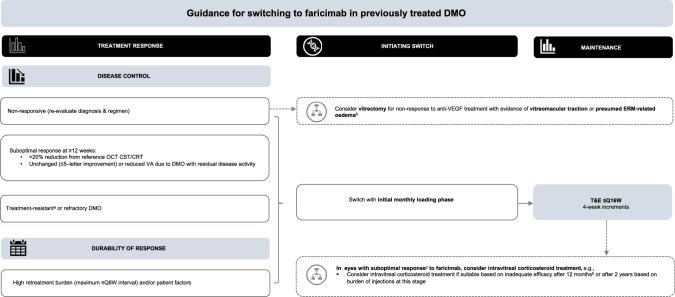
While there is no standardised protocol for identifying suboptimal response, the authors review relevant clinical biomarkers of disease activity used in routine clinical practice to determine patient response and guide treatment decisions. Common reasons identified for considering a change of treatment were lack of efficacy demonstrated by suboptimal anatomic or visual improvement and insufficient durability of response. The panel outline strategies for switching to faricimab among eligible patients with a prior anti-VEGF treatment history, with initial monthly loading doses or maintaining the previous treatment interval before attempting to extend, that may be integrated into current treat-and-extend (T&E) clinical pathways for treating patients with nAMD and DMO. General considerations for switching between treatments are also reviewed.
CONCLUSION
Clinicians may consider a treatment switch to faricimab in nAMD and DMO patients who have suboptimal disease control or insufficient durability of response on initial anti-VEGF therapy.
背景/目的:一些患有新生血管性年龄相关性黄斑变性(nAMD)和中心性累及糖尿病性黄斑水肿(DMO)的患者,对标准治疗方案中的玻璃体内抗血管内皮生长因子(anti-VEGF)治疗的反应不足或随着时间的推移失去反应。本文探讨了在先前接受过 anti-VEGF 治疗的患者中,转换为双重作用血管生成素-2(Ang-2)/VEGF-A 抑制剂 faricimab(Vabysmo,罗氏产品有限公司)的临床情况。
方法
2023 年 10 月 27 日,英国视网膜专家在伦敦举行了一次全国指导小组会议。一起审查了临床医生的实践和经验,以及关键的临床试验数据和真实环境中的早期发现。罗氏产品有限公司促成并资助了此次会议。
结果
虽然确定反应不佳的标准化方案并不存在,但作者回顾了用于常规临床实践中确定患者反应和指导治疗决策的相关疾病活动的临床生物标志物。确定考虑改变治疗的常见原因是缺乏疗效,表现为解剖学或视觉改善不佳,以及反应的持久性不足。该小组概述了在具有先前 anti-VEGF 治疗史的合格患者中转换为 faricimab 的策略,包括初始每月负荷剂量或在尝试延长之前维持之前的治疗间隔,这些策略可能会整合到当前治疗和延长(T&E)治疗 nAMD 和 DMO 患者的临床途径中。还审查了治疗之间转换的一般注意事项。
结论
对于初始 anti-VEGF 治疗反应不佳或反应持久性不足的 nAMD 和 DMO 患者,临床医生可以考虑将治疗转换为 faricimab。


 Zotero 插件