
社会、人口和经济因素对海湾合作委员会国家生育趋势的影响:1980 年至 2021 年的纵向时间趋势分析。
The influence of social, demographic and economic factors on fertility trends in Gulf Cooperation Council countries: A longitudinal time trend analysis-1980-2021.
机构信息
From the Department of Physiology (S. Meo), College of Medicine, King Saud University; from the College of Medicine (Shaikh), King Saud University, Riyadh, Kingdom of Saudi Arabial; and from the School of Medicin (A. Meo), Medical Sciences & Nutrition, University of Aberdeen, Scotland, United Kingdom.
出版信息
Saudi Med J. 2024 Aug;45(9):935-944. doi: 10.15537/smj.2024.45.9.20240437.
OBJECTIVES
To analyze the fertility rate trends in the GCC countries and their association with socioeconomic factors so that policymakers may use the study findings for future healthcare plans.
METHODS
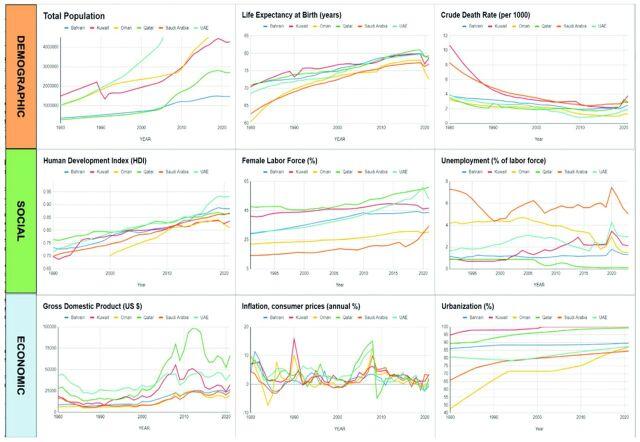
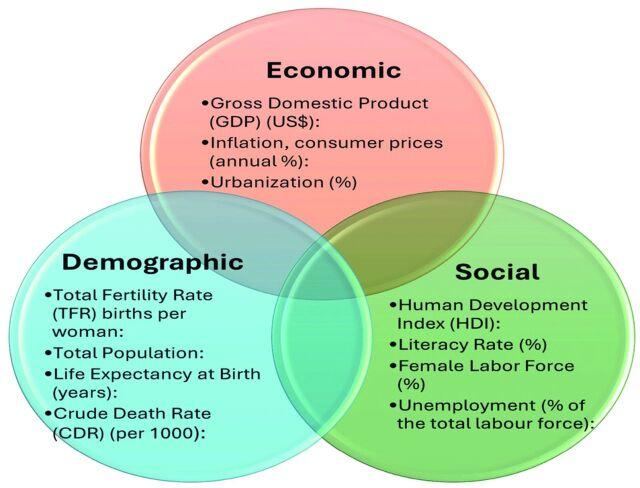
Total population, crude death rate, life expectancy, literacy rate, human development index (HDI), female employment, unemployment rate, urbanisation, gross domestic product (GDP) per capita and inflation were chosen as possible predictors of TFR trends. The data were collected for the Global Burden of Disease 2021 study and other official databases such as the World Bank, the United Nations Development Program and Our World in Data for the 6 Gulf Cooperation Council (GCC) countries. Mean with standard deviation and percentage change was calculated to assess trends of TFR and all other variables from 1980-2021.
RESULTS
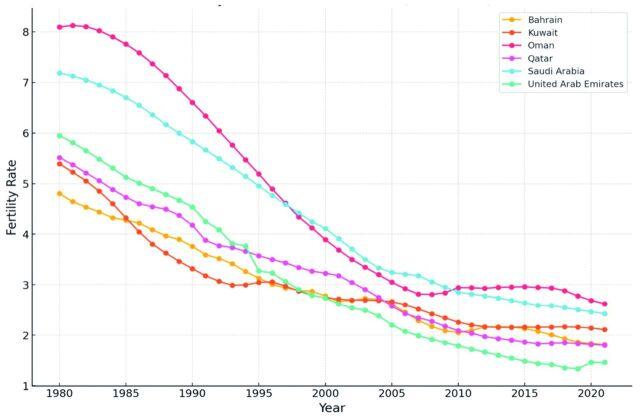
The fertility rate declined in all 6 countries in 2021 compared to 1980. The highest decline was found in the United Arab Emirates (75.5%), while the lowest was in Kuwait (60.9%). From 1980-2021, total population, life expectancy, HDI, literacy rate, GDP, urbanisation, and female labor force increased in all GCC countries. The total population, life expectancy, urbanisation, female labor force, GDP and HDI were negatively and significantly correlated with TFR (<0.01). The literacy rate showed a negative and significant correlation with TFR in Bahrain, Kuwait, Saudi Arabia, and Qatar.
CONCLUSION
The TFR is declining in GCC countries. The plausible causes include the inclination towards postponement of marriages and excessive costs of living. These trends and associations need to be evaluated by policymakers so that they identify priority areas for interventions, allocate resources and formulate developmental plans accordingly to ensure strategic progress of the region.
目的
分析海湾合作委员会(GCC)国家的生育率趋势及其与社会经济因素的关系,以便决策者可以将研究结果用于未来的医疗保健计划。
方法
选择总人口、粗死亡率、预期寿命、识字率、人类发展指数(HDI)、女性就业、失业率、城市化、人均国内生产总值(GDP)和通货膨胀率作为可能影响总和生育率趋势的预测因素。数据来自 2021 年全球疾病负担研究和世界银行、联合国开发计划署和 Our World in Data 等其他官方数据库,用于评估 2021 年和 1980 年至 2021 年期间总和生育率和所有其他变量的趋势。
结果
与 1980 年相比,2021 年 6 个 GCC 国家的生育率均有所下降。阿联酋的降幅最大(75.5%),科威特的降幅最小(60.9%)。1980 年至 2021 年期间,GCC 所有国家的总人口、预期寿命、HDI、识字率、GDP、城市化和女性劳动力均有所增加。总人口、预期寿命、城市化、女性劳动力、GDP 和 HDI 与总和生育率呈负相关且具有统计学意义(<0.01)。在巴林、科威特、沙特阿拉伯和卡塔尔,识字率与总和生育率呈负相关且具有统计学意义。
结论
GCC 国家的总和生育率正在下降。可能的原因包括结婚意愿推迟和生活成本过高。决策者需要评估这些趋势和关联,以便确定干预的优先领域,相应地分配资源和制定发展计划,以确保该地区的战略进步。
 Zotero 插件