
利用白细胞介素-2进行癌症和慢性感染的免疫治疗:历史视角与新趋势
Harnessing IL-2 for immunotherapy against cancer and chronic infection: a historical perspective and emerging trends.
作者信息
Im Se Jin, Lee Kyungmin, Ha Sang-Jun
机构信息
Department of Immunology, Sungkyunkwan University School of Medicine, Suwon, Korea.
Department of Biochemistry, College of Life Science & Biotechnology, Yonsei University, Seoul, Korea.
出版信息
Exp Mol Med. 2024 Sep;56(9):1900-1908. doi: 10.1038/s12276-024-01301-3. Epub 2024 Sep 2.
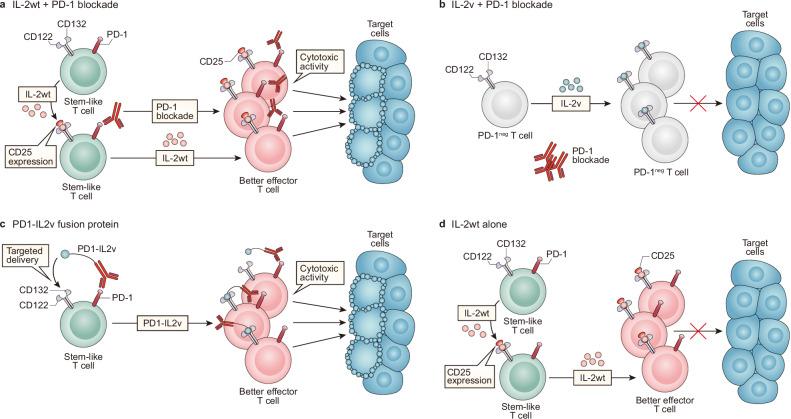
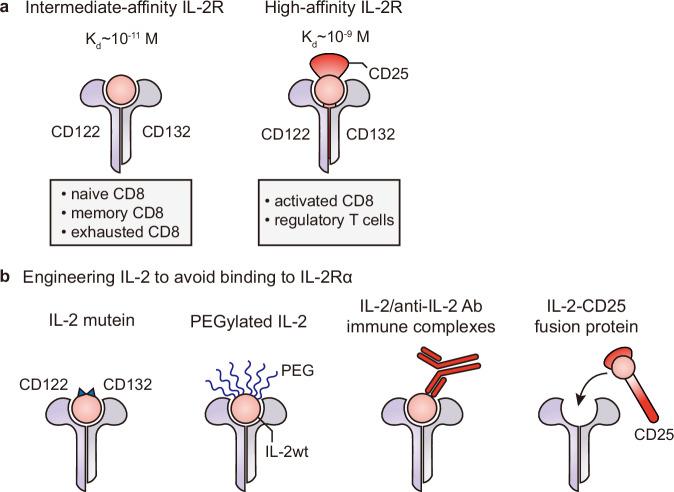
IL-2 therapy, which enhances the function of CD8 + T cells, was initially employed as the cornerstone of immunotherapy against cancer. However, the impact of this therapy extends beyond CD8 + T cells to cells expressing IL-2R, such as endothelial cells and regulatory T cells (Tregs), resulting in various side effects. Consequently, IL-2 therapy has taken a step back from the forefront of treatment. Immune checkpoint inhibitors (ICIs), such as anti-PD-1/PD-L1 antibodies and CTLA-4 antibodies, are used because of their durable therapeutic responses and the reduced incidence of side effects. Nevertheless, only a small fraction of cancer patients respond to ICIs, and research on IL-2 as a combination treatment to improve the efficacy of these ICIs is ongoing. To mitigate side effects, efforts have focused on developing IL-2 variants that do not strongly bind to cells expressing IL-2Rα and favor signaling through IL-2Rβγ. However, recent studies have suggested that, in the context of persistent antigen stimulation models, effective stimulation of antigen-specific exhausted CD8 + T cells in combination with PD-1 inhibitors requires either 1) binding to IL-2Rα or 2) delivery via a fusion with PD-1. This review explores the historical context of IL-2 as an immunotherapeutic agent and discusses future directions for its use in cancer immunotherapy.
白细胞介素-2(IL-2)疗法可增强CD8 + T细胞的功能,最初被用作抗癌免疫疗法的基石。然而,这种疗法的影响不仅限于CD8 + T细胞,还扩展到表达IL-2受体的细胞,如内皮细胞和调节性T细胞(Tregs),从而导致各种副作用。因此,IL-2疗法已从治疗前沿退居二线。免疫检查点抑制剂(ICIs),如抗PD-1/PD-L1抗体和CTLA-4抗体,因其持久的治疗反应和较低的副作用发生率而被使用。然而,只有一小部分癌症患者对ICIs有反应,目前正在进行关于将IL-2作为联合治疗以提高这些ICIs疗效的研究。为了减轻副作用,研究重点集中在开发不与表达IL-2Rα的细胞强烈结合且有利于通过IL-2Rβγ信号传导的IL-2变体。然而,最近的研究表明,在持续抗原刺激模型的背景下,与PD-1抑制剂联合有效刺激抗原特异性耗竭的CD8 + T细胞需要:1)与IL-2Rα结合或2)通过与PD-1融合进行递送。本文综述探讨了IL-2作为免疫治疗剂的历史背景,并讨论了其在癌症免疫治疗中的未来应用方向。

 Zotero 插件