
分析肠道细菌对新生儿重症监护补充剂的反应。
Analyzing the Responses of Enteric Bacteria to Neonatal Intensive Care Supplements.
作者信息
Waller Megan E, Eichhorn Caroline J, Gutierrez Alyssa, Baatz John E, Wagner Carol L, Chetta Katherine E, Engevik Melinda A
机构信息
Department of Regenerative Medicine and Cell Biology Medical University of South Carolina, Charleston, USA.
Department of Pediatrics C.P. Darby Children's Research Institute Medical University of South Carolina, Charleston, USA.
出版信息
Int J Microbiol. 2024 Aug 23;2024:3840327. doi: 10.1155/2024/3840327. eCollection 2024.
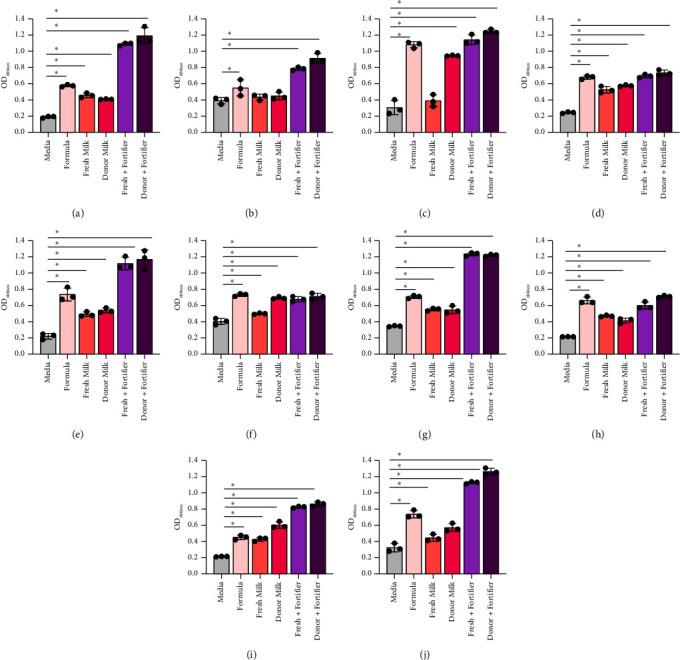
In the neonatal intensive care unit, adequate nutrition requires various enteral products, including human milk and formula. Human milk is typically fortified to meet increased calorie goals, and infants commonly receive vitamin mixes, iron supplements, and less frequently, thickening agents. We examined the growth of 16 commensal microbes and 10 pathobionts found in the premature infant gut and found that formula, freshly pasteurized milk, and donated banked milk generally increased bacterial growth. Fortification of human milk significantly elevated the growth of all microbes. Supplementation with thickeners or NaCl in general did not stimulate additional growth. Vitamin mix promoted the growth of several commensals, while iron promoted growth of pathobionts. These data indicate that pathobionts in the preterm gut have significant growth advantage with preterm formula, fortified donor milk, and supplemented iron and suggest that the choice of milk and supplements may impact the infant gut microbiota.
在新生儿重症监护病房,充足的营养需要多种肠内产品,包括母乳和配方奶。母乳通常会强化以满足增加的热量目标,婴儿通常会接受维生素混合物、铁补充剂,较少情况下还会接受增稠剂。我们研究了在早产儿肠道中发现的16种共生微生物和10种致病共生菌的生长情况,发现配方奶、新鲜巴氏杀菌牛奶和捐赠的储存牛奶通常会增加细菌生长。母乳强化显著提高了所有微生物的生长。一般来说,添加增稠剂或氯化钠不会刺激额外的生长。维生素混合物促进了几种共生菌的生长,而铁促进了致病共生菌的生长。这些数据表明,早产肠道中的致病共生菌在早产配方奶、强化捐赠母乳以及补充铁的情况下具有显著的生长优势,并表明牛奶和补充剂的选择可能会影响婴儿肠道微生物群。


 Zotero 插件