
空气污染:痴呆症的潜在关键驱动因素。
Air pollution: a latent key driving force of dementia.
机构信息
Department of Health in Emergencies and Disasters, School of Public Health, Tehran University of Medical Sciences, Tehran, Iran.
Climate Change and Health Research Center (CCHRC), Institute for Environmental Research (IER), Tehran University of Medical Sciences, Tehran, Iran.
出版信息
BMC Public Health. 2024 Sep 2;24(1):2370. doi: 10.1186/s12889-024-19918-4.
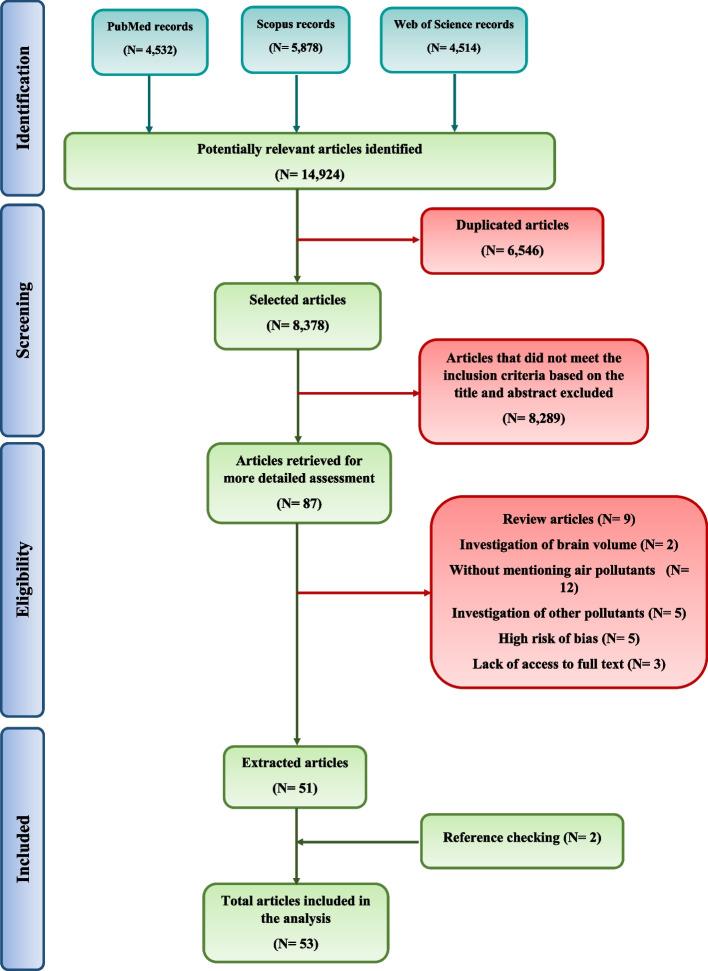
Many researchers have studied the role of air pollutants on cognitive function, changes in brain structure, and occurrence of dementia. Due to the wide range of studies and often contradictory results, the present systematic review was conducted to try and clarify the relationship between air pollutants and dementia. To identify studies for this review, a systematic search was conducted in Scopus, PubMed, and Web of Science databases (without historical restrictions) until May 22, 2023. The PECO statement was created to clarify the research question, and articles that did not meet the criteria of this statement were excluded. In this review, animal studies, laboratory studies, books, review articles, conference papers and letters to the editors were avoided. Also, studies focused on the effect of air pollutants on cellular and biochemical changes (without investigating dementia) were also excluded. A quality assessment was done according to the type of design of each article, using the checklist developed by the Joanna Briggs Institute (JBI). Finally, selected studies were reviewed and discussed in terms of Alzheimer's dementia and non-Alzheimer's dementia. We identified 14,924 articles through a systematic search in databases, and after comprehensive reviews, 53 articles were found to be eligible for inclusion in the current systematic review. The results showed that chronic exposure to higher levels of air pollutants was associated with adverse effects on cognitive abilities and the presence of dementia. Studies strongly supported the negative effects of PM and then NO on the brain and the development of neurodegenerative disorders in old age. Because the onset of brain structural changes due to dementia begins decades before the onset of disease symptoms, and that exposure to air pollution is considered a modifiable risk factor, taking preventive measures to reduce air pollution and introducing behavioral interventions to reduce people's exposure to pollutants is advisable.
许多研究人员研究了空气污染物对认知功能、大脑结构变化和痴呆症发生的作用。由于研究范围广泛,且结果往往相互矛盾,因此进行了本次系统评价,试图厘清空气污染物与痴呆症之间的关系。为了确定本次综述的研究,在 Scopus、PubMed 和 Web of Science 数据库中进行了系统检索(没有历史限制),直到 2023 年 5 月 22 日。为了阐明研究问题,制定了 PECO 声明,并排除了不符合该声明标准的文章。在本次综述中,避免了动物研究、实验室研究、书籍、综述文章、会议论文和给编辑的信件。此外,还排除了专门研究空气污染物对细胞和生化变化影响(而不调查痴呆症)的研究。根据每篇文章的设计类型,使用 Joanna Briggs 研究所(JBI)制定的检查表进行了质量评估。最后,根据阿尔茨海默病痴呆症和非阿尔茨海默病痴呆症对选定的研究进行了回顾和讨论。通过数据库的系统检索,我们共识别出 14924 篇文章,经过全面审查,发现有 53 篇文章符合纳入本次系统评价的标准。结果表明,长期暴露于较高水平的空气污染物与认知能力下降和痴呆症存在有关。研究强烈支持 PM 和 NO 对大脑的负面影响,以及它们在老年期对神经退行性疾病的发展的影响。由于由于痴呆症引起的大脑结构变化的开始早于疾病症状出现的几十年,并且空气污染物暴露被认为是一种可改变的风险因素,因此采取预防措施减少空气污染和引入行为干预措施以减少人们对污染物的暴露是明智的。

 Zotero 插件