
巴西圣保罗州蒂埃特河地表水的微塑料和吸附有机污染物污染
Contamination by microplastics and sorbed organic pollutants in the surface waters of the Tietê River, São Paulo-SP, Brazil.
作者信息
de Moraes Nicoli Gomes, Olivatto Glaucia Peregrina, Lourenço Felipe Machado de Oliveira, Lourenço Ana Laura Athayde, Garcia Gustavo Munhoz, Pimpinato Rodrigo Floriano, Tornisielo Valdemar Luiz
机构信息
University of São Paulo (USP), Center for Nuclear Energy in Agriculture and the Environment (CENA), Ecotoxicology Laboratory, CEP, 13400-970, Piracicaba, SP, Brazil.
出版信息
Heliyon. 2024 Aug 9;10(16):e36047. doi: 10.1016/j.heliyon.2024.e36047. eCollection 2024 Aug 30.
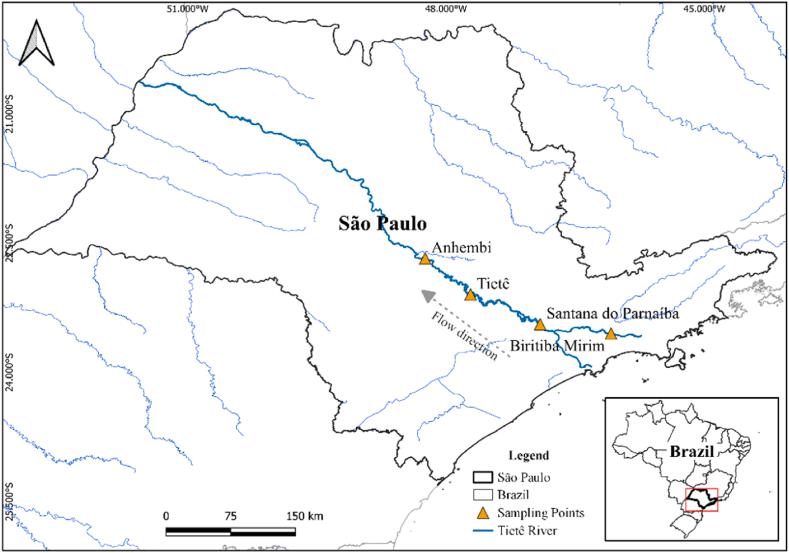
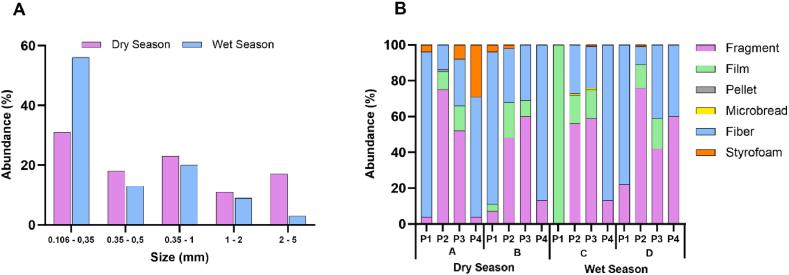
Microplastics (MPs) are particles between 1 μm and 5 mm in size, originating mainly from poor solid waste and effluent management, that can reach water bodies from various sources. In freshwater environments, the occurrence, distribution, and characterization of this new class of pollutants are still little explored, especially in Brazil. The aim of this study was to assess the occurrence of MPs, as well as the presence and concentration of polychlorinated biphenyls (PCBs) sorbed to these particles in the surface waters of the Tietê River - SP. Surface water samples were collected in duplicate during the dry and wet seasons. The identification and characterization of the MPs was carried out through visual inspection and the chemical identity of the particles was verified using Fourier transform infrared spectroscopy with attenuated total reflectance (FTIR-ATR). For the analysis of PCBs adsorbed to the MPs, the sample extracts were analyzed by gas chromatography coupled with mass spectrometry (GC-MS). The MPs were found in concentrations ranging from 6.67 to 1530 particles m, with a predominance of the polymers polyethylene (PE, with 58.17 %) and polypropylene (PP, with 23.53 %). The main morphological categories identified were fragments (56.63 %), fibers (28.42 %), and transparent films (13.06 %). Higher abundances of PCBs were observed in the lower size range, between 0.106 and 0.35 mm. The total concentrations of PCBs in MPs ranged from 20.53 to 133.12 ng g. The results obtained here are relevant for understanding the dynamics and level of contamination of MPs and organic pollutants sorbed to these particles in the Tietê River, as well as helping with mitigation measures for the restoration and preservation of this ecosystem.
微塑料(MPs)是尺寸在1微米至5毫米之间的颗粒,主要源于固体废弃物管理不善和废水管理不当,可从各种来源进入水体。在淡水环境中,这类新型污染物的出现、分布和特征仍鲜为人知,尤其是在巴西。本研究的目的是评估蒂埃特河(圣保罗州)地表水微塑料的出现情况,以及吸附在这些颗粒上的多氯联苯(PCBs)的存在情况和浓度。在旱季和雨季分别采集了两份地表水样本。通过目视检查对微塑料进行识别和表征,并使用衰减全反射傅里叶变换红外光谱(FTIR-ATR)验证颗粒的化学特性。对于吸附在微塑料上的多氯联苯分析,样本提取物通过气相色谱-质谱联用(GC-MS)进行分析。发现微塑料的浓度范围为每立方米6.67至1530个颗粒,其中聚合物聚乙烯(PE,占58.17%)和聚丙烯(PP,占23.53%)占主导。识别出的主要形态类别为碎片(56.63%)、纤维(28.42%)和透明薄膜(13.06%)。在0.106至0.35毫米的较小尺寸范围内观察到较高丰度的多氯联苯。微塑料中多氯联苯的总浓度范围为20.53至133.12纳克/克。此处获得的结果对于理解蒂埃特河中微塑料和吸附在这些颗粒上的有机污染物的污染动态和水平具有重要意义,同时有助于采取缓解措施来恢复和保护这个生态系统。


 Zotero 插件