
新型高选择性 SARS-CoV-2 主蛋白酶抑制剂的设计。
Design of novel and highly selective SARS-CoV-2 main protease inhibitors.
机构信息
Medicinal Chemistry, The Wistar Institute, Philadelphia, Pennsylvania, USA.
HIV-1 Program in the Vaccine and Immunotherapy Center, The Wistar Institute, Philadelphia, Pennsylvania, USA.
出版信息
Antimicrob Agents Chemother. 2024 Oct 8;68(10):e0056224. doi: 10.1128/aac.00562-24. Epub 2024 Sep 3.
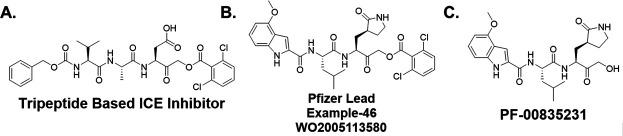
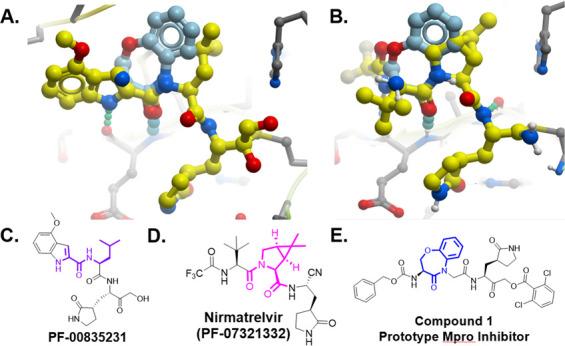
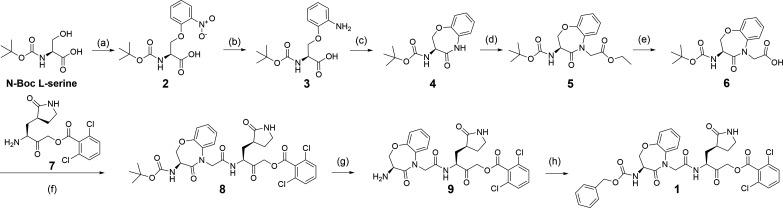
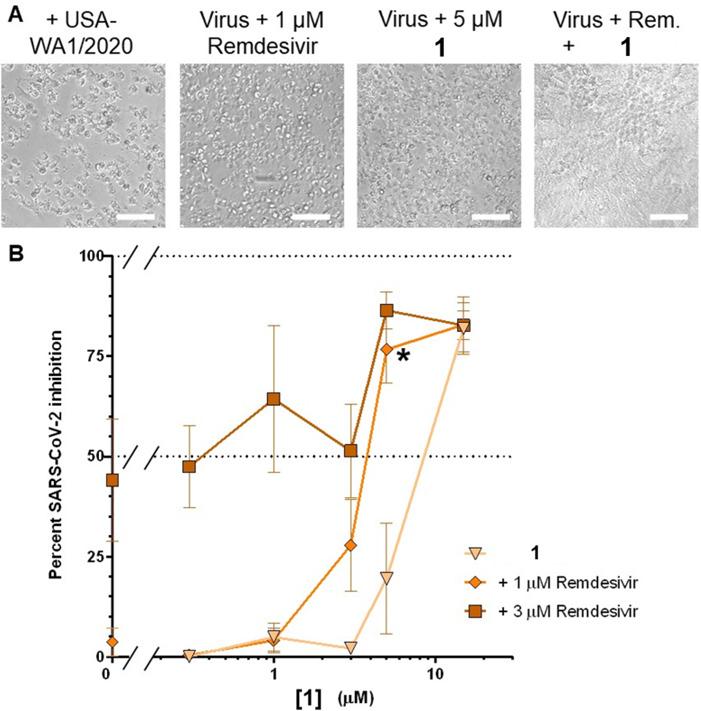
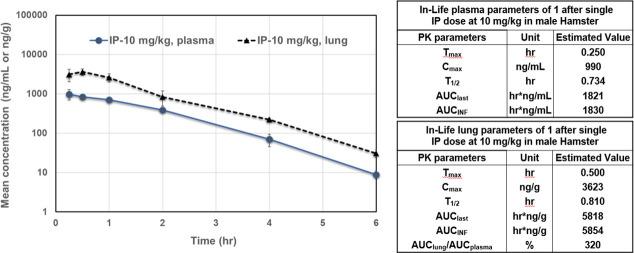
We have synthesized a novel and highly selective severe acute respiratory syndrome coronavirus 2 (SARS-CoV-2) main protease peptide mimetic inhibitor mimicking the replicase 1ab recognition sequence -Val-Leu-Gln- and utilizing a cysteine selective acyloxymethyl ketone as the electrophilic warhead to target the active site Cys145. Utilizing a constrained cyclic peptide that locks the conformation between the P3 (Val) and P2 (Leu) residues, we identified a highly selective inhibitor that fills the P2 pocket occupied by the leucine residue sidechain of PF-00835231 and the dimethyl-3-azabicyclo-hexane motif in nirmatrelvir (PF-07321332). This strategy resulted in potent and highly selective Mpro inhibitors without inhibiting essential host cathepsin cysteine or serine proteases. The lead prototype compound 1 (MPro IC = 230 ± 18 nM) also inhibits the replication of multiple SARS-CoV-2 variants , including SARS-CoV-2 variants of concern, and can synergize at lower concentrations with the viral RNA polymerase inhibitor, remdesivir, to inhibit replication. It also reduces SARS-CoV-2 replication in SARS-CoV-2 Omicron-infected Syrian golden hamsters without obvious toxicities, demonstrating efficacy. This novel lead structure provides the basis for optimization of improved agents targeting evolving SARS-CoV-2 drug resistance that can selectively act on Mpro versus host proteases and are less likely to have off-target effects due to non-specific targeting. Developing inhibitors against the active site of the main protease (Mpro), which is highly conserved across coronaviruses, is expected to impart a higher genetic barrier to evolving SARS-CoV-2 drug resistance. Drugs that selectively inhibit the viral Mpro are less likely to have off-target effects warranting efforts to improve this therapy.
我们合成了一种新型的、高选择性的严重急性呼吸综合征冠状病毒 2 (SARS-CoV-2) 主要蛋白酶肽模拟抑制剂,模拟了复制酶 1ab 的识别序列-Val-Leu-Gln-,并利用半胱氨酸选择性的酰氧基甲基酮作为亲电弹头,靶向活性位点 Cys145。利用一个约束的环状肽,锁定 P3 (Val) 和 P2 (Leu) 残基之间的构象,我们鉴定出一种高选择性的抑制剂,该抑制剂填充了 PF-00835231 的亮氨酸残基侧链和 nirmatrelvir (PF-07321332) 中的二甲基-3-氮杂双环[3.3.0]辛烷基模体占据的 P2 口袋。这种策略导致了有效的、高选择性的 Mpro 抑制剂,而不会抑制必需的宿主半胱氨酸或丝氨酸蛋白酶。先导原型化合物 1 (MPro IC = 230 ± 18 nM) 也抑制多种 SARS-CoV-2 变体的复制,包括关注的 SARS-CoV-2 变体,并且可以在较低浓度下与病毒 RNA 聚合酶抑制剂瑞德西韦协同作用,抑制复制。它还能降低感染 SARS-CoV-2 的叙利亚金黄地鼠体内的 SARS-CoV-2 复制,而没有明显的毒性,证明了它的疗效。这种新型的先导结构为优化针对不断进化的 SARS-CoV-2 耐药性的靶向药物提供了基础,这些药物可以选择性地作用于 Mpro 而不是宿主蛋白酶,并且由于非特异性靶向,不太可能产生脱靶效应。开发针对冠状病毒高度保守的主要蛋白酶 (Mpro) 活性位点的抑制剂有望赋予 SARS-CoV-2 耐药性更高的遗传屏障。选择性抑制病毒 Mpro 的药物不太可能产生脱靶效应,值得努力改进这种治疗方法。





 Zotero 插件