
精细有序的细胞内结构域包含一个变构位点,可调节 P2X3 受体的生理病理功能。
Finely ordered intracellular domain harbors an allosteric site to modulate physiopathological function of P2X3 receptors.
机构信息
School of Basic Medicine and Clinical Pharmacy, and State Key Laboratory of Natural Medicines, China Pharmaceutical University, Nanjing, China.
Departments of Chemical Biology and Pharmacology, College of Basic Medical Sciences, Shanghai Jiao Tong University School of Medicine, Shanghai, China.
出版信息
Nat Commun. 2024 Sep 3;15(1):7652. doi: 10.1038/s41467-024-51815-7.
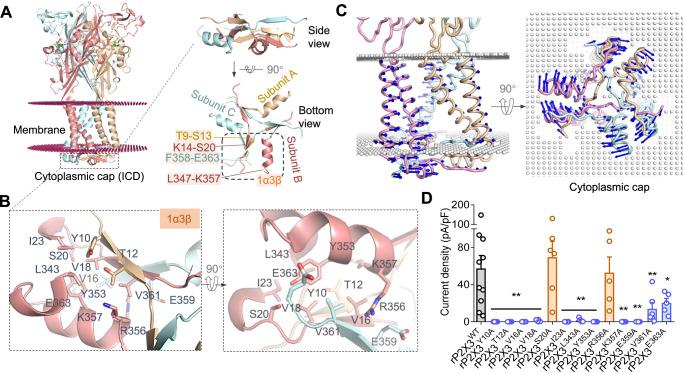
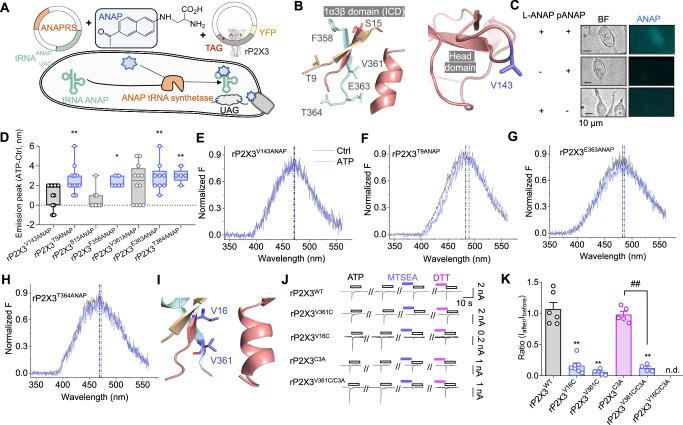
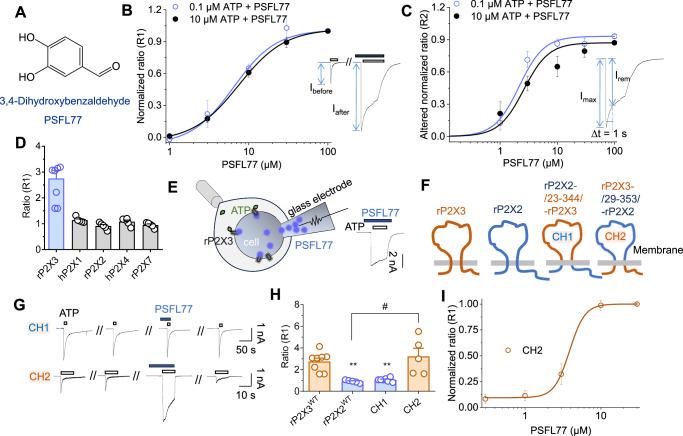
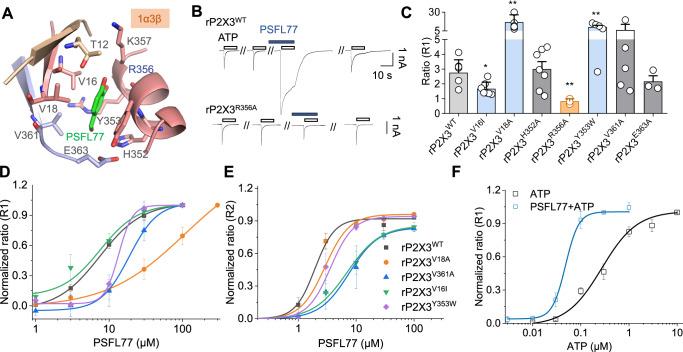
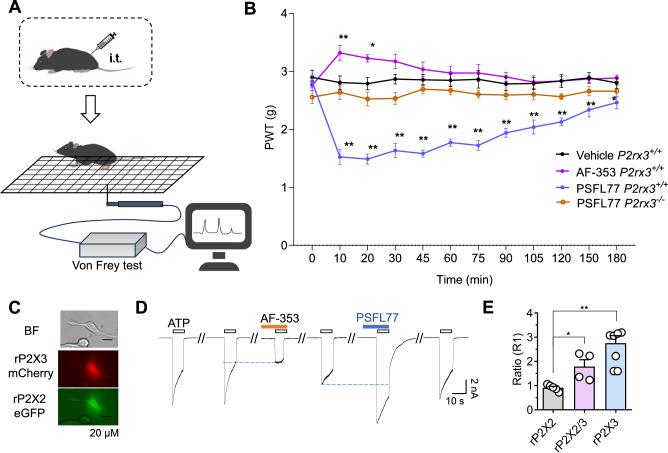
P2X receptors, a subfamily of ligand-gated ion channels activated by extracellular ATP, are implicated in various physiopathological processes, including inflammation, pain perception, and immune and respiratory regulations. Structural determinations using crystallography and cryo-EM have revealed that the extracellular three-dimensional architectures of different P2X subtypes across various species are remarkably identical, greatly advancing our understanding of P2X activation mechanisms. However, structural studies yield paradoxical architectures of the intracellular domain (ICD) of different subtypes (e.g., P2X3 and P2X7) at the apo state, and the role of the ICD in P2X functional regulation remains unclear. Here, we propose that the P2X3 receptor's ICD has an apo state conformation similar to the open state but with a less tense architecture, containing allosteric sites that influence P2X3's physiological and pathological roles. Using covalent occupancy, engineered disulfide bonds and voltage-clamp fluorometry, we suggested that the ICD can undergo coordinated motions with the transmembrane domain of P2X3, thereby facilitating channel activation. Additionally, we identified a novel P2X3 enhancer, PSFL77, and uncovered its potential allosteric site located in the 1α3β domain of the ICD. PSFL77 modulated pain perception in P2rx3, but not in P2rx3, mice, indicating that the 1α3β, a "tunable" region implicated in the regulation of P2X3 functions. Thus, when P2X3 is in its apo state, its ICD architecture is fairly ordered rather than an unstructured outward folding, enabling allosteric modulation of the signaling of P2X3 receptors.
P2X 受体是一种由细胞外 ATP 激活的配体门控离子通道亚家族,参与多种生理病理过程,包括炎症、疼痛感知、免疫和呼吸调节。晶体学和 cryo-EM 的结构测定揭示了不同物种中不同 P2X 亚型的细胞外三维结构惊人地相似,极大地促进了我们对 P2X 激活机制的理解。然而,结构研究对不同亚型(如 P2X3 和 P2X7)的细胞内结构域(ICD)在apo 状态下产生了矛盾的结构,而 ICD 在 P2X 功能调节中的作用仍不清楚。在这里,我们提出 P2X3 受体的 ICD 在 apo 状态下具有类似于开放状态的构象,但结构更为松弛,包含影响 P2X3 生理和病理作用的变构位点。我们使用共价占据、工程化二硫键和电压钳荧光法,提出 ICD 可以与 P2X3 的跨膜结构域协调运动,从而促进通道激活。此外,我们鉴定了一种新型的 P2X3 增强子 PSFL77,并揭示了其位于 ICD 的 1α3β 结构域的潜在变构位点。PSFL77 调节 P2rx3 中的疼痛感知,但不调节 P2rx3 中的疼痛感知,表明 1α3β 是一个“可调”区域,参与 P2X3 功能的调节。因此,当 P2X3 处于 apo 状态时,其 ICD 结构相当有序,而不是无序的向外折叠,从而能够对 P2X3 受体的信号进行变构调节。



 Zotero 插件