
危险的勾结:黑色素瘤发生过程中角质形成细胞对黑素细胞失去控制。
Dangerous liaisons: Loss of keratinocyte control over melanocytes in melanomagenesis.
机构信息
Department of Pathology, Northwestern University Feinberg School of Medicine, Chicago, USA.
Department of Dermatology, Northwestern University Feinberg School of Medicine, Chicago, USA.
出版信息
Bioessays. 2024 Nov;46(11):e2400135. doi: 10.1002/bies.202400135. Epub 2024 Sep 4.
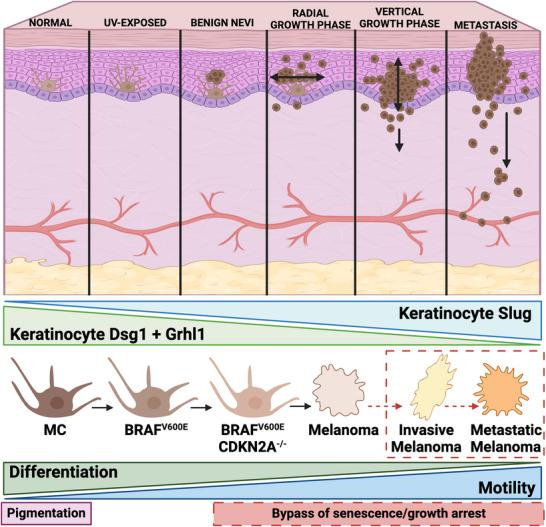
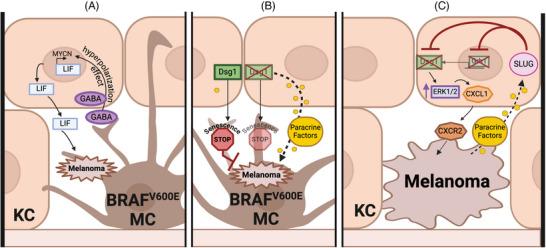
Melanomas arise from transformed melanocytes, positioned at the dermal-epidermal junction in the basal layer of the epidermis. Melanocytes are completely surrounded by keratinocyte neighbors, with which they communicate through direct contact and paracrine signaling to maintain normal growth control and homeostasis. UV radiation from sunlight reshapes this communication network to drive a protective tanning response. However, repeated rounds of sun exposure result in accumulation of mutations in melanocytes that have been considered as primary drivers of melanoma initiation and progression. It is now clear that mutations in melanocytes are not sufficient to drive tumor formation-the tumor environment plays a critical role. This review focuses on changes in melanocyte-keratinocyte communication that contribute to melanoma initiation and progression, with a particular focus on recent mechanistic insights that lay a foundation for developing new ways to intercept melanoma development.
黑色素瘤起源于转化的黑素细胞,这些细胞位于表皮基底层的表皮-真皮交界处。黑素细胞完全被角质形成细胞包围,它们通过直接接触和旁分泌信号进行交流,以维持正常的生长控制和体内平衡。阳光中的紫外线会重塑这种通信网络,从而引发保护性的晒黑反应。然而,反复的阳光暴露会导致黑素细胞积累突变,这些突变被认为是黑色素瘤起始和进展的主要驱动因素。现在已经很清楚,黑素细胞的突变不足以驱动肿瘤的形成——肿瘤微环境起着至关重要的作用。本篇综述重点介绍了黑色素瘤起始和进展过程中黑素细胞-角质形成细胞通讯的改变,并特别关注了最近的机制见解,这些见解为开发新的方法来阻断黑色素瘤的发展奠定了基础。

 Zotero 插件