
耐药性黑色素瘤的新型基因疗法:PTEN质粒与负载BRD4 PROTAC的脂质纳米载体的协同组合
Novel gene therapy for drug-resistant melanoma: Synergistic combination of PTEN plasmid and BRD4 PROTAC-loaded lipid nanocarriers.
作者信息
Saraswat Aishwarya, Vemana Hari Priya, Dukhande Vikas, Patel Ketan
机构信息
College of Pharmacy and Health Sciences, St. John's University, Queens, NY 11439, USA.
出版信息
Mol Ther Nucleic Acids. 2024 Jul 31;35(3):102292. doi: 10.1016/j.omtn.2024.102292. eCollection 2024 Sep 10.
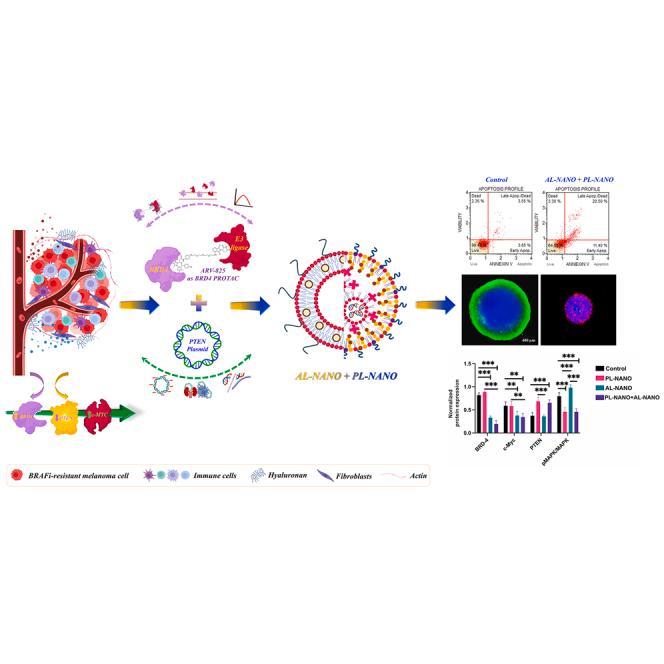
Patients suffering from BRAF mutant melanoma have tumor recurrence within merely 7 months of treatment with a potent BRAF inhibitor (BRAFi) like vemurafenib. It has been proven that diverse molecular pathways driving BRAFi resistance converge to activation of c-Myc in melanoma. Therefore, we identified a novel combinatorial therapeutic strategy by targeting loss of phosphatase and tensin homolog deleted on chromosome 10 (PTEN) tumor suppressor gene and upregulated BRD4 oncoprotein as Myc-dependent vulnerabilities of drug-resistant melanoma. Being promising therapeutic targets, we decided to concomitantly deliver PTEN plasmid and BRD4 targeted PROteolysis-TArgeting Chimera (ARV) to drug the "undruggable" c-Myc in BRAFi-resistant melanoma. Since PTEN plasmid and ARV are distinct in their physicochemical properties, we fabricated PTEN-plasmid loaded lipid nanoparticles (PL-NANO) and ARV-825-loaded nanoliposomes (AL-NANO) to yield a mean particle size of less than 100 nm and greater than 99% encapsulation efficiency for each therapeutic payload. Combination of PL-NANO and AL-NANO displayed synergistic tumor growth inhibition and substantial apoptosis in two-dimensional and three-dimensional models. Importantly, simultaneous delivery of PL-NANO and AL-NANO achieved significant upregulation of PTEN expression levels and degradation of BRD4 protein to ultimately downregulate c-Myc levels in BRAFi-resistant melanoma cells. Altogether, lipid nanocarriers delivering this novel lethal cocktail stands as one-of-a-kind gene therapy to target undruggable c-Myc oncogene in BRAFi-resistant melanoma.
患有BRAF突变型黑色素瘤的患者在使用维莫非尼等强效BRAF抑制剂(BRAFi)治疗仅7个月后就会出现肿瘤复发。事实证明,驱动BRAFi耐药的多种分子途径在黑色素瘤中都汇聚到c-Myc的激活上。因此,我们通过靶向10号染色体缺失的磷酸酶和张力蛋白同源物(PTEN)肿瘤抑制基因的缺失以及上调作为耐药性黑色素瘤中Myc依赖性脆弱点的BRD4癌蛋白,确定了一种新的联合治疗策略。作为有前景的治疗靶点,我们决定同时递送PTEN质粒和靶向BRD4的蛋白酶靶向嵌合体(ARV),以作用于BRAFi耐药黑色素瘤中 “不可成药” 的c-Myc。由于PTEN质粒和ARV在物理化学性质上不同,我们制备了负载PTEN质粒的脂质纳米颗粒(PL-NANO)和负载ARV-825的纳米脂质体(AL-NANO),以使每种治疗有效载荷的平均粒径小于100nm且包封效率大于99%。PL-NANO和AL-NANO的组合在二维和三维模型中显示出协同的肿瘤生长抑制和大量凋亡。重要的是,同时递送PL-NANO和AL-NANO可使BRAFi耐药黑色素瘤细胞中PTEN表达水平显著上调和BRD4蛋白降解,最终下调c-Myc水平。总之,递送这种新型致命组合的脂质纳米载体是一种独特的基因疗法,可靶向BRAFi耐药黑色素瘤中不可成药的c-Myc癌基因。



 Zotero 插件