
在三级护理儿科重症监护病房中比较序贯器官衰竭评估(pSOFA)与小儿死亡风险评估系统(PRISM III)及小儿死亡指数(PIM 2)作为预后预测指标的前瞻性横断面研究。
Comparison of pSOFA with PRISM III and PIM 2 as Predictors of Outcome in a Tertiary Care Pediatric ICU: A Prospective Cross-sectional Study.
作者信息
Agrwal Shipra, Saxena Romit, Jha Mridna, Jhamb Urmila
机构信息
Department of Pediatrics, ESIC Medical College and Hospital, Faridabad, Haryana, India.
Department of Pediatrics, Maulana Azad Medical College, University of Delhi, New Delhi, India.
出版信息
Indian J Crit Care Med. 2024 Aug;28(8):796-801. doi: 10.5005/jp-journals-10071-24772. Epub 2024 Jul 31.
AIMS AND BACKGROUND
Severity scores are used to predict the outcome of children admitted to the intensive care unit. A descriptive score such as the pediatric sequential organ failure assessment (pSOFA) may be useful for prediction of outcome. This study was planned to compare the pSOFA score with these well-studied scores for prediction of mortality.
MATERIALS AND METHODS
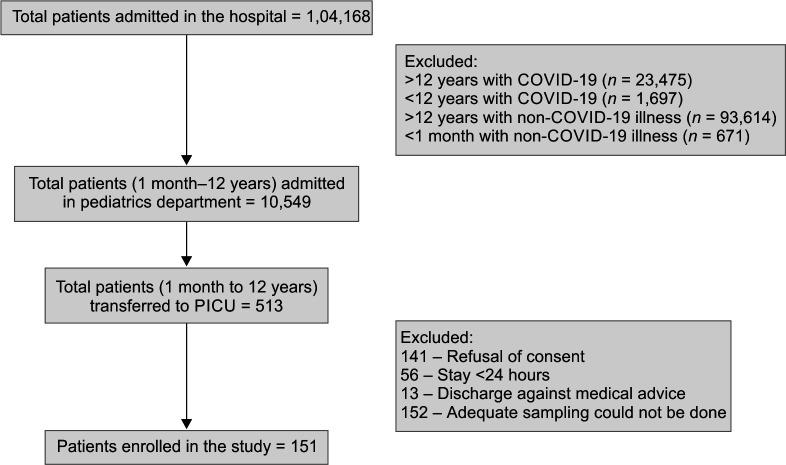
This prospective cross-sectional study was conducted at the pediatric intensive care units (PICU) of a tertiary care hospital. Children aged from 1 month to 12 years were enrolled sequentially. The pediatric index of mortality (PIM 2) score was calculated within 1 hour, and pediatric risk of mortality (PRISM) III and pSOFA scores were calculated within 24 hours of PICU admission. The pediatric sequential organ failure assessment score was recalculated after 72 hours. The primary outcome variable was hospital mortality, and secondary outcome variables were duration of PICU stay, need for mechanical ventilation, and occurrence of acute kidney injury (AKI). Appropriate statistical tests were used.
RESULTS
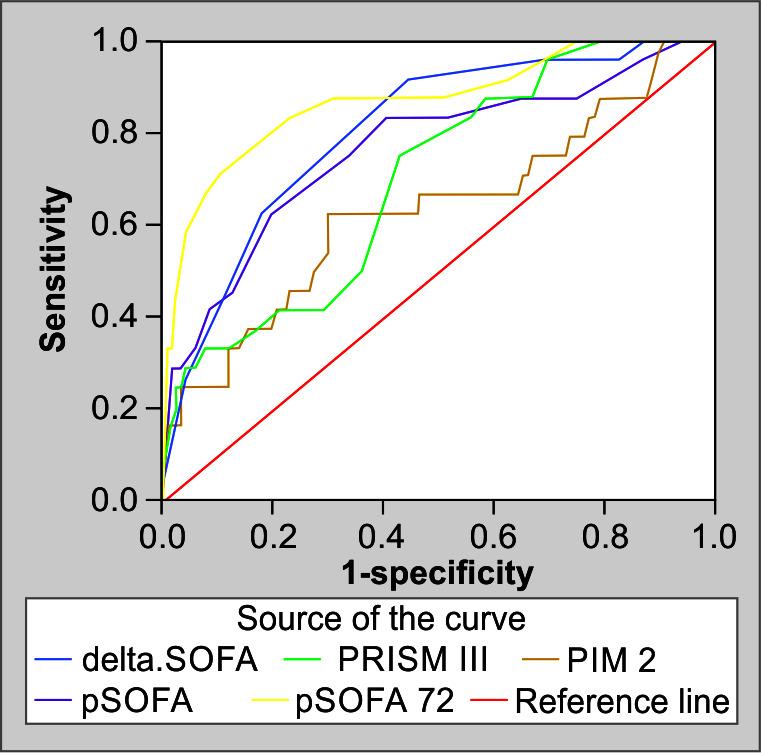
About 151 children with median (IQR) age of 36 (6, 84) months were enrolled. Mechanical ventilation was required in 87 (57.6%) children. Mortality was 21.2% at 28 days. The median (IQR) predicted mortality using PRISM III and PIM 2 score were 3.4 (1.5%, 11%) and 8.2 (3.1%, 16.6%) respectively. Area under ROC for prediction of mortality was highest for pSOFA 72 with a cut-off of 6.5 having sensitivity of 83.3% and specificity of 76.9%.
CONCLUSION
The pSOFA score calculated at admission and at 72 hours had a better predictive ability for the PICU mortality compared to PRISM III and PIM 2 score.
HOW TO CITE THIS ARTICLE
Agrwal S, Saxena R, Jha M, Jhamb U, Pallavi. Comparison of pSOFA with PRISM III and PIM 2 as Predictors of Outcome in a Tertiary Care Pediatric ICU: A Prospective Cross-sectional Study. Indian J Crit Care Med 2024;28(8):796-801.
目的与背景
严重程度评分用于预测入住重症监护病房儿童的预后。诸如儿科序贯器官衰竭评估(pSOFA)这样的描述性评分可能有助于预测预后。本研究旨在比较pSOFA评分与这些经过充分研究的评分对死亡率的预测能力。
材料与方法
这项前瞻性横断面研究在一家三级医院的儿科重症监护病房(PICU)进行。连续纳入1个月至12岁的儿童。在1小时内计算儿科死亡率指数(PIM 2)评分,在入住PICU后24小时内计算儿科死亡风险(PRISM)III评分和pSOFA评分。72小时后重新计算儿科序贯器官衰竭评估评分。主要结局变量是医院死亡率,次要结局变量是PICU住院时间、机械通气需求以及急性肾损伤(AKI)的发生情况。使用了适当的统计检验。
结果
共纳入约151名年龄中位数(四分位间距)为36(6,84)个月的儿童。87名(57.6%)儿童需要机械通气。28天死亡率为21.2%。使用PRISM III和PIM 2评分预测的死亡率中位数(四分位间距)分别为3.4(1.5%,11%)和8.2(3.1%,16.6%)。预测死亡率的ROC曲线下面积,pSOFA 72最高,截断值为6.5时,灵敏度为83.3%,特异度为76.9%。
结论
与PRISM III和PIM 2评分相比,the pSOFA评分在入院时和72小时时对PICU死亡率具有更好的预测能力。
如何引用本文
Agrwal S, Saxena R, Jha M, Jhamb U, Pallavi. Comparison of pSOFA with PRISM III and PIM 2 as Predictors of Outcome in a Tertiary Care Pediatric ICU: A Prospective Cross-sectional Study. Indian J Crit Care Med 2024;28(8):796 - 801. (原文中“the pSOFA score”前多了个“the”,译文已修正)
 Zotero 插件