
锯齿状途径对结直肠癌筛查试验模拟比较效果的影响。
Impact of the serrated pathway on the simulated comparative effectiveness of colorectal cancer screening tests.
机构信息
Division of Gastroenterology and Hepatology, Stanford University School of Medicine, Stanford, CA, USA.
Health Economics and Outcomes Research, Freenome Holdings, Inc, South San Francisco, CA, USA.
出版信息
JNCI Cancer Spectr. 2024 Sep 2;8(5). doi: 10.1093/jncics/pkae077.
BACKGROUND
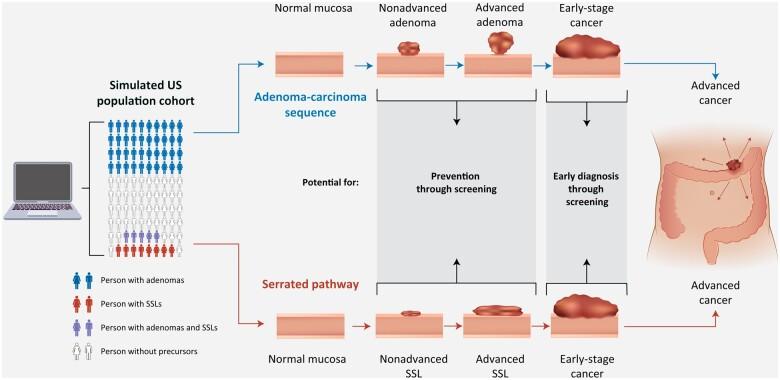
Colorectal cancers (CRCs) arise from adenomas, which can produce fecal occult blood and can be detected endoscopically, or sessile serrated lesions (SSLs), which rarely bleed and may be more challenging to detect. Models informing CRC screening policy should reflect both pathways, accounting for uncertainty.
METHODS
Novel decision-analytic model of the adenoma and serrated pathways for CRC (ANSER) to compare current and emerging screening strategies, accounting for differential test sensitivities for adenomas and SSLs, and uncertainty. Strategies included colonoscopy every 10 years, stool-DNA/FIT (sDNA-FIT) every 1-3 years, or fecal immunochemical testing (FIT) every year from age 45 to 75 years. Outcomes included CRC cases and deaths, cost-effectiveness (cost/quality-adjusted life-year [QALY] gained), and burden-benefit (colonoscopies/life-year gained), with 95% uncertainty intervals (UIs).
RESULTS
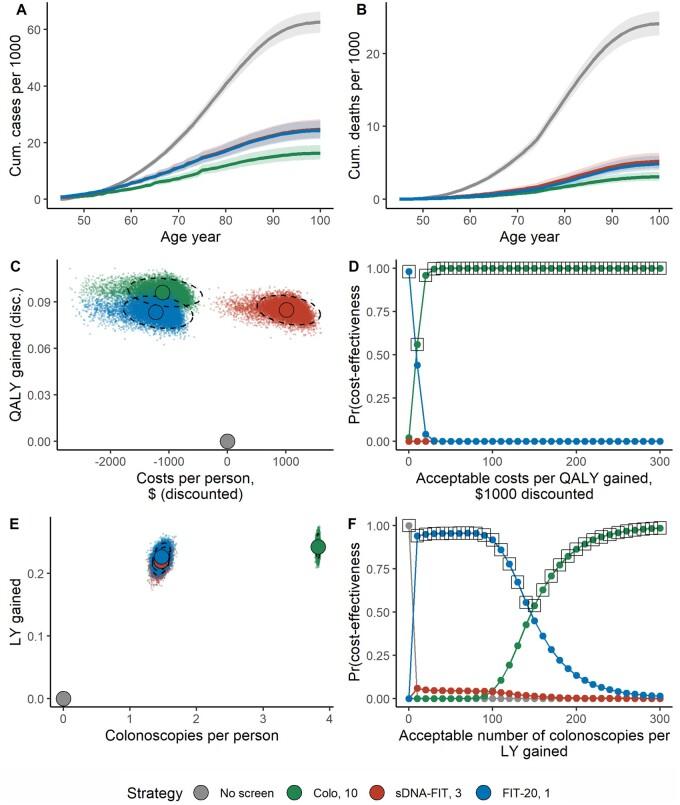
ANSER predicted 62.5 (95% UI = 58.8-66.3) lifetime CRC cases and 24.1 (95% UI = 22.5-25.7) CRC deaths/1000 45-year-olds without screening, and 78%-87% CRC mortality reductions with screening. The tests' outcome distributions overlapped for QALYs gained but separated for required colonoscopies and costs. All strategies cost less than $100 000/QALY gained vs no screening. Colonoscopy was the most effective and cost-effective, costing $9300/life-year gained (95% UI = $500-$21 900) vs FIT. sDNA-FIT cost more than $500 000/QALY gained vs FIT. As more CRCs arose from SSLs, colonoscopy remained preferred based on clinical benefit and cost-effectiveness, but cost-effectiveness improved for a next-generation sDNA-FIT.
CONCLUSION
When the serrated pathway is considered, modeling suggests that colonoscopy is cost-effective vs FIT. In contrast, modeling suggests that sDNA-FIT is not cost-effective vs FIT despite its greater sensitivity for SSLs, even if a substantial minority of CRCs arise from SSLs.
背景
结直肠癌(CRC)源自腺瘤,腺瘤可产生粪便潜血,并可通过内镜检测到,也可源自无蒂锯齿状病变(SSLs),SSL 很少出血,可能更难以检测。为 CRC 筛查提供信息的模型应反映这两种途径,并考虑到不确定性。
方法
本研究建立了结直肠腺瘤和锯齿状途径的新型决策分析模型(ANSER),以比较当前和新兴的筛查策略,同时考虑到腺瘤和 SSL 检测的敏感性差异和不确定性。策略包括结肠镜检查每 10 年一次、粪便-DNA/粪便免疫化学测试(sDNA-FIT)每 1-3 年一次或 FIT 每年一次,筛查年龄为 45-75 岁。结果包括 CRC 病例和死亡、成本效益(每获得一个质量调整生命年的成本[C/QALY])和获益-负担(结肠镜检查/生命年获益),并计算 95%的置信区间(UI)。
结果
ANSER 预测在没有筛查的情况下,1000 名 45 岁人群中终生 CRC 病例数为 62.5(95% UI = 58.8-66.3),CRC 死亡人数为 24.1(95% UI = 22.5-25.7)。筛查可降低 78%-87%的 CRC 死亡率。对于获得的 QALYs,检测结果的分布有重叠,但所需的结肠镜检查和成本有分离。所有策略的成本均低于无筛查时的 100000 美元/QALY。结肠镜检查的有效性和成本效益最高,每获得一个生命年的成本为 9300 美元(95% UI = 500-21900 美元),而 FIT 为 500000 美元/QALY。sDNA-FIT 的成本高于 FIT 时的 500000 美元/QALY。随着更多的 CRC 源自 SSL,基于临床获益和成本效益,结肠镜检查仍然是首选,但下一代 sDNA-FIT 的成本效益有所提高。
结论
当考虑锯齿状途径时,建模表明结肠镜检查比 FIT 更具成本效益。相比之下,尽管 sDNA-FIT 对 SSL 更敏感,但相对于 FIT 并不具有成本效益,即使 CRC 的很大一部分源自 SSL。
 Zotero 插件