
不同内脏转移部位对转移性前列腺癌患者生存的影响。
Impact of different visceral metastatic sites on survival in metastatic prostate cancer patients.
机构信息
Institute of Medicine, Chung Shan Medical University, Taichung, Taiwan.
Department of Urology, Taichung Veterans General Hospital, Taichung, Taiwan.
出版信息
PLoS One. 2024 Sep 6;19(9):e0309941. doi: 10.1371/journal.pone.0309941. eCollection 2024.
INTRODUCTION
Visceral metastasis is an important predictor for poor outcomes in prostate cancer, however, the prognostic significance surrounding the specific sites of visceral metastasis remains unclear. The aim of this study was to evaluate the impact of different visceral metastatic sites on survival in patients with prostate cancer.
METHODS
We identified patients with metastatic prostate cancer between January 1, 2010 and December 31, 2023 using the TriNetX database. Patients were divided into 4 cohorts according to their specific metastatic sites: lung metastases, brain metastases, liver metastases, and bone metastases. Survival analysis was calculated using the Kaplan-Meier method and Cox regression models.
RESULTS
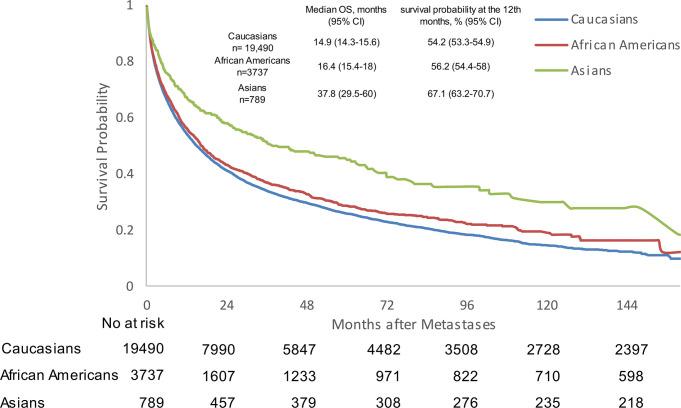
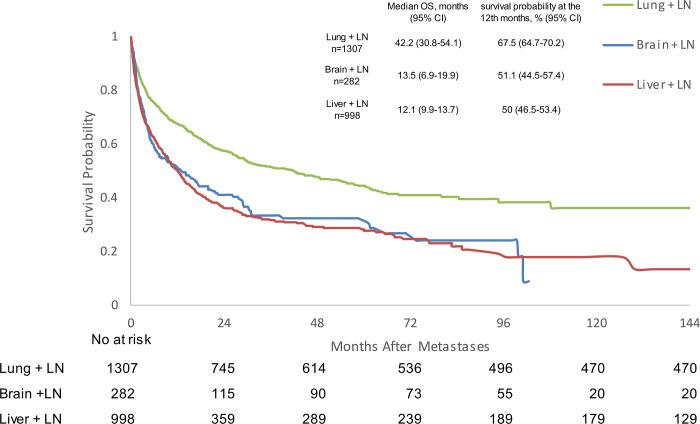
In total, 59,875 patients diagnosed with metastatic prostate cancer were identified, with 39,495 (65.2%) having bone metastases, 7,573 (12.5%) lung metastases, 5,240 (8.7%) brain metastases, and 7,567 (12.5%) liver metastases. The median overall survival was 44.4 months for patients with bone metastases, 31.9 months for lung metastases, 9.6 months for brain metastases, and 10 months for liver metastases. Lung metastases were associated with an improved survival when compared with liver and brain metastases. For patients with two visceral metastatic sites or concomitant bone metastases, liver metastases were related to worse outcomes. Asian patients experienced better OS than Caucasian and African American patients in visceral metastatic prostate cancer.
CONCLUSION
Patients with lung metastases experienced better survival outcomes in prostate cancer with only one visceral metastatic site. Liver metastases were associated with worse outcomes when there were two visceral metastatic sites combined or concomitant bone metastases. Asian patients displayed improved survival rates when compared with both Caucasian and African American patients in visceral metastatic prostate cancer.
简介
内脏转移是前列腺癌预后不良的重要预测因素,然而,内脏转移特定部位的预后意义尚不清楚。本研究旨在评估不同内脏转移部位对前列腺癌患者生存的影响。
方法
我们使用 TriNetX 数据库确定了 2010 年 1 月 1 日至 2023 年 12 月 31 日期间患有转移性前列腺癌的患者。根据特定的转移部位,患者分为 4 组:肺转移、脑转移、肝转移和骨转移。使用 Kaplan-Meier 方法和 Cox 回归模型计算生存分析。
结果
共确定了 59875 例诊断为转移性前列腺癌的患者,其中 39495 例(65.2%)有骨转移,7573 例(12.5%)有肺转移,5240 例(8.7%)有脑转移,7567 例(12.5%)有肝转移。骨转移患者的中位总生存期为 44.4 个月,肺转移患者为 31.9 个月,脑转移患者为 9.6 个月,肝转移患者为 10 个月。与肝转移和脑转移相比,肺转移与生存改善相关。对于有两个内脏转移部位或同时伴有骨转移的患者,肝转移与较差的预后相关。与白种人和非裔美国人相比,亚洲患者在有内脏转移的前列腺癌中表现出更好的 OS。
结论
在仅有一个内脏转移部位的前列腺癌患者中,肺转移患者的生存结果更好。当存在两个内脏转移部位合并或同时伴有骨转移时,肝转移与较差的预后相关。与白种人和非裔美国人相比,亚洲患者在有内脏转移的前列腺癌中显示出改善的生存率。



 Zotero 插件