
硅通过调节生长、生理、生化和根系特性介导改善黑豆对干旱和盐胁迫的耐受性。
Silicon-Mediated Improvement in Drought and Salinity Stress Tolerance of Black Gram ( L.) by Modulating Growth, Physiological, Biochemical, and Root Attributes.
作者信息
Ahmad Waheed, Waraich Ejaz Ahmad, Haider Arslan, Mahmood Nasir, Ramzan Tahrim, Alamri Saud, Siddiqui Manzer H, Akhtar Mohd Sayeed
机构信息
Department of Agronomy, University of Agriculture, Faisalabad 38040, Pakistan.
Department of Botany, University of Agriculture, Faisalabad 38040, Pakistan.
出版信息
ACS Omega. 2024 Aug 20;9(35):37231-37242. doi: 10.1021/acsomega.4c04727. eCollection 2024 Sep 3.
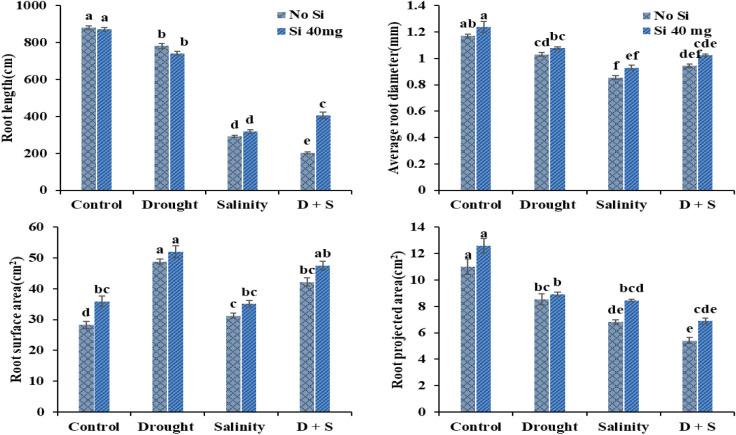
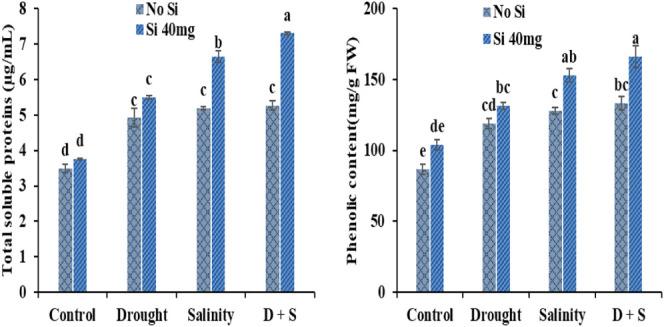
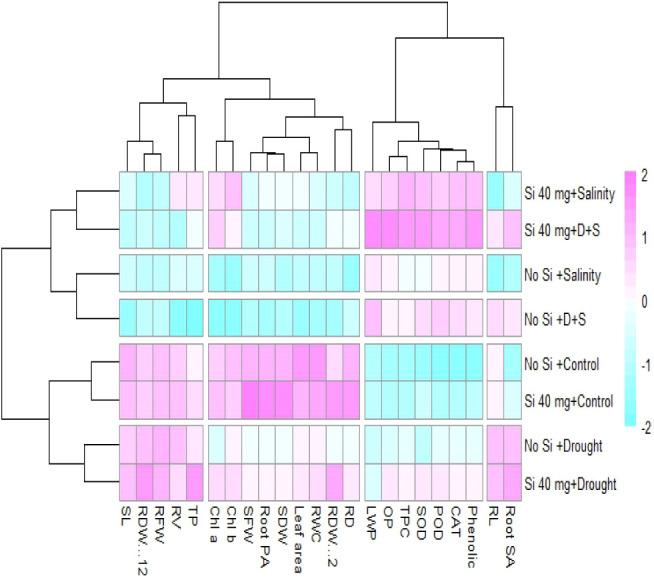
Water is a precious commodity for plant growth and metabolism; however, its scarcity and saline sand conditions have a drastic effect on plant growth and development. The main objective of the current study was to understand how silicon (Si) application might help Black gram ( L.) against the negative impacts of salt stress and drought. The treatments of this study were: no silicon = 0 mg/kg; silicon = 40 mg/kg; control = no stress; drought stress = 50% field capacity (FC); salinity = 10 dSm; drought + salinity = 10 dSm + 50% field capacity (FC). The findings showed that the application of silicon in the sand significantly affected growth indices such as leaf area (LA), shoot fresh weight (SFW), shoot dry weight (SDW), and shoot length (SL). Root length (RL) increased significantly up to 55.9% in response to drought stress. Applying Si to the sand increased the root length (RL) by 53.9%. In comparison to the control, the turgor potential of leaves decreased by 10.3% under salinity, while it increased by 44.7% under drought stress. However, the application of silicon to the sand significantly improved the turgor potential of leaves by 98.7%. Under both drought and salt stress, gas exchange characteristics and photosynthetic pigments dramatically decreased. Applying 40 mg/kg silicon to sand improved the gas exchange characteristics, protein contents, and photosynthetic pigments of plants under drought and salt stress, such as levels of chlorophyll (, and ) increased by 18% and 26%, respectively. Under control conditions, the hydrogen peroxide (HO) concentration was lower but increased during periods of drought and salinity stress. The concentrations of peroxidase (POD), superoxide dismutase (SOD), and catalase (CAT) were decreased by salt and drought stress and increased by sand application of silicon at a rate of 40 mg/kg. Application of silicon at 40 mg/kg sand rate improved the growth and development under control and stress conditions. Overall, this study provides an extensive understanding of the physiological mechanisms underlying the black gram's ability to withstand under salt stress and drought stress by application of Si which will serve as a roadmap for future cellular research.
水是植物生长和新陈代谢的珍贵资源;然而,水资源稀缺和盐碱沙地条件对植物的生长发育有巨大影响。本研究的主要目的是了解施用硅(Si)如何帮助黑豆(Vigna mungo (L.) Hepper)抵御盐胁迫和干旱的负面影响。本研究的处理方式为:不施硅 = 0毫克/千克;施硅 = 40毫克/千克;对照 = 无胁迫;干旱胁迫 = 50% 田间持水量(FC);盐度 = 10 dSm⁻¹;干旱 + 盐度 = 10 dSm⁻¹ + 50% 田间持水量(FC)。研究结果表明,在沙地中施用硅对生长指标有显著影响,如叶面积(LA)、地上部鲜重(SFW)、地上部干重(SDW)和地上部长度(SL)。响应干旱胁迫,根长(RL)显著增加高达55.9%。在沙地中施用硅使根长(RL)增加了53.9%。与对照相比,在盐胁迫下叶片的膨压势降低了10.3%,而在干旱胁迫下则增加了44.7%。然而,在沙地中施用硅显著提高了叶片的膨压势,增幅达98.7%。在干旱和盐胁迫下,气体交换特性和光合色素均显著下降。在沙地中施用40毫克/千克硅改善了干旱和盐胁迫下植物的气体交换特性、蛋白质含量和光合色素,例如叶绿素(叶绿素a、叶绿素b和总叶绿素)水平分别提高了18%和26%。在对照条件下,过氧化氢(H₂O₂)浓度较低,但在干旱和盐胁迫期间升高。过氧化物酶(POD)、超氧化物歧化酶(SOD)和过氧化氢酶(CAT)的浓度因盐胁迫和干旱胁迫而降低,而在沙地中以40毫克/千克的速率施用硅则使其增加。以40毫克/千克沙地施硅量施用硅改善了对照和胁迫条件下的生长发育。总体而言,本研究广泛了解了黑豆通过施用硅来耐受盐胁迫和干旱胁迫的生理机制,这将为未来的细胞研究提供路线图。


 Zotero 插件