
嗜酸性食管炎的围产期环境风险:一项系统评价和荟萃分析
Perinatal Environmental Risks for Eosinophilic Esophagitis: A Systemic Review and Meta-Analysis.
作者信息
Wongjarupong Nicha, Delbrune Malique, Songtanin Busara, Reardon Erin E, Moutsoglou Daphne M, Christian Vikram J, Sloan Joshua A
机构信息
Division of Gastroenterology, Hepatology, and Nutrition, Department of Medicine, University of Minnesota, Minneapolis, USA.
Department of Medicine, University of Minnesota School of Medicine, Minneapolis, USA.
出版信息
Cureus. 2024 Aug 6;16(8):e66326. doi: 10.7759/cureus.66326. eCollection 2024 Aug.
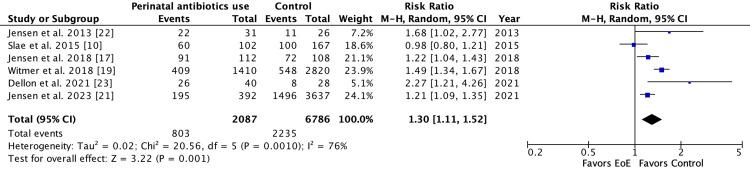
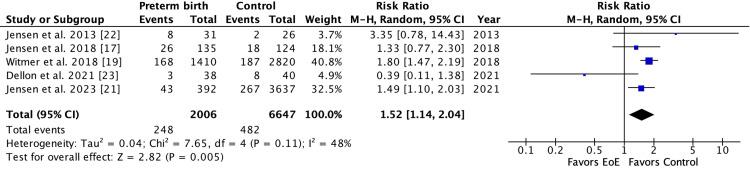
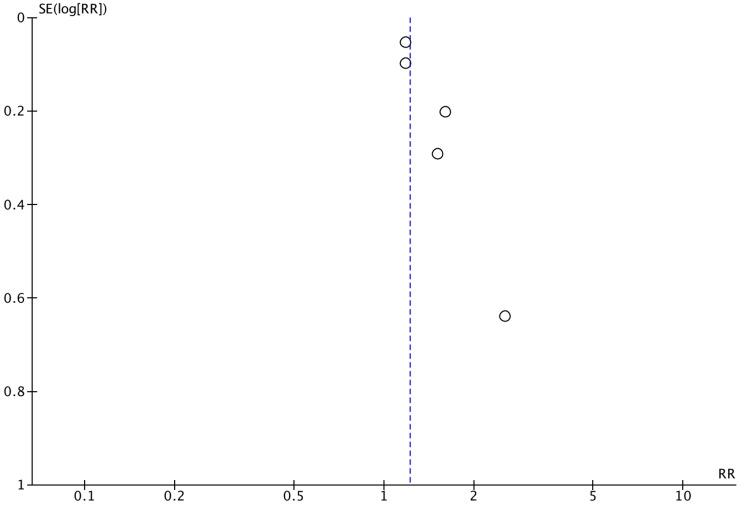
There are limited data on the association of eosinophilic esophagitis (EoE) and environmental risk factors. The aim of this study was to determine the potential associations between perinatal risk factors and EoE. A search was conducted for relevant studies published up to December 12th, 2023, using MEDLINE, EMBASE, Scopus, Web of Sciences, and Cochrane databases. Risk ratios with the 95% confidence interval (CI) were estimated using a random-effects model. Case-control or cohort studies that determined perinatal environmental factors within the first year of life and their association with EoE were included. Six case-control studies were included in the analysis. Six studies (2,087 EoE and 6,786 controls) were included for risk of infant antibiotic use with a pooled risk ratio of 1.30 (95%CI: 1.11-1.52, I2 = 76%), and five studies were included for cesarean section with a pooled risk ratio of 1.22 (95%CI: 1.10-1.34, I2 = 5%). There were three studies for breastfeeding with a pooled risk ratio of 1.07 (95%CI: 1.00-1.15, I2 = 0%); five studies were included for preterm birth with a pooled risk ratio of 1.52 (95%CI: 1.14-2.04, I2 = 48%). There were three studies for neonatal intensive care unit admission with a pooled risk ratio of 1.75 (95% CI: 1.41-2.18, I2 = 0%). Publication bias was found between EoE and infant antibiotic use and cesarean section, but not for EoE and preterm birth, neonatal care unit admission, or breastfeeding. This meta-analysis suggests a weak association between antibiotic use during the first year of life, cesarean section, preterm birth, and neonatal intensive care unit admission and a possible risk of EoE. Further studies are warranted to confirm these findings as they may be indirect associations rather than causal.
关于嗜酸性食管炎(EoE)与环境风险因素之间关联的数据有限。本研究的目的是确定围产期风险因素与EoE之间的潜在关联。使用MEDLINE、EMBASE、Scopus、Web of Sciences和Cochrane数据库对截至2023年12月12日发表的相关研究进行了检索。采用随机效应模型估计风险比及95%置信区间(CI)。纳入确定生命第一年围产期环境因素及其与EoE关联的病例对照研究或队列研究。分析纳入了六项病例对照研究。六项研究(2087例EoE患者和6786例对照)纳入婴儿使用抗生素风险分析,合并风险比为1.30(95%CI:1.11 - 1.52,I² = 76%),五项研究纳入剖宫产风险分析,合并风险比为1.22(95%CI:1.10 - 1.34,I² = 5%)。三项研究纳入母乳喂养风险分析,合并风险比为1.07(95%CI:1.00 - 1.15,I² = 0%);五项研究纳入早产风险分析,合并风险比为1.52(95%CI:1.14 - 2.04,I² = 48%)。三项研究纳入新生儿重症监护病房入院风险分析,合并风险比为1.75(95%CI:1.41 - 2.18,I² = 0%)。发现EoE与婴儿使用抗生素及剖宫产之间存在发表偏倚,但EoE与早产、新生儿重症监护病房入院或母乳喂养之间不存在发表偏倚。这项荟萃分析表明,生命第一年使用抗生素、剖宫产、早产和新生儿重症监护病房入院与EoE可能存在较弱的关联且有潜在风险。鉴于这些可能是间接关联而非因果关系,需要进一步研究来证实这些发现。






 Zotero 插件