
用于进展性多发性硬化症的免疫调节剂和免疫抑制剂:网状荟萃分析。
Immunomodulators and immunosuppressants for progressive multiple sclerosis: a network meta-analysis.
机构信息
IRCCS Istituto delle Scienze Neurologiche di Bologna, Bologna, Italy.
Department of Epidemiology, Lazio Regional Health Service, Rome, Italy.
出版信息
Cochrane Database Syst Rev. 2024 Sep 10;9(9):CD015443. doi: 10.1002/14651858.CD015443.pub2.
BACKGROUND
In recent years a broader range of immunomodulatory and immunosuppressive treatment options have emerged for people with progressive forms of multiple sclerosis (PMS). While consensus supports these options as reducing relapses, their relative benefit and safety profiles remain unclear due to a lack of direct comparison trials.
OBJECTIVES
To compare through network meta-analysis the efficacy and safety of alemtuzumab, azathioprine, cladribine, cyclophosphamide, daclizumab, dimethylfumarate, diroximel fumarate, fingolimod, fludarabine, glatiramer acetate, immunoglobulins, interferon beta 1-a and beta 1-b, interferon beta-1b (Betaferon), interferon beta-1a (Avonex, Rebif), laquinimod, leflunomide, methotrexate, minocycline, mitoxantrone, mycophenolate mofetil, natalizumab, ocrelizumab, ofatumumab, ozanimod, pegylated interferon beta-1a, ponesimod, rituximab, siponimod, corticosteroids, and teriflunomide for PMS.
SEARCH METHODS
We searched CENTRAL, MEDLINE, and Embase up to August 2022, as well as ClinicalTrials.gov and the WHO ICTRP.
SELECTION CRITERIA
Randomised controlled trials (RCTs) that studied one or more treatments as monotherapy, compared to placebo or to another active agent, for use in adults with PMS.
DATA COLLECTION AND ANALYSIS
Two review authors independently selected studies and extracted data. We performed data synthesis by pair-wise and network meta-analysis. We assessed the certainty of the body of evidence according to GRADE.
MAIN RESULTS
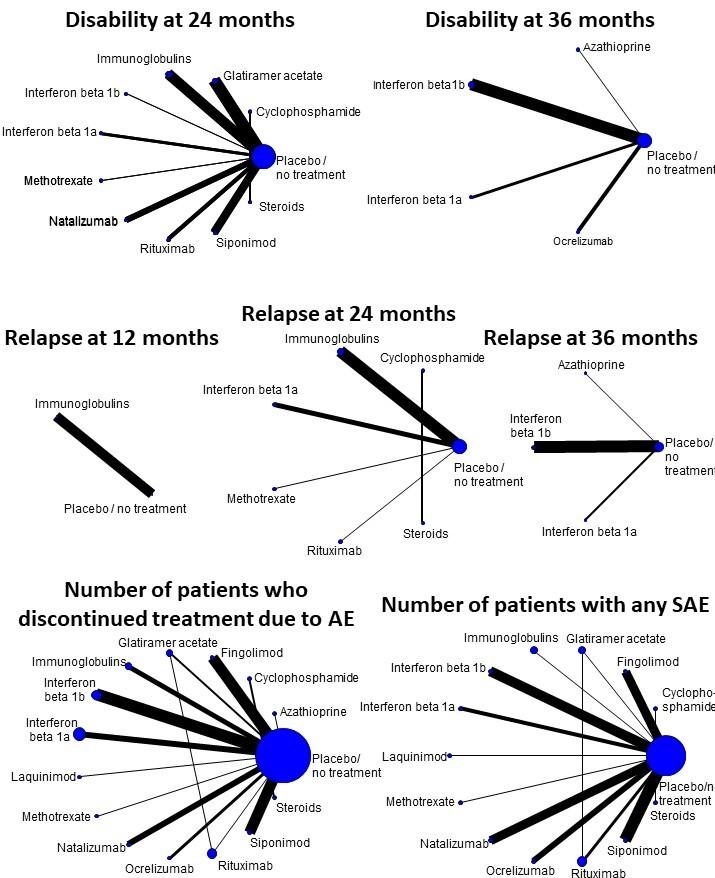
We included 23 studies involving a total of 10,167 participants. The most frequent (39% of studies) reason for a rating of high risk of bias was sponsor role in study authorship and data management and analysis. Other concerns were performance, attrition, and selective reporting bias, with 8.7% of studies at high risk of bias for all three of these domains. The common comparator for network analysis was placebo. Relapses over 12 months: assessed in one study (318 participants). None of the treatments assessed showed moderate or high certainty evidence compared to placebo. Relapses over 24 months: assessed in six studies (1622 participants). The number of people with clinical relapses is probably trivially reduced with rituximab (risk ratio (RR) 0.60, 95% confidence interval (CI) 0.19 to 1.95; moderate certainty evidence). None of the remaining treatments assessed showed moderate or high certainty evidence compared to placebo. Relapses over 36 months: assessed in four studies (2095 participants). The number of people with clinical relapses is probably trivially reduced with interferon beta-1b (RR 0.82, 95% CI 0.73 to 0.93; moderate certainty evidence). None of the remaining treatments assessed showed moderate or high certainty evidence compared to placebo. Disability worsening over 24 months: assessed in 11 studies (5284 participants). None of the treatments assessed showed moderate or high certainty evidence compared to placebo. Disability worsening over 36 months: assessed in five studies (2827 participants). None of the treatments assessed showed moderate or high certainty evidence compared to placebo. Serious adverse events: assessed in 15 studies (8019 participants). None of the treatments assessed showed moderate or high certainty evidence compared to placebo. Discontinuation due to adverse events: assessed in 21 studies (9981 participants). The number of people who discontinued treatment due to adverse events is trivially increased with interferon beta-1a (odds ratio (OR) 2.93, 95% CI 1.64 to 5.26; high certainty evidence). The number of people who discontinued treatment due to adverse events is probably trivially increased with rituximab (OR 4.00, 95% CI 0.84 to 19.12; moderate certainty evidence); interferon beta-1b (OR 2.98, 95% CI 1.92 to 4.61; moderate certainty evidence); immunoglobulins (OR 1.95, 95% CI 0.99 to 3.84; moderate certainty evidence); glatiramer acetate (OR 3.98, 95% CI 1.48 to 10.72; moderate certainty evidence); natalizumab (OR 1.02, 95% CI 0.55 to 1.90; moderate certainty evidence); siponimod (OR 1.53, 95% CI 0.98 to 2.38; moderate certainty evidence); fingolimod (OR 2.29, 95% CI 1.46 to 3.60; moderate certainty evidence), and ocrelizumab (OR 1.24, 95% CI 0.54 to 2.86; moderate certainty evidence). None of the remaining treatments assessed showed moderate or high certainty evidence compared to placebo.
AUTHORS' CONCLUSIONS: The number of people with PMS with relapses is probably slightly reduced with rituximab at two years, and interferon beta-1b at three years, compared to placebo. Both drugs are also probably associated with a slightly higher proportion of withdrawals due to adverse events, as are immunoglobulins, glatiramer acetate, natalizumab, fingolimod, siponimod, and ocrelizumab; we have high confidence that this is the case with interferon beta-1a. We found only low or very low certainty evidence relating to disability progression for the included disease-modifying treatments compared to placebo, largely due to imprecision. We are also uncertain about the effect of interventions on serious adverse events, also because of imprecision. These findings are due in part to the short follow-up of the included RCTs, which lacked detection of less common severe adverse events. Moreover, the funding source of many included studies may have introduced bias into the results. Future research on PMS should include head-to-head rather than placebo-controlled trials, with a longer follow-up of at least three years. Given the relative rarity of PMS, controlled, non-randomised studies on large samples may usefully integrate data from pivotal RCTs. Outcomes valuable and meaningful to people with PMS should be consistently adopted and measured to permit the evaluation of relative effectiveness among treatments.
背景
近年来,对于进展型多发性硬化症(PMS)患者,出现了更广泛的免疫调节和免疫抑制治疗选择。虽然共识支持这些选择可减少复发,但由于缺乏直接比较试验,其相对益处和安全性情况仍不清楚。
目的
通过网络荟萃分析比较阿仑单抗、硫唑嘌呤、克拉屈滨、环磷酰胺、达利珠单抗、二甲基富马酸、二盐酸二甲氧基富马酸酯、芬戈莫德、氟达拉滨、聚乙二醇干扰素β-1a 和 β-1-b、干扰素β-1b(Betaferon)、干扰素β-1a(Avonex、Rebif)、拉喹莫德、来氟米特、甲氨蝶呤、米诺环素、米托蒽醌、吗替麦考酚酯、那他珠单抗、奥瑞珠单抗、奥法妥木单抗、奥昔布宁、聚乙二醇干扰素β-1a、泼尼莫司汀、利妥昔单抗、西尼莫德、皮质类固醇和特立氟胺治疗 PMS 的疗效和安全性。
检索方法
我们检索了截止 2022 年 8 月的 CENTRAL、MEDLINE 和 Embase,以及 ClinicalTrials.gov 和世界卫生组织国际临床试验注册平台。
选择标准
研究一种或多种治疗方法作为单药治疗,与安慰剂或另一种活性药物进行比较,用于治疗 PMS 成人患者的随机对照试验。
数据收集和分析
两位综述作者独立选择研究并提取数据。我们通过两两比较和网络荟萃分析进行数据综合。我们根据 GRADE 评估证据体的确定性。
主要结果
我们纳入了 23 项研究,共涉及 10167 名参与者。研究偏倚风险高的最常见(39%的研究)原因是赞助商在研究作者和数据管理与分析中的作用。其他关注点是表现、失访和选择性报告偏倚,8.7%的研究在这三个领域都存在高偏倚风险。网络分析的常见比较药物是安慰剂。12 个月时的复发:一项研究(318 名参与者)评估。与安慰剂相比,评估的治疗方法均未显示出中度或高度确定性证据。24 个月时的复发:六项研究(1622 名参与者)评估。与安慰剂相比,临床复发的人数可能略有减少(风险比(RR)0.60,95%置信区间(CI)0.19 至 1.95;中等确定性证据)。与安慰剂相比,其余评估的治疗方法均未显示出中度或高度确定性证据。36 个月时的复发:四项研究(2095 名参与者)评估。与安慰剂相比,干扰素β-1b 治疗可能使临床复发的人数略有减少(RR 0.82,95%CI 0.73 至 0.93;中等确定性证据)。与安慰剂相比,其余评估的治疗方法均未显示出中度或高度确定性证据。24 个月时的残疾恶化:11 项研究(5284 名参与者)评估。与安慰剂相比,评估的治疗方法均未显示出中度或高度确定性证据。36 个月时的残疾恶化:五项研究(2827 名参与者)评估。与安慰剂相比,评估的治疗方法均未显示出中度或高度确定性证据。严重不良事件:15 项研究(8019 名参与者)评估。与安慰剂相比,评估的治疗方法均未显示出中度或高度确定性证据。因不良事件停药:21 项研究(9981 名参与者)评估。与安慰剂相比,因不良事件而停药的人数可能略有增加(优势比(OR)2.93,95%CI 1.64 至 5.26;高确定性证据)。与安慰剂相比,因不良事件而停药的人数可能略有增加(OR 4.00,95%CI 0.84 至 19.12;中等确定性证据);干扰素β-1b(OR 2.98,95%CI 1.92 至 4.61;中等确定性证据);免疫球蛋白(OR 1.95,95%CI 0.99 至 3.84;中等确定性证据);聚乙二醇干扰素β-1a(OR 3.98,95%CI 1.48 至 10.72;中等确定性证据);那他珠单抗(OR 1.02,95%CI 0.55 至 1.90;中等确定性证据);西尼莫德(OR 1.53,95%CI 0.98 至 2.38;中等确定性证据);芬戈莫德(OR 2.29,95%CI 1.46 至 3.60;中等确定性证据);和奥瑞珠单抗(OR 1.24,95%CI 0.54 至 2.86;中等确定性证据)。与安慰剂相比,其余评估的治疗方法均未显示出中度或高度确定性证据。
作者结论
与安慰剂相比,利妥昔单抗在两年时,干扰素β-1b 在三年时,可能使 PMS 患者的复发人数略有减少。两种药物也可能与更高比例的因不良事件而停药相关,包括免疫球蛋白、聚乙二醇干扰素β-1a、那他珠单抗、芬戈莫德、西尼莫德和奥瑞珠单抗;我们有高度信心认为,这种情况也适用于干扰素β-1a。与安慰剂相比,我们发现纳入的疾病修饰治疗方法在残疾进展方面的证据仅为低或非常低确定性,主要是因为不精确。我们也不确定干预措施对严重不良事件的影响,这也是因为不精确。这些发现部分归因于纳入的 RCT 随访时间较短,未能检测到不太常见的严重不良事件。此外,许多纳入研究的资金来源可能会对结果产生偏差。未来关于 PMS 的研究应包括头对头而非安慰剂对照试验,随访时间至少为 3 年。鉴于 PMS 的相对罕见性,纳入大量参与者的受控、非随机研究可能会整合来自关键 RCT 的数据。应始终采用对 PMS 患者有价值且有意义的结果进行测量,以评估治疗方法之间的相对有效性。









 Zotero 插件