
lncRNA TFAP2A-AS1 的失调通过调节 microRNA-32-5p 参与牙髓炎的发病机制。
Dysregulation of lncRNA TFAP2A-AS1 is involved in the pathogenesis of pulpitis by the regulation of microRNA-32-5p.
机构信息
Department of Laboratory Center, The First Hospital of Hebei Medical University, Shijiazhuang, China.
Department of Stomatology, Shijiazhuang Fourth Hospital, Shijiazhuang, China.
出版信息
Immun Inflamm Dis. 2024 Sep;12(9):e1312. doi: 10.1002/iid3.1312.
OBJECTIVE
This study was designed to evaluate TFAP2A-AS1 expression in the dental pulp of teeth with or without pulpitis and to determine the function of TFAP2A-AS1 in pulp cells.
METHODS
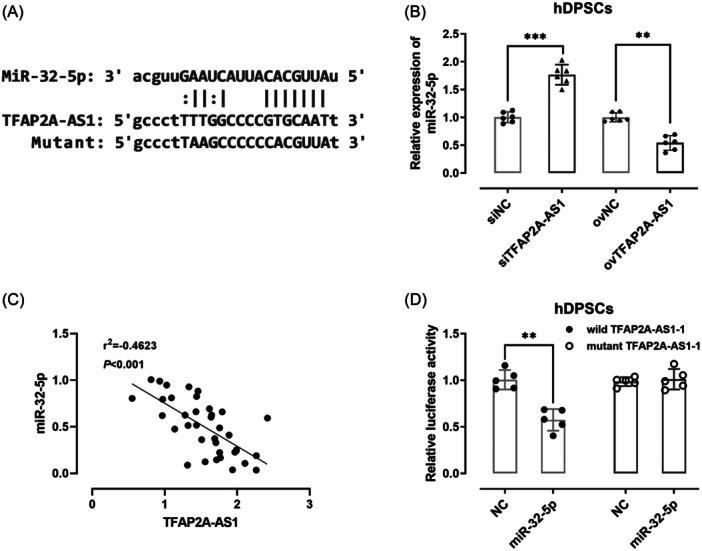
GSE92681 was analyzed to filter out differentially expressed lncRNAs. Pulp samples from teeth with pulpitis and healthy teeth (control) were examined using real-time (RT) quantitative polymerase chain reaction (qPCR). Human dental pulp stem cells (hDPSCs) were cultured in a specific medium for osteogenic induction, or treated with lipopolysaccharide (LPS) to simulate inflammation. The viability and apoptosis of human DPSCs (hDPSCs) were determined by XTT assay and apoptosis detection kit. Inflammation was induced by LPS and assessed by measuring the expression and release of inflammatory cytokines after TFAP2A-AS1 knockdown. Osteogenic differentiation of hDPSCs was investigated by determining expression levels of osteogenic markers and alkaline phosphatase (ALP) activity after TFAP2A-AS1 overexpression. The downstream microRNA (miRNA) was predicted. Dual-luciferase reporter was used to confirm the binding between miR-32-5p and TFAP2A-AS1.
RESULTS
The expression of TFAP2A-AS1 was evaluated in inflamed pulp using RT-qPCR. TFAP2A-AS1 had a discriminatory ability for healthy individuals and patients with pulpitis. The expression of TFAP2A-AS1 decreased upon the osteogenic differentiation of hDPSCs, and increased upon the LPS induction. TFAP2A-AS1 can reverse the osteogenic differentiation of hDPSCs, as evidenced by decreased levels of dentine sialophosphoprotein, dentin matrix protein-1, and ALP activity. TFAP2A-AS1 knockdown can promote cell proliferation of hDPSCs and relieve LPS-induced inflammation, as evidenced by decreased levels of TNF-α, IL-1β, and IL-6. miR-32-5p was identified as a downstream miRNA of TFAP2A-AS1.
CONCLUSION
This study demonstrated the expression and potential function of TFAP2A-AS1 in the human dental pulp. TFAP2A-AS1 can inhibit odontogenic differentiation but promote inflammation in pulp cells.
目的
本研究旨在评估牙髓组织中 TFAP2A-AS1 的表达,并研究 TFAP2A-AS1 在牙髓细胞中的功能。
方法
利用 GSE92681 数据库筛选差异表达的 lncRNA,通过实时定量聚合酶链反应(RT-qPCR)检测牙髓组织中 TFAP2A-AS1 的表达。体外分离培养人牙髓干细胞(hDPSCs),用成骨诱导液诱导其向成骨细胞分化,或用脂多糖(LPS)模拟炎症状态。通过 XTT 法和细胞凋亡试剂盒检测 hDPSCs 的活力和凋亡。通过 RT-qPCR 检测 hDPSCs 中炎症因子的表达和释放来评价 TFAP2A-AS1 敲低对炎症反应的影响。通过检测成骨相关基因和碱性磷酸酶(ALP)活性来研究 TFAP2A-AS1 过表达对 hDPSCs 成骨分化的影响。预测下游 microRNA(miRNA),并通过双荧光素酶报告基因实验验证 miR-32-5p 与 TFAP2A-AS1 的靶向关系。
结果
利用 RT-qPCR 检测炎性牙髓组织中 TFAP2A-AS1 的表达水平,结果表明 TFAP2A-AS1 对健康个体和牙髓炎患者具有鉴别能力。体外实验发现,hDPSCs 成骨诱导分化时 TFAP2A-AS1 表达下调,LPS 诱导炎症时 TFAP2A-AS1 表达上调。TFAP2A-AS1 过表达抑制 hDPSCs 成骨分化,下调牙本质涎磷蛋白、牙本质基质蛋白 1 和 ALP 活性;TFAP2A-AS1 敲低促进 hDPSCs 增殖,减轻 LPS 诱导的炎症反应,降低 TNF-α、IL-1β 和 IL-6 的表达。miR-32-5p 被鉴定为 TFAP2A-AS1 的下游 miRNA。
结论
本研究证实了 TFAP2A-AS1 在人牙髓组织中的表达和潜在功能,TFAP2A-AS1 可抑制牙髓细胞的成牙本质向分化,但促进其炎症反应。


 Zotero 插件