
基于随机森林算法的心率变异性特征筛查中重度阻塞性睡眠呼吸暂停。
Screening for moderate to severe obstructive sleep apnea by using heart rate variability features based on random forest algorithm.
机构信息
West China School of Public Health and West China Fourth Hospital, Sichuan University, Chengdu, China.
出版信息
Sleep Breath. 2024 Dec;28(6):2521-2530. doi: 10.1007/s11325-024-03151-9. Epub 2024 Sep 10.
PURPOSE
More than 80% of patients with moderate to severe obstructive sleep apnea (OSA) are still not diagnosed timely. The prediction model based on random forest (RF) algorithm was established by using heart rate variability (HRV), clinical and demographic features so as to screen for the patients with high risk of moderate and severe obstructive sleep apnea.
METHODS
The sleep monitoring data of 798 patients were randomly divided into training set (n = 558) and test set (n = 240) in 7:3 proportion. Grid search was applied to determine the best parameters of the RF model. 10-fold cross validation was utilized to evaluate the predictive performance of the RF model, which was then compared to the performance of the Logistic regression model.
RESULTS
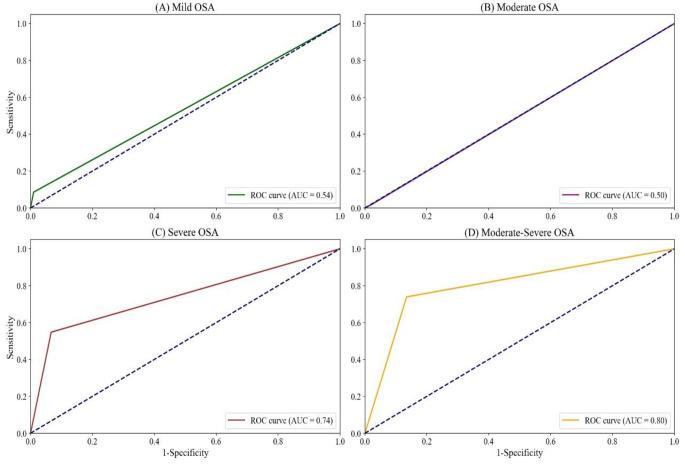
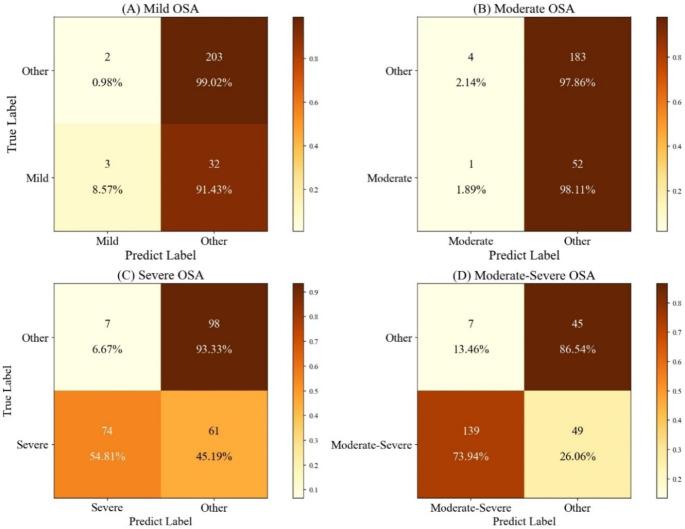
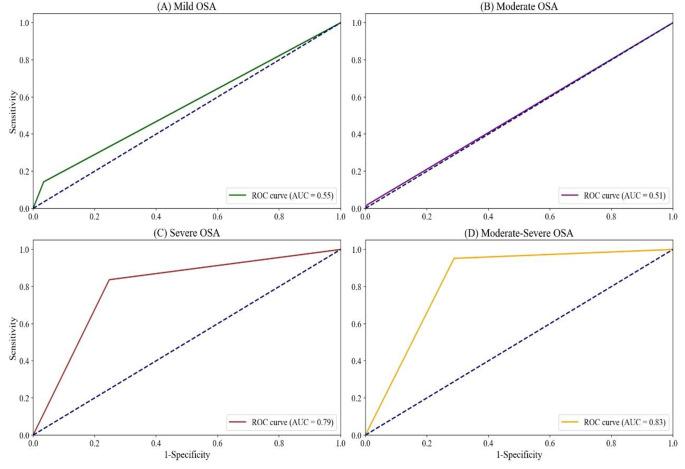
Among the 798 patients, 638 were males and 160 were females, with the average age of 43.51 years old and the mean body mass index (BMI) of 25.92 kg/m. The sensitivity, specificity, accuracy, F1 score and the area under receiver operating characteristic curve for RF model and Logistic regression model were 94.68% vs. 73.94%; 73.08% vs. 86.54%; 90.00% vs. 76.67%; 0.94 vs. 0.83 and 0.83 vs. 0.80 respectively.
CONCLUSIONS
The RF prediction model can effectively distinguish patients with moderate to severe OSA, which is expected to carry out in a large-scale population in order to screening for high-risk patients, and helps to evaluate the effect of OSA treatment continuously.
目的
超过 80%的中重度阻塞性睡眠呼吸暂停(OSA)患者仍未得到及时诊断。本研究旨在通过心率变异性(HRV)、临床和人口统计学特征,建立基于随机森林(RF)算法的预测模型,以筛选出中重度 OSA 高危患者。
方法
将 798 例患者的睡眠监测数据随机分为训练集(n=558)和测试集(n=240),比例为 7:3。使用网格搜索确定 RF 模型的最佳参数。采用 10 折交叉验证评估 RF 模型的预测性能,并与 Logistic 回归模型的性能进行比较。
结果
798 例患者中,男性 638 例,女性 160 例,平均年龄 43.51 岁,平均体重指数(BMI)为 25.92 kg/m。RF 模型和 Logistic 回归模型的灵敏度、特异度、准确度、F1 评分和受试者工作特征曲线下面积分别为 94.68%比 73.94%;73.08%比 86.54%;90.00%比 76.67%;0.94 比 0.83 和 0.83 比 0.80。
结论
RF 预测模型能有效区分中重度 OSA 患者,有望在大样本人群中进行推广,以筛选高危患者,并有助于持续评估 OSA 治疗效果。

 Zotero 插件