
外周血CD4 T细胞可预测非小细胞肺癌(NSCLC)患者接受抗PD-1治疗的疗效。
The peripheral CD4 T cells predict efficacy in non-small cell lung cancer (NSCLC) patients with the anti-PD-1 treatment.
作者信息
Zhuang Weixia, Wang Moufeng, Jiang Li, Su Zudong, Lin Shenglu
机构信息
Department of Pharmacy, The First Affiliated Hospital of Fujian Medical University, Fuzhou, China.
Department of Oncology, The First Affiliated Hospital of Fujian Medical University, Fuzhou, China.
出版信息
Transl Cancer Res. 2024 Aug 31;13(8):4052-4061. doi: 10.21037/tcr-24-405. Epub 2024 Aug 22.
BACKGROUND
Programmed cell death protein 1 (PD-1) inhibitor therapy has become a routine treatment for advanced non-small cell lung cancer (NSCLC). However, only some NSCLC patients would benefit from anti-PD-1 therapy. We urgently need to identify biomarkers associated with clinical response to change treatment strategies promptly for patients who fail to benefit from anti-PD-1 treatment. This study was aimed to explore whether circulating CD4 T cells and CD8 T cells could be biomarkers for predicting anti-PD-1 efficacy.
METHODS
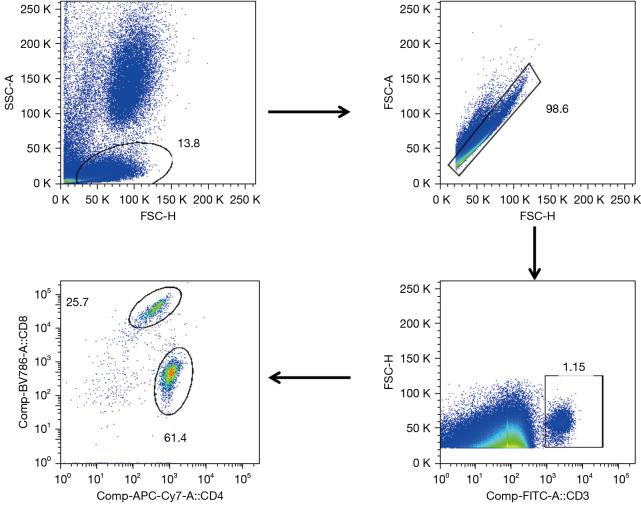
In this study, 118 NSCLC patients who received anti-PD-1 therapy were enrolled. The percentages of circulating CD4 T cells and CD8 T cells before and after anti-PD-1 treatment were determined by flow cytometry. The programmed cell death ligand 1 (PD-L1) expression of tumor tissues was detected by immunocytochemistry. The anti-PD-1 treatment efficacy was assessed by immune response evaluation criteria in solid tumors (iRECIST).
RESULTS
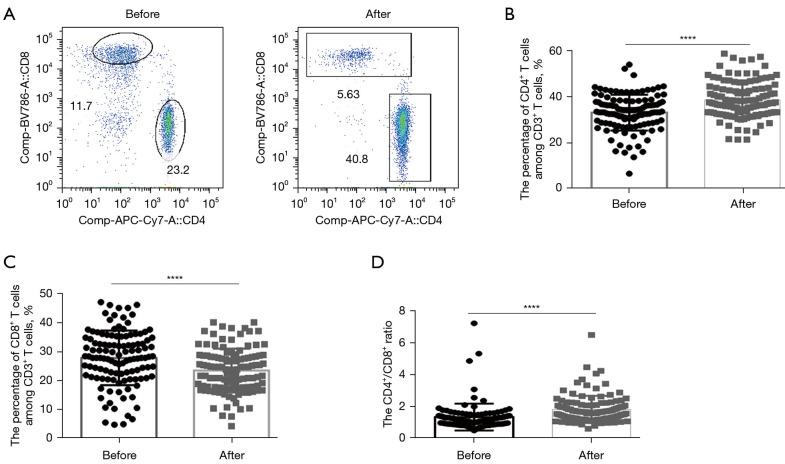
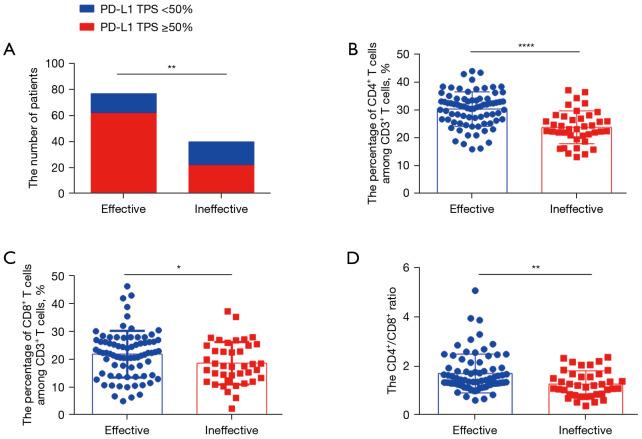
The percentage of CD4 T cells and CD4/CD8 ratio in the peripheral blood (PB) was significantly elevated after anti-PD-1 treatment. In contrast, the percentage of CD8 T cells in the PB was significantly decreased after anti-PD-1 treatment. Furthermore, we found that the percentages of CD4 T cells and CD4/CD8 ratios considerably increased, and the percentages of CD8 T cells significantly reduced in the effective group. On the contrary, the patients in the ineffective group showed no significant differences in the biomarkers. Multivariate logistic revealed that the percentage of CD4 T cells at baseline was an independent predictor of anti-PD-1 treatment. The area under the curve (AUC) of the CD4 T cells percentage was 0.7834 with a cut-off value of 28.53% (sensitivity =82.5%, specificity =66.23%).
CONCLUSIONS
The percentage of CD4 T cells at baseline could predict anti-PD-1 efficacy in NSCLC patients.
背景
程序性细胞死亡蛋白1(PD-1)抑制剂疗法已成为晚期非小细胞肺癌(NSCLC)的常规治疗方法。然而,只有部分NSCLC患者能从抗PD-1治疗中获益。对于那些无法从抗PD-1治疗中获益的患者,我们迫切需要确定与临床反应相关的生物标志物,以便及时改变治疗策略。本研究旨在探讨循环CD4 T细胞和CD8 T细胞是否可作为预测抗PD-1疗效的生物标志物。
方法
本研究纳入了118例接受抗PD-1治疗的NSCLC患者。采用流式细胞术测定抗PD-1治疗前后循环CD4 T细胞和CD8 T细胞的百分比。通过免疫细胞化学检测肿瘤组织中程序性细胞死亡配体1(PD-L1)的表达。根据实体瘤免疫反应评估标准(iRECIST)评估抗PD-1治疗疗效。
结果
抗PD-1治疗后外周血(PB)中CD4 T细胞百分比和CD4/CD8比值显著升高。相反,抗PD-1治疗后PB中CD8 T细胞百分比显著降低。此外,我们发现有效组中CD4 T细胞百分比和CD4/CD8比值显著增加,CD8 T细胞百分比显著降低。相反,无效组患者的生物标志物无显著差异。多因素逻辑回归显示,基线时CD4 T细胞百分比是抗PD-1治疗的独立预测因子。CD4 T细胞百分比的曲线下面积(AUC)为0.7834,临界值为28.53%(敏感性=82.5%,特异性=66.23%)。
结论
基线时CD4 T细胞百分比可预测NSCLC患者的抗PD-1疗效。


 Zotero 插件