
测定脂多糖转运的初始速率。
Determination of Initial Rates of Lipopolysaccharide Transport.
机构信息
Department of Chemistry and Chemical Biology, Harvard University, 12 Oxford Street, Cambridge, Massachusetts 02138, United States.
出版信息
Biochemistry. 2024 Oct 1;63(19):2440-2448. doi: 10.1021/acs.biochem.4c00379. Epub 2024 Sep 12.
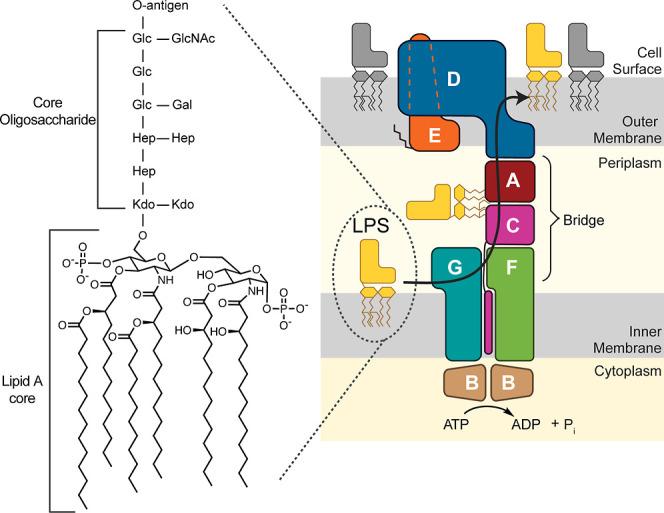
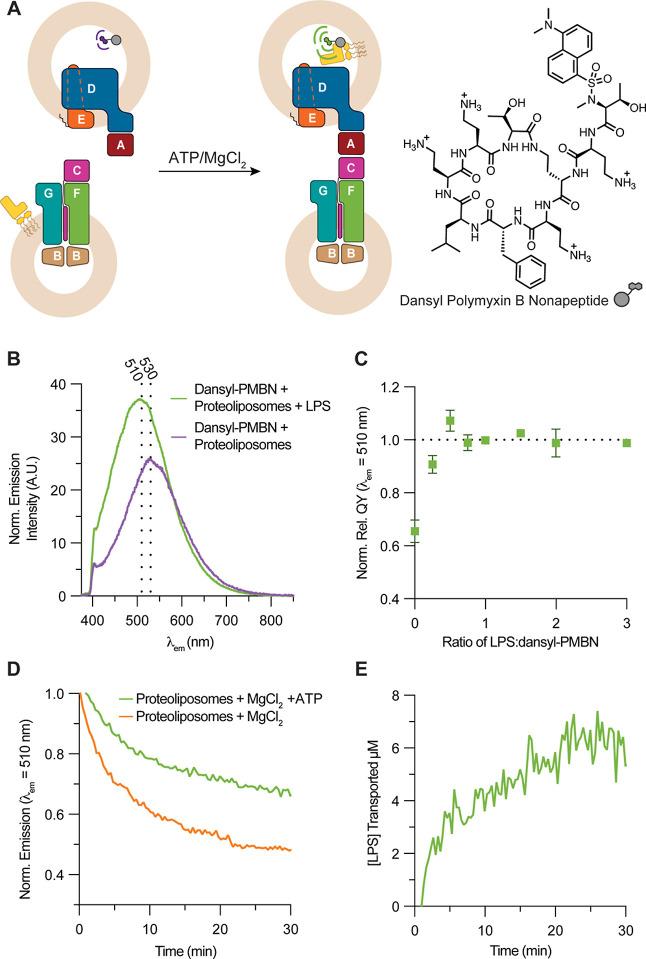
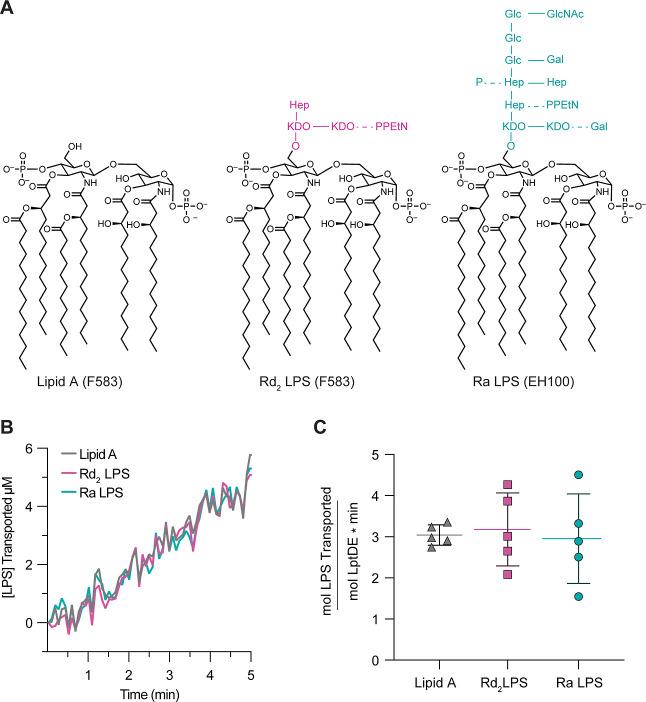
Nonvesicular lipid trafficking pathways are an important process in every domain of life. The mechanisms of these processes are poorly understood in part due to the difficulty in kinetic characterization. One important class of glycolipids, lipopolysaccharides (LPS), are the primary lipidic component of the outer membrane of Gram-negative bacteria. LPS are synthesized in the inner membrane and then trafficked to the cell surface by the ipoolysaccharide ransport proteins, BFGCADE. By characterizing the interaction of a fluorescent probe and LPS, we establish a quantitative assay to monitor the flux of LPS between proteoliposomes on the time scale of seconds. We then incorporate photocaged ATP into this system, which allows for light-based control of the initiation of LPS transport. This control allows us to measure the initial rate of LPS transport (3.0 min per LptDE). We also find that the rate of LPS transport by the Lpt complex is independent of the structure of LPS. In contrast, we find the rate of LPS transport is dependent on the proper function of the LptDE complex. Mutants of the outer membrane Lpt components, LptDE, that cause defective LPS assembly in live cells display attenuated transport rates and slower ATP hydrolysis compared to wild type proteins. Analysis of these mutants reveals that the rates of ATP hydrolysis and LPS transport are correlated such that 1.2 ± 0.2 ATP are hydrolyzed for each LPS transported. This correlation suggests a model where the outer membrane components ensure the coupling of ATP hydrolysis and LPS transport by stabilizing a transport-active state of the Lpt bridge.
非囊泡脂质转运途径是生命各领域的重要过程。由于动力学特征难以确定,这些过程的机制在一定程度上仍未得到充分了解。一类重要的糖脂,脂多糖 (LPS),是革兰氏阴性菌外膜的主要脂质成分。LPS 在内膜中合成,然后通过 BFGCADE 类脂多糖转运蛋白转运到细胞表面。通过对荧光探针与 LPS 的相互作用进行特征描述,我们建立了一种定量测定法,可在数秒的时间尺度上监测 LPS 在蛋白脂质体之间的通量。然后,我们将光笼化的 ATP 整合到该系统中,从而可以基于光来控制 LPS 转运的起始。这种控制使我们能够测量 LPS 转运的初始速率(LptDE 每 3.0 分钟一次)。我们还发现,Lpt 复合物的 LPS 转运速率与 LPS 的结构无关。相比之下,我们发现 LPS 转运的速率取决于 LptDE 复合物的正常功能。在活细胞中导致 LPS 组装缺陷的外膜 Lpt 成分(LptDE)突变体显示出转运速率降低和 ATP 水解速度减慢,与野生型蛋白相比。对这些突变体的分析表明,ATP 水解和 LPS 转运的速率是相关的,即每转运一个 LPS 水解 1.2 ± 0.2 个 ATP。这种相关性表明了一种模型,其中外膜成分通过稳定 Lpt 桥的转运活性状态来确保 ATP 水解和 LPS 转运的偶联。


 Zotero 插件