
四醇的苯甲酰化:d-半乳糖苷和苷的区域选择性模式比较。
Benzoylation of Tetrols: A Comparison of Regioselectivity Patterns for and Glycosides of d-Galactose.
机构信息
Centre for Glycoscience and School of Chemical and Physical Sciences, Keele University, Keele, Staffordshire ST5 5BG, U.K.
出版信息
J Org Chem. 2024 Oct 4;89(19):14090-14097. doi: 10.1021/acs.joc.4c01508. Epub 2024 Sep 12.
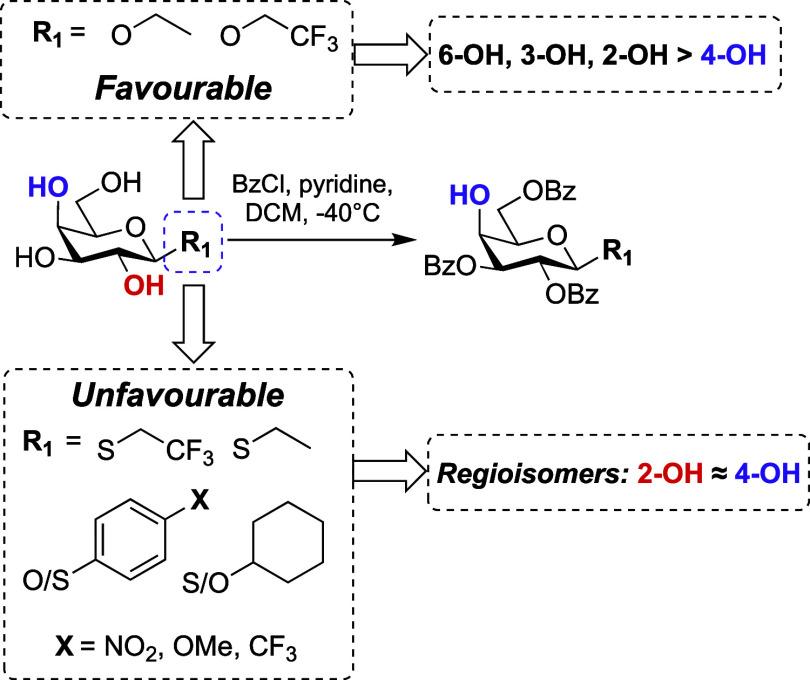
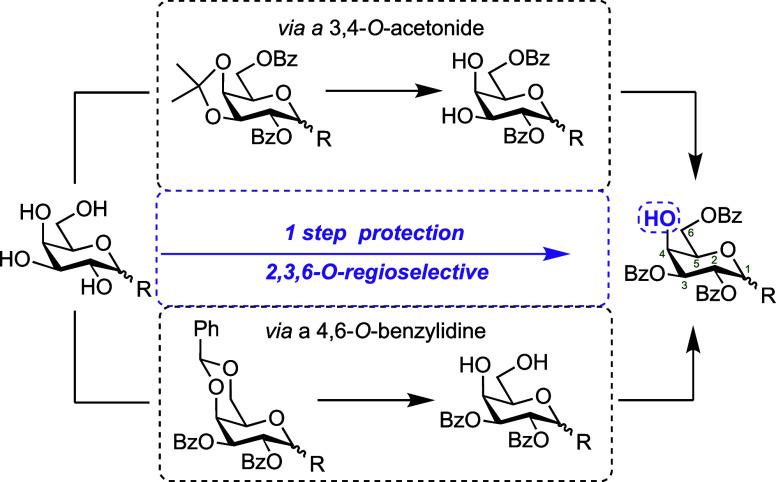
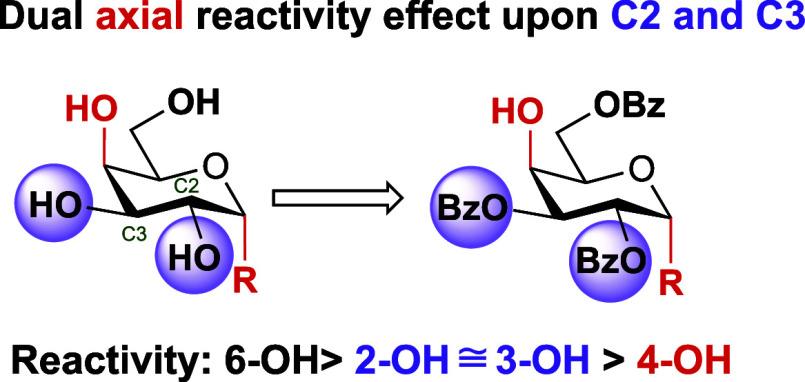
Efficient protecting group strategies are important for glycan synthesis and represent a unique synthetic challenge in differentiating sugar ring hydroxyl groups. Direct methods to enable regioselective protecting group installation are thus desirable. Herein, we explore a one-step regioselective benzoylation to deliver 2,3,6-protected d-galactose building blocks from tetrols across a variety of α- and β-, - and -glycoside substrates. We focus on benzoyl chloride as the esterifying reagent and a reaction temperature of -40 °C to screen the regioselectivity outcome for twenty-two different glycosides, based on isolated yields. Using this methodology, we demonstrate the capability for α-linked aryl and alkyl glycosides (- and - d-galactosides, d-galactosamines, and l-fucose), delivering consistent isolated yields (>65%) for 2,3,6-benzoylated products. We extend to explore β-linked systems, where the observed regioselectivity is not paralleled. We posit that both steric and electronic factors from the anomeric substituent contribute to modulating the reactivity competition between 2-OH and 4-OH, enabling the formation of regioisomeric mixtures. However, a certain balance of these factors within the aglycon can deliver 2,3,6-regioselectivity, notably for -Et and -CHCF glycosides. The methodology contributes toward understanding the peculiarities of regioselective carbohydrate-protecting group installation, exploring the importance of the anomeric substituent upon ring hydroxyl group reactivity.
有效的保护基策略对于糖合成至关重要,并且代表了区分糖环羟基的独特合成挑战。因此,需要直接的方法来实现区域选择性的保护基安装。在此,我们探索了一种一步区域选择性苯甲酰化方法,从各种α-和β-、-和-β-糖苷底物的四醇中提供 2,3,6-保护的 d-半乳糖砌块。我们专注于使用苯甲酰氯作为酯化试剂,并将反应温度设定为-40°C,以根据分离产率筛选二十二种不同糖苷的区域选择性结果。使用这种方法,我们证明了α-连接的芳基和烷基糖苷(-和-β-d-半乳糖苷、d-半乳糖胺和 l-岩藻糖)的能力,为 2,3,6-苯甲酰化产物提供了一致的分离产率(>65%)。我们进一步扩展到探索β-连接的系统,其中观察到的区域选择性不一致。我们假设来自糖苷配基的立体和电子因素都有助于调节 2-OH 和 4-OH 之间的反应竞争,从而形成区域异构体混合物。然而,糖苷配基内这些因素的某种平衡可以提供 2,3,6-区域选择性,特别是对于-β-Et 和-β-CHCF 糖苷。该方法有助于理解区域选择性碳水化合物保护基安装的特殊性,探索糖苷配基对环羟基反应性的重要性。
 Zotero 插件