
胰岛中转瞬即逝到持续炎症的临界点转变。
Tipping-point transition from transient to persistent inflammation in pancreatic islets.
机构信息
Niels Bohr Institute, University of Copenhagen, Copenhagen, Denmark.
Department of Applied Mathematics and Computer Science, Technical University of Denmark, Lyngby, Denmark.
出版信息
NPJ Syst Biol Appl. 2024 Sep 12;10(1):102. doi: 10.1038/s41540-024-00427-4.
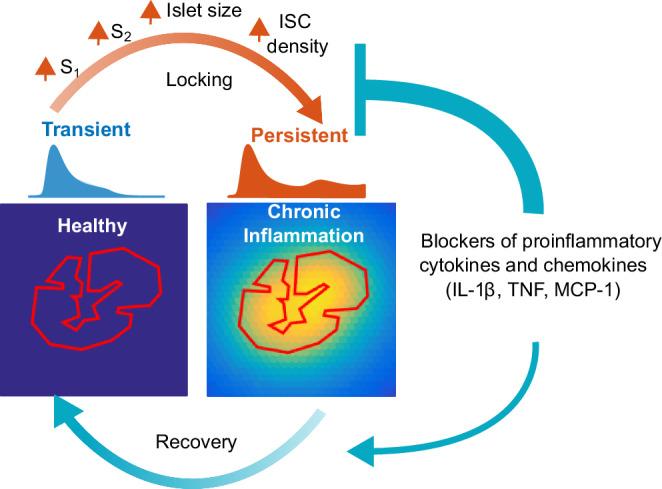
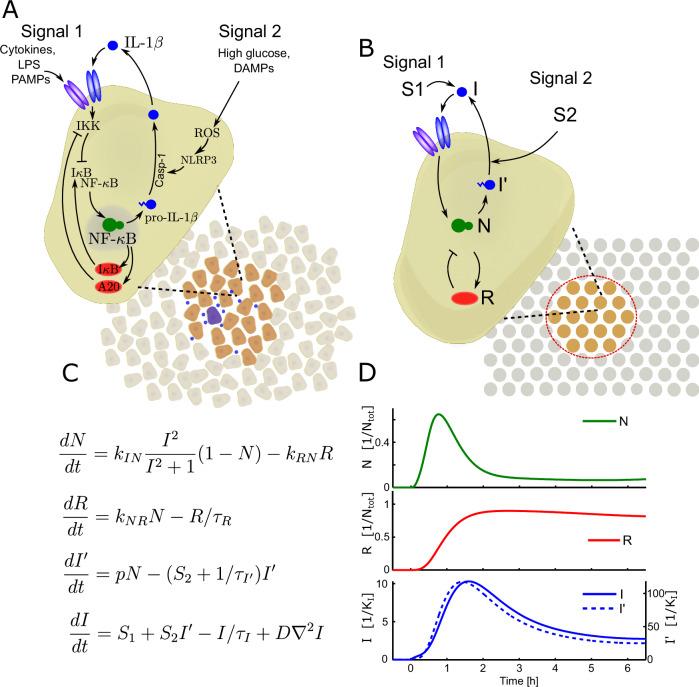
Type 2 diabetes (T2D) is associated with a systemic increase in the pro-inflammatory cytokine IL-1β. While transient exposure to low IL-1β concentrations improves insulin secretion and β-cell proliferation in pancreatic islets, prolonged exposure leads to impaired insulin secretion and collective β-cell death. IL-1 is secreted locally by islet-resident macrophages and β-cells; however, it is unknown if and how the two opposing modes may emerge at single islet level. We investigated the duality of IL-1β with a quantitative in silico model of the IL-1 regulatory network in pancreatic islets. We find that the network can produce either transient or persistent IL-1 responses when induced by pro-inflammatory and metabolic cues. This suggests that the duality of IL-1 may be regulated at the single islet level. We use two core feedbacks in the IL-1 regulation to explain both modes: First, a fast positive feedback in which IL-1 induces its own production through the IL-1R/IKK/NF-κB pathway. Second, a slow negative feedback where NF-κB upregulates inhibitors acting at different levels along the IL-1R/IKK/NF-κB pathway-IL-1 receptor antagonist and A20, among others. A transient response ensues when the two feedbacks are balanced. When the positive feedback dominates over the negative, islets transit into the persistent inflammation mode. Consistent with several observations, where the size of islets was implicated in its inflammatory state, we find that large islets and islets with high density of IL-1β amplifying cells are more prone to transit into persistent IL-1β mode. Our results are likely not limited to IL-1β but are general for the combined effect of multiple pro-inflammatory cytokines and chemokines. Generalizing complex regulations in terms of two feedback mechanisms of opposing nature and acting on different time scales provides a number of testable predictions. Taking islet architecture and cellular heterogeneity into consideration, further dynamic monitoring and experimental validation in actual islet samples will be crucial to verify the model predictions and enhance its utility in clinical applications.
2 型糖尿病(T2D)与促炎细胞因子 IL-1β 的全身增加有关。虽然短暂暴露于低浓度的 IL-1β 可改善胰岛中胰岛素的分泌和 β 细胞的增殖,但长期暴露会导致胰岛素分泌受损和 β 细胞的集体死亡。IL-1 由胰岛驻留巨噬细胞和 β 细胞局部分泌;然而,尚不清楚这两种相反的模式是否以及如何在单个胰岛水平上出现。我们使用胰岛中 IL-1 调节网络的定量计算模型研究了 IL-1β 的双重性。我们发现,当受到促炎和代谢信号的诱导时,该网络可以产生短暂或持续的 IL-1 反应。这表明 IL-1 的双重性可能在单个胰岛水平上受到调节。我们使用 IL-1 调节中的两个核心反馈来解释这两种模式:首先,是一种快速正反馈,其中 IL-1 通过 IL-1R/IKK/NF-κB 途径诱导自身产生。其次,是一种缓慢的负反馈,其中 NF-κB 上调沿着 IL-1R/IKK/NF-κB 途径作用于不同水平的抑制剂——IL-1 受体拮抗剂和 A20 等。当两种反馈达到平衡时,就会产生短暂的反应。当正反馈超过负反馈时,胰岛就会进入持续炎症模式。与许多观察结果一致,其中胰岛的大小与其炎症状态有关,我们发现,较大的胰岛和具有高浓度的 IL-1β 放大细胞的胰岛更容易进入持续的 IL-1β 模式。我们的结果可能不仅限于 IL-1β,而是普遍适用于多种促炎细胞因子和趋化因子的综合作用。根据两种具有相反性质并作用于不同时间尺度的反馈机制来概括复杂的调节,可以提供许多可测试的预测。考虑到胰岛的结构和细胞异质性,在实际胰岛样本中进行进一步的动态监测和实验验证对于验证模型预测和提高其在临床应用中的实用性至关重要。


 Zotero 插件