
术中吸入一氧化二氮预防电视辅助胸腔镜手术慢性术后疼痛:一项前瞻性观察队列研究。
Intraoperative nitrous oxide inhalation to prevent chronic postsurgical pain in video-assisted thoracoscopic surgery: a prospective observational cohort study.
作者信息
Yuan Yuchen, Zhang Le, Zhang Yuelun, Shen Le, Huang Yuguang
机构信息
Department of Anesthesiology, Peking Union Medical College Hospital, Chinese Academy of Medical Sciences and Peking Union Medical College, Beijing, China.
Medical Research Centre, Peking Union Medical College Hospital, Chinese Academy of Medical Sciences and Peking Union Medical College, Beijing, China.
出版信息
J Thorac Dis. 2024 Aug 31;16(8):5110-5121. doi: 10.21037/jtd-24-556. Epub 2024 Aug 21.
BACKGROUND
Chronic postsurgical pain (CPSP) is a significant detriment to postsurgical recovery. Previous studies have shown that nitrous oxide (NO) may produce long-term analgesia and may benefit the prevention of CPSP in Chinese patients. We tested the hypothesis that NO is a protective factor against chronic pain after video-assisted thoracoscopic surgery (VATS).
METHODS
Two groups of patients with and without NO inhalation during VATS in Peking Union Medical College Hospital were recruited. Perioperative information was documented, and postsurgical pain was followed up by telephone. The primary outcome was the presence of CPSP at 6 months postoperatively. Odds ratios (ORs) and their 95% confidence intervals (CIs) were estimated using a multivariate logistic regression model adjusted for relevant confounding factors.
RESULTS
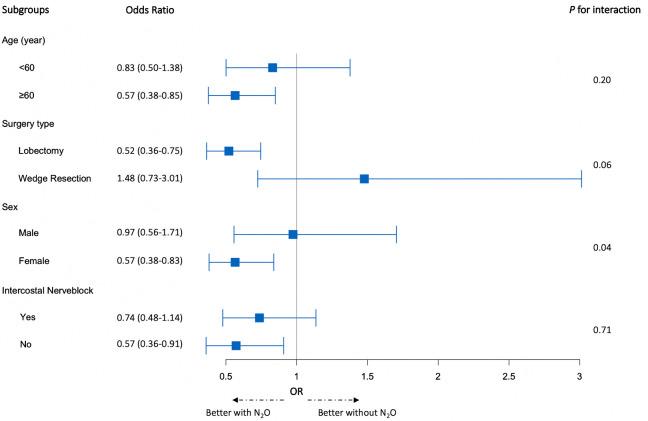
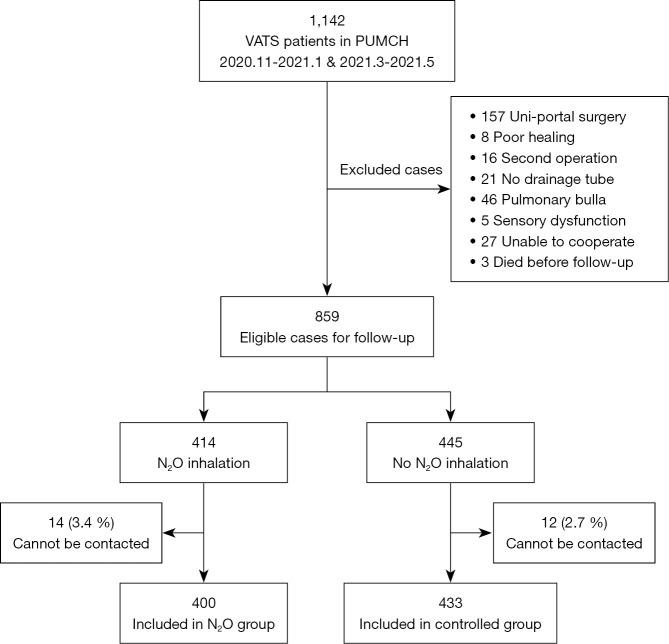
A total of 833 patients were eligible, among whom 33.6% were male and 66.4% were female, with an average age of 56.3±11.1 years. A total of 387 (46.5%) patients reported incision-related pain at 6 months after surgery, and 160 (40.0%) out of 400 patients with NO inhalation during surgery and 227 (52.4%) out of 433 patients without NO inhalation during surgery developed CPSP. After adjusting for confounding factors, NO inhalation during surgery was associated with lower odds of CPSP (OR =0.654; 95% CI: 0.480-0.890; P=0.007).
CONCLUSIONS
NO inhalation during surgery was associated with lower odds of CPSP in VATS patients, and NO may benefit the prevention of chronic pain after thoracoscopic surgery.
背景
慢性术后疼痛(CPSP)是术后恢复的重大不利因素。既往研究表明,氧化亚氮(NO)可能产生长期镇痛作用,且可能有助于预防中国患者的CPSP。我们检验了以下假设:NO是电视辅助胸腔镜手术(VATS)后慢性疼痛的保护因素。
方法
招募了北京协和医院两组在VATS期间有或无吸入NO的患者。记录围手术期信息,并通过电话随访术后疼痛情况。主要结局是术后6个月时CPSP的存在情况。使用针对相关混杂因素进行调整的多因素逻辑回归模型估计比值比(OR)及其95%置信区间(CI)。
结果
共有833例患者符合条件,其中男性占33.6%,女性占66.4%,平均年龄为56.3±11.1岁。共有387例(46.5%)患者在术后6个月报告有切口相关疼痛,手术期间吸入NO的400例患者中有例160(40.0%)发生CPSP,手术期间未吸入NO的433例患者中有227例(52.4%)发生CPSP。在调整混杂因素后,手术期间吸入NO与CPSP的较低发生几率相关(OR =0.654;95%CI:0.480-0.890;P=0.007)。
结论
手术期间吸入NO与VATS患者CPSP的较低发生几率相关,且NO可能有助于预防胸腔镜手术后的慢性疼痛。
 Zotero 插件