
孟加拉国锡塔昆达分区乡村医生的识别、定位和自我报告的实践模式。
Identification, mapping, and self-reported practice patterns of village doctors in Sitakunda subdistrict, Bangladesh.
机构信息
Division of Infectious Diseases, Department of Internal Medicine, Spencer Fox Eccles School of Medicine at the University of Utah, Salt Lake City, Utah, USA.
Infectious Diseases Division, International Center for Diarrhoeal Disease Research, Bangladesh, Dhaka, Bangladesh.
出版信息
J Glob Health. 2024 Sep 13;14:04185. doi: 10.7189/jogh.14.04185.
BACKGROUND
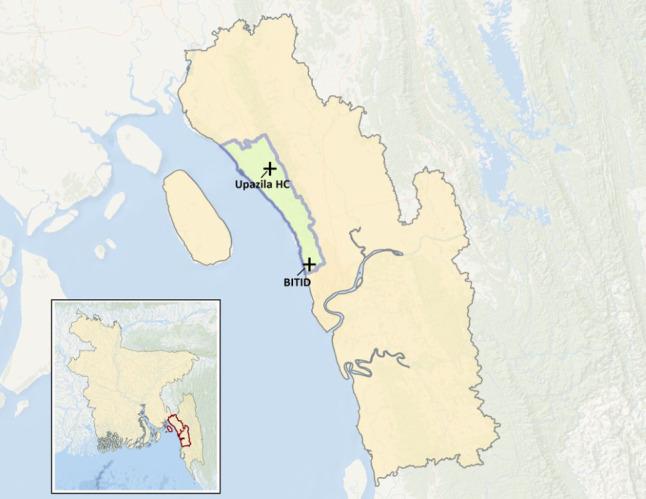
Informally trained health care providers, such as village doctors in Bangladesh, are crucial in providing health care services to the rural poor in low- and middle-income countries. Despite being one of the primary vendors of antibiotics in rural Bangladesh, village doctors often have limited knowledge about appropriate antibiotic use, leading to varied and potentially inappropriate dispensing and treatment practices. In this study, we aimed to identify, map, and survey village doctors in the Sitakunda subdistrict of Bangladesh to understand their distribution, practice characteristics, clinical behaviours, access to technologies, and use of these technologies for clinical decision-making.
METHODS
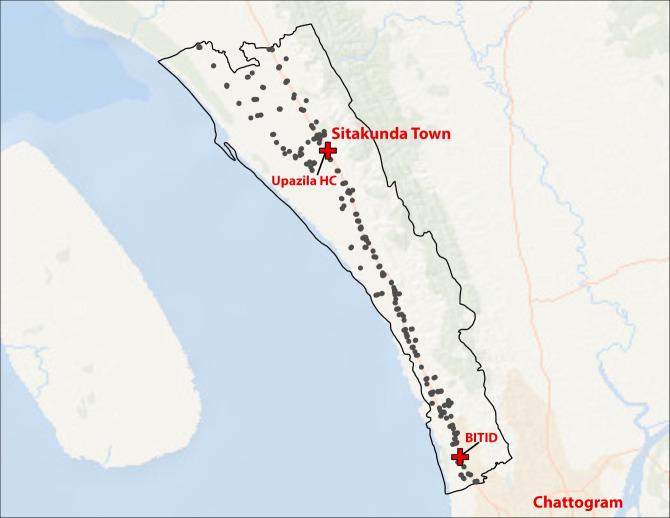
Using a 'snowball' sampling method, we identified and mapped 411 village doctors, with 371 agreeing to complete a structured survey.
RESULTS
The median distance between a residential household and the closest village doctor practice was 0.37 km, and over half of the practices (51.2%) were within 100 m of the major highway. Village doctors were predominately male (98.7%), with a median age of 39. After completing village doctor training, 39.4% had completed an internship, with a median of 15 years of practice experience. Village doctors reported seeing a median of 84 patients per week, including a median of five paediatric diarrhoea cases per week. They stocked a range of antibiotics, with ciprofloxacin and metronidazole being the most prescribed for diarrhoea. Most had access to phones with an internet connection and used online resources for clinical decision-making and guidance.
CONCLUSIONS
The findings provide insights into the characteristics and practices of village doctors and point to the potential for internet and phone-based interventions to improve patient care and reduce inappropriate antibiotic use in this health care provider group.
背景
在孟加拉国等中低收入国家,非正式培训的医疗保健提供者(如乡村医生)在为农村贫困人口提供医疗服务方面发挥着至关重要的作用。尽管乡村医生是孟加拉国农村地区抗生素的主要销售者之一,但他们通常对抗生素的合理使用知之甚少,导致配药和治疗实践存在差异,且可能并不合理。在这项研究中,我们旨在确定、绘制并调查孟加拉国锡塔昆达分区的乡村医生,以了解他们的分布、实践特征、临床行为、技术获取情况以及这些技术在临床决策中的应用情况。
方法
我们使用“滚雪球”抽样方法确定并绘制了 411 名乡村医生的位置,其中 371 名同意完成一项结构化调查。
结果
居民家庭与最近的乡村医生诊所之间的中位数距离为 0.37 公里,超过一半的诊所(51.2%)位于主要公路 100 米以内。乡村医生主要为男性(98.7%),中位数年龄为 39 岁。完成乡村医生培训后,39.4%的人完成了实习,中位数实践经验为 15 年。乡村医生报告每周平均接诊 84 名患者,其中每周平均有 5 名儿童腹泻患者。他们储备了一系列抗生素,其中治疗腹泻时最常开的抗生素是环丙沙星和甲硝唑。大多数人都可以使用带互联网连接的手机,并使用在线资源进行临床决策和指导。
结论
这些发现深入了解了乡村医生的特征和实践情况,并指出了通过互联网和手机干预措施改善该医疗服务提供者群体的患者护理和减少不合理使用抗生素的潜力。

 Zotero 插件