
胚胎亮氨酸通过mTOR信号通路促进日本鹌鹑出生后的早期生长。
Embryonic Leucine Promotes Early Postnatal Growth via mTOR Signalling in Japanese Quails.
作者信息
Ndunguru Sawadi F, Reda Gebrehaweria K, Csernus Brigitta, Knop Renáta, Lugata James K, Szabó Csaba, Lendvai Ádám Z, Czeglédi Levente
机构信息
Department of Animal Science, Institute of Animal Science, Biotechnology and Nature Conservation, Faculty of Agricultural and Food Sciences and Environmental Management, University of Debrecen, 4032 Debrecen, Hungary.
Doctoral School of Animal Science, University of Debrecen, 4032 Debrecen, Hungary.
出版信息
Animals (Basel). 2024 Sep 6;14(17):2596. doi: 10.3390/ani14172596.
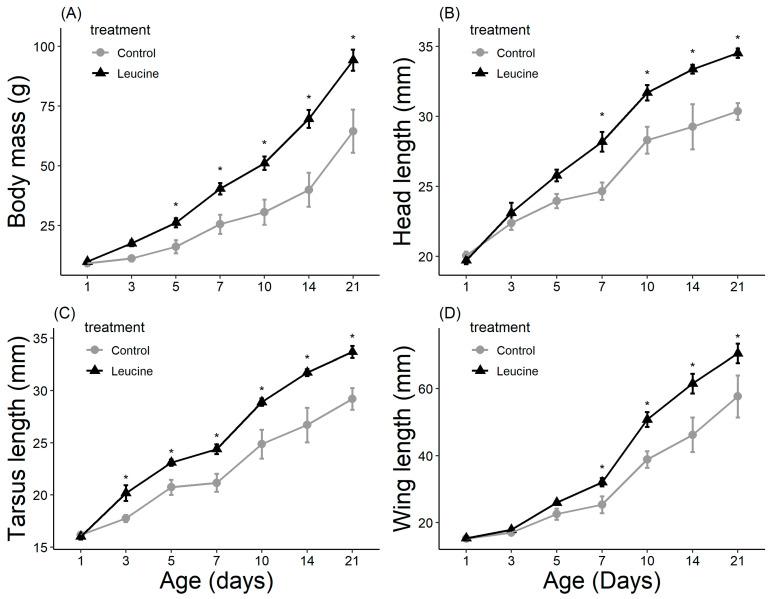
Nutritional cues during embryonic development can alter developmental trajectories and affect postnatal growth. However, the specific mechanisms by which nutrients influence avian growth remain largely unknown. Amino acids can directly interact with the nutrient-sensing pathways, such as the insulin-like growth factor 1 (IGF-1)/mechanistic target of rapamycin (mTOR) pathways, which are known to regulate growth. We examined the effects of embryonic leucine on gene expression and phenotypic growth in Japanese quails by injecting 2.5 mg leucine or saline (control) into Japanese quail eggs on the tenth day of incubation and incubating them under standard conditions. The treatment groups had similar hatching success and size at hatching. However, between 3 and 7 days post-hatching, quails treated with embryonic leucine showed increased growth in body mass and wing, tarsus, head, and intestinal lengths, lasting up to 21 days. The hepatic expression of , , , and was upregulated in leucine-treated quails, while the expression of remained unaffected. In conclusion, a subtle increase in embryonic leucine may induce developmental programming effects in Japanese quail by interacting with the IGF-1/mTOR nutrient-sensing pathway to promote growth. This study highlights the role of embryonic amino acids as crucial nutrients for enhancing growth. It provides valuable insight into nutrient intervention strategies during embryonic development to potentially improve poultry growth performance.
胚胎发育过程中的营养信号可以改变发育轨迹并影响出生后的生长。然而,营养素影响禽类生长的具体机制在很大程度上仍然未知。氨基酸可以直接与营养感应途径相互作用,例如胰岛素样生长因子1(IGF-1)/雷帕霉素作用靶点(mTOR)途径,已知这些途径可调节生长。我们通过在孵化第10天向日本鹌鹑蛋中注射2.5毫克亮氨酸或生理盐水(对照),并在标准条件下孵化,研究了胚胎亮氨酸对日本鹌鹑基因表达和表型生长的影响。各处理组的孵化成功率和孵化时的大小相似。然而,在孵化后3至7天之间,经胚胎亮氨酸处理的鹌鹑体重以及翅膀、跗骨、头部和肠道长度的生长增加,这种情况持续到21天。在经亮氨酸处理的鹌鹑中,肝脏中、、和的表达上调,而的表达未受影响。总之,胚胎亮氨酸的轻微增加可能通过与IGF-1/mTOR营养感应途径相互作用来促进生长,从而在日本鹌鹑中诱导发育编程效应。本研究突出了胚胎氨基酸作为促进生长的关键营养素的作用。它为胚胎发育期间的营养干预策略提供了有价值的见解,以潜在地改善家禽生长性能。


 Zotero 插件