
基于共生理学机制视角下的 DNA 甲基化预测多种退行性疾病。
Prediction of Multiple Degenerative Diseases Based on DNA Methylation in a Co-Physiology Mechanisms Perspective.
机构信息
College of Computer Science and Engineering, Changchun University of Technology, Changchun 130051, China.
School of Information Science and Technology, Institute of Computational Biology, Northeast Normal University, Changchun 130117, China.
出版信息
Int J Mol Sci. 2024 Sep 1;25(17):9514. doi: 10.3390/ijms25179514.
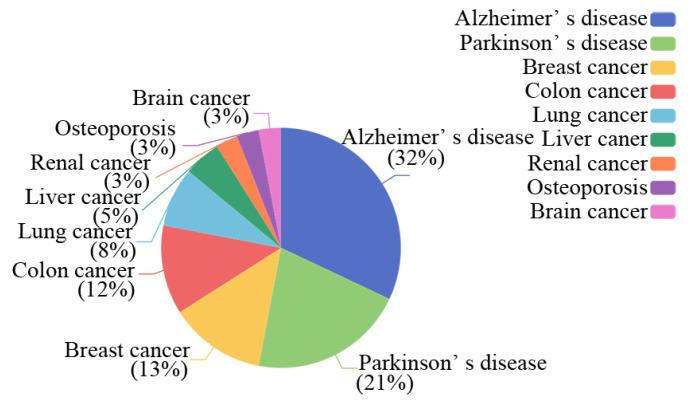
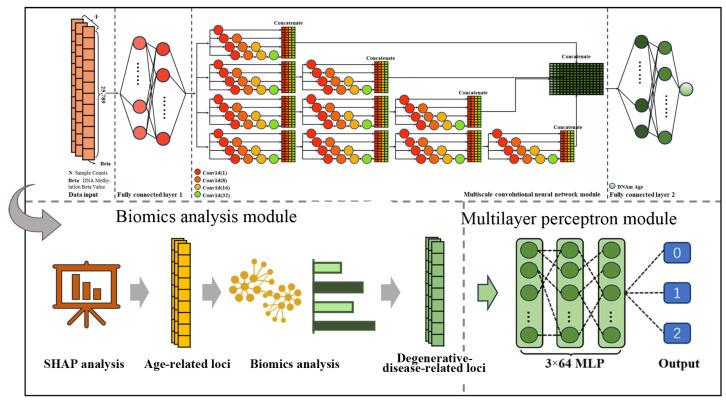
Degenerative diseases oftentimes occur within the continuous process of aging, and the corresponding clinical manifestations may be neurodegeneration, neoplastic diseases, or various human complex diseases. DNA methylation provides the opportunity to explore aging and degenerative diseases as epigenetic traits. It has already been applied to age prediction and disease diagnosis. It has been shown that various degenerative diseases share co-physiology mechanisms with each other, clues of which may be gained from studying the aging process. Here, we endeavor to predict the risk of degenerative diseases in an aging-relevant comorbid mechanism perspective. Firstly, an epigenetic clock method was implemented based on a multi-scale convolutional neural network, and a Shapley feature attribution analysis was applied to discover the aging-related CpG sites. Then, these sites were further screened to a smaller subset composed of 196 sites by using biomics analysis according to their biological functions and mechanisms. Finally, we constructed a multilayer perceptron (MLP)-based degenerative disease risk prediction model, Mlp-DDR, which was well trained and tested to accurately classify nine degenerative diseases. Recent studies also suggest that DNA methylation plays a significant role in conditions like osteoporosis and osteoarthritis, broadening the potential applications of our model. This approach significantly advances the ability to understand degenerative diseases and represents a substantial shift from traditional diagnostic methods. Despite the promising results, limitations regarding model complexity and dataset diversity suggest directions for future research, including the development of tissue-specific epigenetic clocks and the inclusion of a wider range of diseases.
退行性疾病通常发生在连续的衰老过程中,相应的临床表现可能是神经退行性疾病、肿瘤性疾病或各种人类复杂疾病。DNA 甲基化提供了将衰老和退行性疾病作为表观遗传特征进行探索的机会。它已经被应用于年龄预测和疾病诊断。已经表明,各种退行性疾病彼此之间具有共同的生理机制,这些机制的线索可以通过研究衰老过程来获得。在这里,我们试图从与衰老相关的共病机制的角度预测退行性疾病的风险。首先,我们基于多尺度卷积神经网络实现了一种表观遗传时钟方法,并应用 Shapley 特征归因分析来发现与衰老相关的 CpG 位点。然后,根据它们的生物学功能和机制,我们使用生物信息学分析将这些位点进一步筛选到由 196 个位点组成的较小子集。最后,我们构建了一个基于多层感知机(MLP)的退行性疾病风险预测模型 Mlp-DDR,该模型经过了良好的训练和测试,可以准确地对九种退行性疾病进行分类。最近的研究还表明,DNA 甲基化在骨质疏松症和骨关节炎等疾病中起着重要作用,拓宽了我们模型的潜在应用。这种方法显著提高了理解退行性疾病的能力,代表了从传统诊断方法的重大转变。尽管取得了有希望的结果,但模型复杂性和数据集多样性的限制表明了未来研究的方向,包括开发组织特异性表观遗传时钟和纳入更广泛的疾病。



 Zotero 插件