
靶向细菌细胞壁的药物:对抗革兰氏阳性病原体的工具。
Agents Targeting the Bacterial Cell Wall as Tools to Combat Gram-Positive Pathogens.
机构信息
Department of Analytical Biochemistry, Faculty of Biochemistry, Biophysics and Biotechnology, Jagiellonian University, Gronostajowa St. 7, 30-348 Cracow, Poland.
Doctoral School of Exact and Natural Sciences, Jagiellonian University, Prof. St. Łojasiewicza St. 11, 30-348 Cracow, Poland.
出版信息
Molecules. 2024 Aug 27;29(17):4065. doi: 10.3390/molecules29174065.
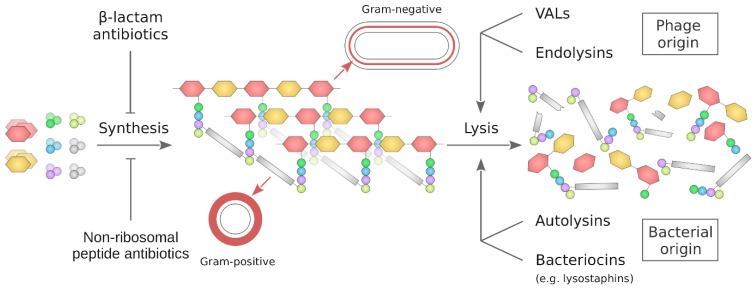
The cell wall is an indispensable element of bacterial cells and a long-known target of many antibiotics. Penicillin, the first discovered beta-lactam antibiotic inhibiting the synthesis of cell walls, was successfully used to cure many bacterial infections. Unfortunately, pathogens eventually developed resistance to it. This started an arms race, and while novel beta-lactams, either natural or (semi)synthetic, were discovered, soon upon their application, bacteria were developing resistance. Currently, we are facing the threat of losing the race since more and more multidrug-resistant (MDR) pathogens are emerging. Therefore, there is an urgent need for developing novel approaches to combat MDR bacteria. The cell wall is a reasonable candidate for a target as it differentiates not only bacterial and human cells but also has a specific composition unique to various groups of bacteria. This ensures the safety and specificity of novel antibacterial agents that target this structure. Due to the shortage of low-molecular-weight candidates for novel antibiotics, attention was focused on peptides and proteins that possess antibacterial activity. Here, we describe proteinaceous agents of various origins that target bacterial cell wall, including bacteriocins and phage and bacterial lysins, as alternatives to classic antibiotic candidates for antimicrobial drugs. Moreover, advancements in protein chemistry and engineering currently allow for the production of stable, specific, and effective drugs. Finally, we introduce the concept of selective targeting of dangerous pathogens, exemplified by staphylococci, by agents specifically disrupting their cell walls.
细胞壁是细菌细胞不可或缺的组成部分,也是许多抗生素长期以来的作用靶点。青霉素是最早发现的抑制细胞壁合成的β-内酰胺类抗生素,成功地用于治疗许多细菌感染。不幸的是,病原体最终对其产生了耐药性。这引发了一场军备竞赛,虽然发现了新型β-内酰胺类抗生素,无论是天然的还是(半)合成的,但在应用后不久,细菌就产生了耐药性。目前,由于越来越多的多药耐药(MDR)病原体的出现,我们面临着失去这场竞赛的威胁。因此,迫切需要开发新的方法来对抗 MDR 细菌。细胞壁是一个合理的靶标,因为它不仅能区分细菌和人类细胞,而且其组成在不同的细菌群中具有独特性,这确保了针对该结构的新型抗菌剂的安全性和特异性。由于缺乏新型抗生素的低分子量候选物,人们的注意力集中在具有抗菌活性的肽和蛋白质上。在这里,我们描述了各种来源的针对细菌细胞壁的蛋白类药物,包括细菌素和噬菌体及细菌溶素,作为经典抗生素候选药物的替代品。此外,蛋白质化学和工程的进步目前允许生产稳定、特异和有效的药物。最后,我们引入了通过专门破坏细胞壁来选择性靶向危险病原体(以葡萄球菌为例)的概念。



 Zotero 插件