
细菌污染与温室气体排放:静脉麻醉中输注组件重复使用与一次性使用的随机研究。
Bacterial contamination and greenhouse gas emissions: A randomised study of reuse versus single-use of infusion-set components for intravenous anaesthesia.
机构信息
From the Department of Anaesthesia, SV Hospital Group, Institute of Clinical Sciences at the Sahlgrenska Academy, University of Gothenburg, Gothenburg (SLK, MVG, PWM), Department of Infection Prevention and Control, Södra Älvsborg Hospital, Borås (JEW), Department of Infectious Disease, Institute of Biomedicine at the Sahlgrenska Academy, University of Gothenburg, Gothenburg (JEW), and Anaesthesiology and Intensive Care, Department of Clinical Sciences Lund, Lund University, Lund, Sweden (PB).
出版信息
Eur J Anaesthesiol. 2024 Dec 1;41(12):910-920. doi: 10.1097/EJA.0000000000002067. Epub 2024 Sep 18.
BACKGROUND
Reusing anaesthesia infusion-set components may reduce the climate impact from plastic waste and discarded medications. Infusion-set contents can be shielded from patient contact by single use of an infusion line fitted with dual antireflux valves, preventing retrograde entry of microorganisms, and eliminating the risk for patient-to-patient cross-contamination. However, infusion-set contamination from compromised aseptic handling could affect quality of care.
INTERVENTIONS
To determine the prevalence of infusion-set bacterial contamination and compare the climate effects, we randomised operating rooms scheduled for total intravenous anaesthesia to handle procedures by infusion-set reuse or single-use. Both methods used dual single-use antireflux valves.
OUTCOMES
The primary outcome was infusion-set bacterial contamination assessed by aerobic culture of infusion-set fluid collected after each procedure. The secondary outcome was CO 2 emissions (CO 2 -eq) estimated by life cycle assessment of component and medication use. To assess feasibility of detecting an inter-method difference in bacterial contamination, an interim analysis was planned after including at least 150 procedures per group.
RESULTS
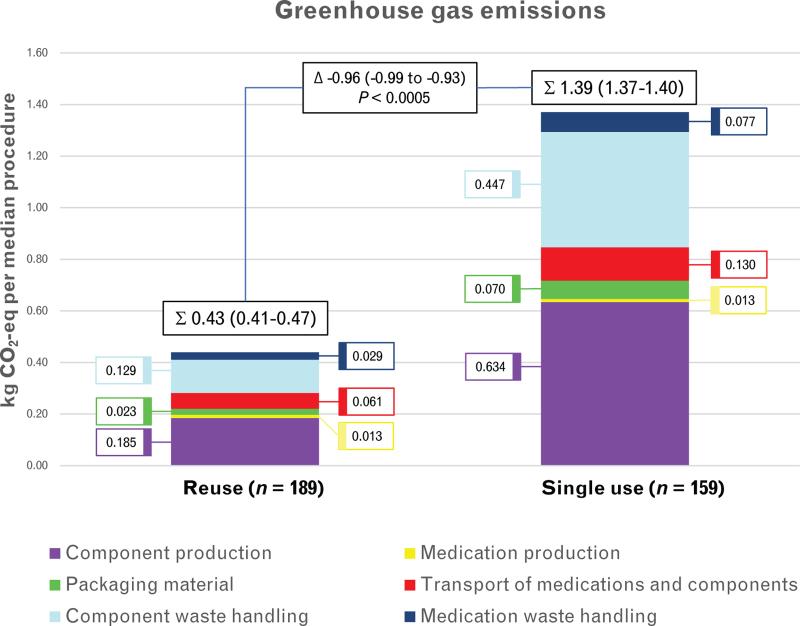
After allocating 54 operating rooms per method, 189 and 159 procedures of reuse and single use were included. Reuse permitted a median of three procedures per infusion set (range 1 to 8). Positive cultures occurred in two procedures per method [mean (95% CI)]; prevalence 1.15% (0.03 to 2.27); relative risk of reuse versus single use 0.84 (0.12 to 5.93), P = 0.861. As prespecified, inclusion was stopped due to futility. The median (95% CI) per-procedure climate emissions were 0.43 (0.41 to 0.47) and 1.39 (1.37 to 1.40) kg CO 2 -eq for reuse and single-use respectively; difference -0.96 (-0.99 to -0.93), P < 0.0005. The main sources for climate emissions were production of infusion-set components and waste handling.
CONCLUSIONS
We conclude that the prevalence of bacterial contamination was low for both methods. A much larger study would be needed to detect an inter-method difference. Reuse of infusion-set components allowed significantly reduced intravenous anaesthesia climate emissions.
背景
重复使用麻醉输注套件的部件可以减少塑料废物和废弃药物产生的气候影响。通过使用带有双反流阀的一次性输注管路,可以将输注套件的内容物与患者隔离开来,防止微生物逆行进入,并消除患者之间交叉污染的风险。然而,由于无菌操作不当而导致的输注套件污染可能会影响护理质量。
干预措施
为了确定输注套件的细菌污染率,并比较气候影响,我们将接受全静脉麻醉的手术室随机分为重复使用和一次性使用的程序。两种方法均使用带有双一次性反流阀的输注套件。
结果
主要结果是通过对每次操作后收集的输注套件液体进行有氧培养来评估输注套件的细菌污染。次要结果是通过对组件和药物使用的生命周期评估来估算 CO 2 排放量(CO 2 -eq)。为了评估检测两种方法之间细菌污染差异的可行性,在每组至少包括 150 个程序后,计划进行中期分析。
结果
在为每种方法分配 54 间手术室后,共纳入了 189 次重复使用和 159 次单次使用的程序。重复使用允许每个输注套件进行三次操作(范围 1 到 8)。两种方法均有两次操作呈阳性培养[平均值(95%CI)];发生率 1.15%(0.03 至 2.27);重复使用与单次使用的相对风险为 0.84(0.12 至 5.93),P = 0.861。按照预设,由于无效而停止纳入。每例操作的气候排放中位数(95%CI)分别为 0.43(0.41 至 0.47)和 1.39(1.37 至 1.40)kg CO 2 -eq 用于重复使用和单次使用;差值 -0.96(-0.99 至 -0.93),P < 0.0005。气候排放的主要来源是输注套件组件的生产和废物处理。
结论
我们的结论是,两种方法的细菌污染发生率均较低。需要进行更大规模的研究才能检测到方法之间的差异。重复使用输注套件组件可显著减少静脉麻醉的气候排放。


 Zotero 插件