
使用饱和度钳夹法对常压低氧环境下急性高负荷抗阻运动的代谢和激素反应。
Metabolic and hormonal responses to acute high-load resistance exercise in normobaric hypoxia using a saturation clamp.
作者信息
Jiang Guole, Qin Shuang, Yan Bing, Girard Olivier
机构信息
Sports Coaching College, Beijing Sport University, Beijing, China.
College of Basic Military and Political Education, National University of Defense Technology, Changsha, China.
出版信息
Front Physiol. 2024 Sep 2;15:1445229. doi: 10.3389/fphys.2024.1445229. eCollection 2024.
INTRODUCTION
We assessed metabolic and hormonal responses to high-load resistance exercise under varying normobaric hypoxia conditions with a saturation clamp.
METHODS
Employing a counterbalanced, crossover test design, ten well-trained men participated in three exercise trials with normoxic or hypoxic gas mixtures to maintain arterial oxygen saturation at -90% and 80% [moderate (MH) and severe (SH) hypoxia, respectively]. The resistance exercise regimen comprised five sets of 10 repetitions of barbell back squats at 70% of one repetition maximum, with 1-min rest between sets. Metabolic and hormonal responses were measured before normoxia or hypoxia exposures (Pre 1), 15 min after the exposures (Pre 2), and at 0-, 15-, and 30-min post-exercises (T0, T15, and T30, respectively).
RESULTS
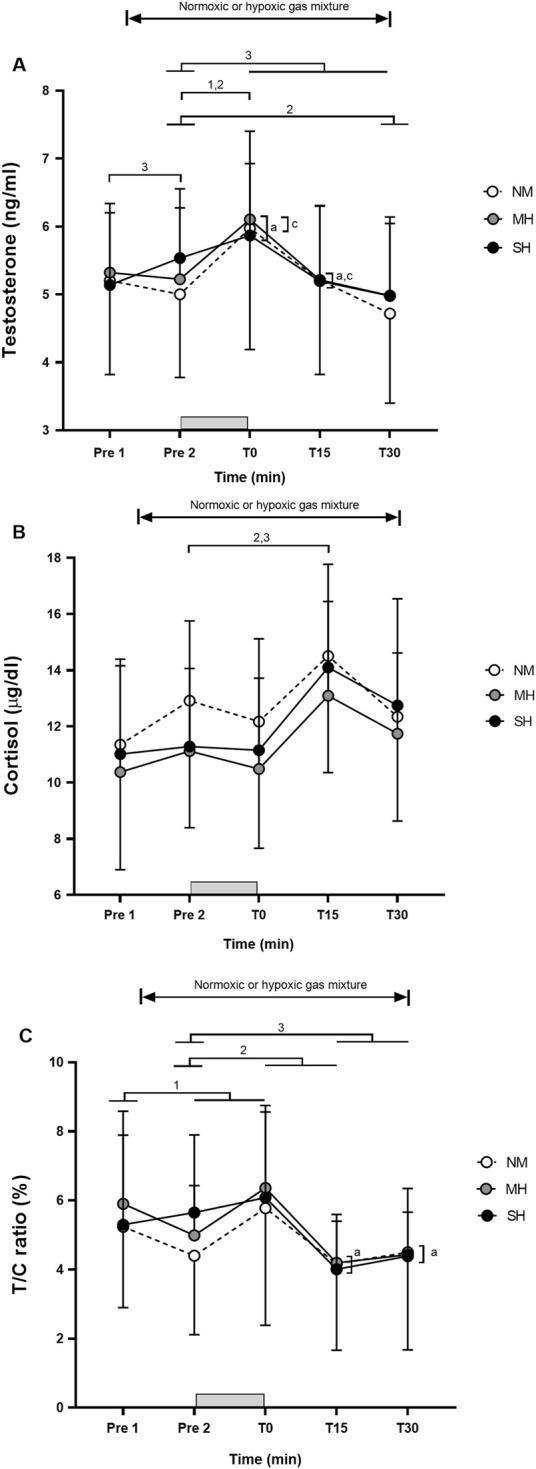
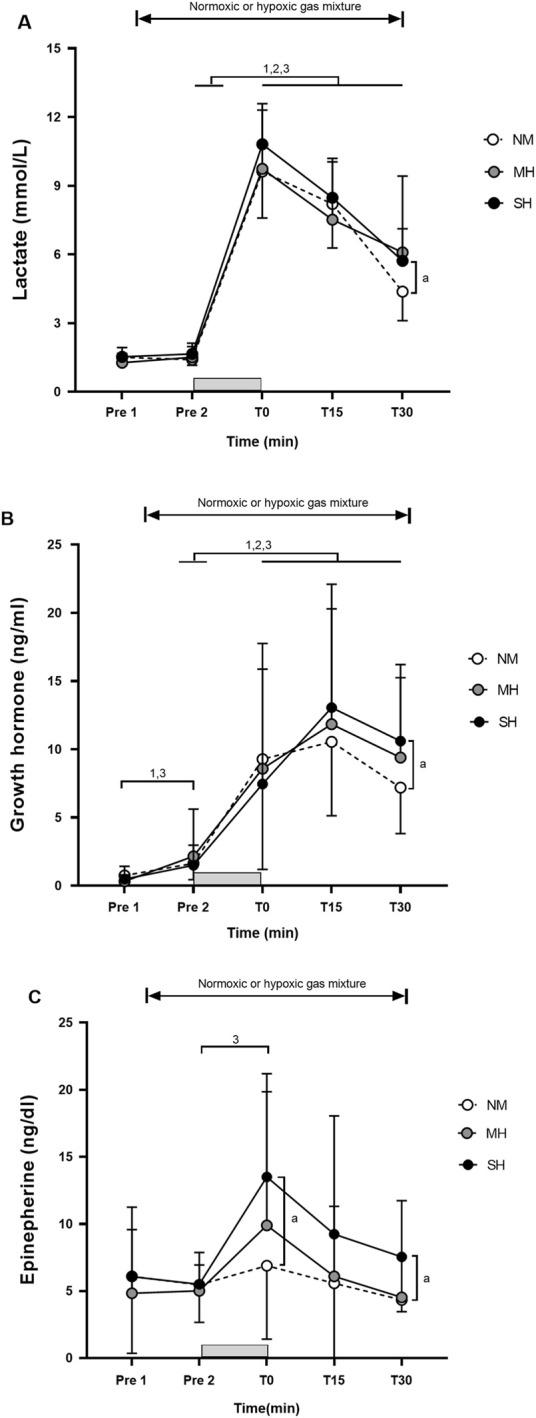
Compared to Pre 2, blood lactate concentrations and growth hormone values were elevated at T0, T15, and T30 ( ≤ 0.001), while testosterone values increased at T0 in all conditions ( ≤ 0.009). Epinephrine values increased significantly from Pre 2 to T0 in SH only ( < 0.001). SH had significantly higher blood lactate concentrations ( = 0.023), growth hormone ( = 0.050), and epinephrine ( = 0.020) values at T30 compared to NM. Cortisol values were elevated above Pre 2 at T15 in MH and SH, while lower testosterone values were noted at T0 and T15 for SH compared to NM and MH (all ≤ 0.05).
DISCUSSION
Severe simulated hypoxia, achieved through a saturation clamp during barbell back squats, may enhance metabolic and hormonal responses, particularly 30 min post-session. Nevertheless, the acute effects of hypoxia exposure seem to be overridden by the impact of high-load resistance exercise.
引言
我们使用饱和度钳夹技术评估了在不同常压低氧条件下高负荷抗阻运动的代谢和激素反应。
方法
采用平衡交叉试验设计,10名训练有素的男性参与了三项运动试验,分别吸入常氧或低氧混合气体,以使动脉血氧饱和度维持在90%和80%[分别为中度(MH)和重度(SH)低氧]。抗阻运动方案包括以一次最大重复量的70%进行五组,每组10次杠铃后深蹲,组间休息1分钟。在常氧或低氧暴露前(Pre 1)、暴露后15分钟(Pre 2)以及运动后0、15和30分钟(分别为T0、T15和T30)测量代谢和激素反应。
结果
与Pre 2相比,T0、T15和T30时血乳酸浓度和生长激素值升高(≤0.001),而在所有条件下T0时睾酮值均升高(≤0.009)。仅在SH组中,肾上腺素值从Pre 2到T0显著增加(<0.001)。与NM相比,SH组在T30时血乳酸浓度(=0.023)、生长激素(=0.050)和肾上腺素(=0.020)值显著更高。在MH和SH组中,T15时皮质醇值高于Pre 2,而与NM和MH相比,SH组在T0和T15时睾酮值较低(均≤0.05)。
讨论
在杠铃后深蹲过程中通过饱和度钳夹实现的严重模拟低氧可能会增强代谢和激素反应,尤其是在运动后30分钟。然而,低氧暴露的急性效应似乎被高负荷抗阻运动的影响所掩盖。

 Zotero 插件