
不同仪器在睑板腺功能障碍强脉冲光治疗中的疗效
Therapeutic effectiveness of different machines in intense pulsed light treatment of meibomian gland dysfunction.
作者信息
Qin Zhenwei, Zhu Yirui, Lu Jiale, Lin Lin, Huo Yanan, Wang Haoyu, Qiao Chen, Chen Xiangxi, Wu Jianhua, Zeng Qingyan, Jin Xiuming
机构信息
Eye Center of the 2nd Affiliated Hospital, Zhejiang University School of Medicine, Zhejiang Provincial Key Lab of Ophthalmology, Hangzhou, China.
Wuhan Aier Eye Hospital, Wuhan, China.
出版信息
Adv Ophthalmol Pract Res. 2024 Jun 4;4(4):182-188. doi: 10.1016/j.aopr.2024.06.002. eCollection 2024 Nov-Dec.
PURPOSE
This study aimed to determine the therapeutic effectiveness of different machines in intense pulsed light (IPL) treatment of meibomian gland dysfunction (MGD).
METHODS
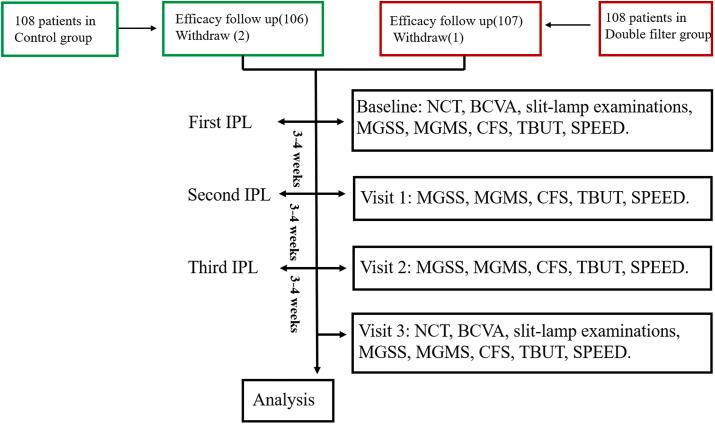
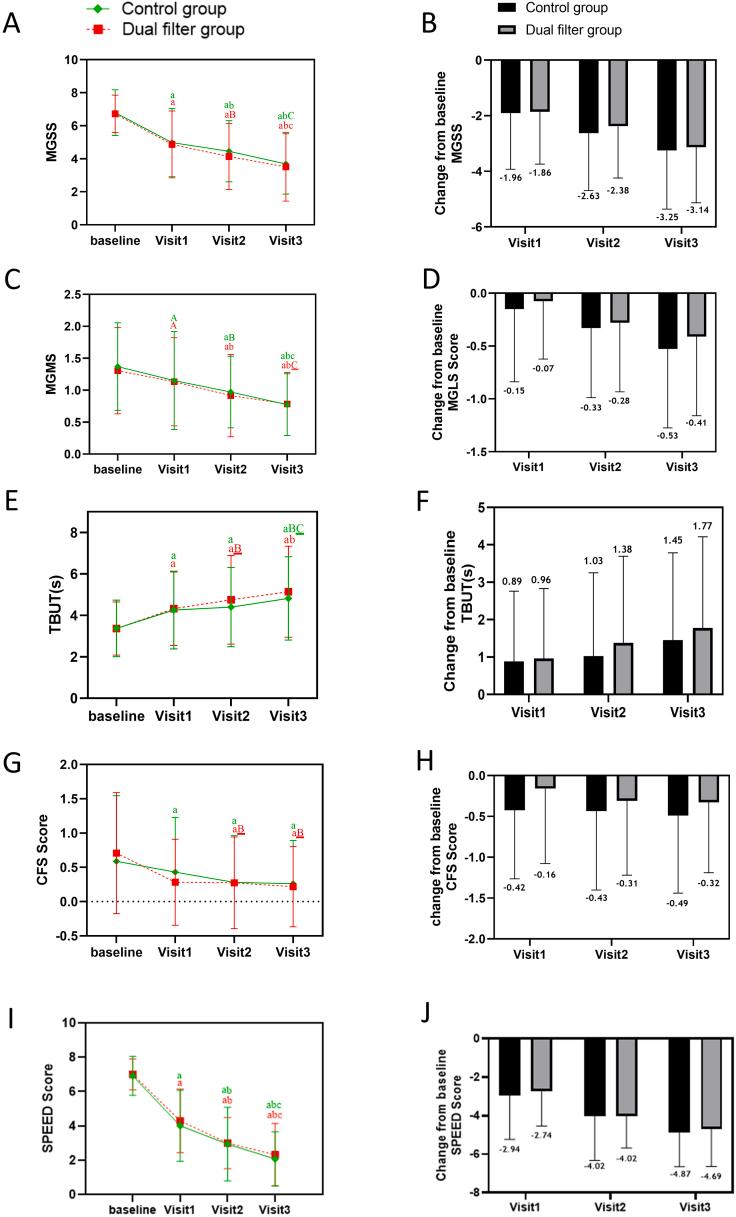
213 subjects diagnosed with MGD underwent three sessions of IPL treatment in a control (M22) treatment group or experimental (OPL-I) treatment group and were followed up three to four weeks after each session. Tear breakup time (TBUT), meibomian gland secretion scores (MGSS), meibomian gland meibum scores (MGMS), corneal fluorescein staining (CFS) scores, and the Standard Patient Evaluation of Eye Dryness (SPEED) was used to assess eye dryness signs and symptoms at baseline and follow-up visits.
RESULTS
Two machines had the same working principles except that experimental (OPL-I) group consist of a dual filter system. Both groups showed significant improvements ( < 0.0001) in TBUT, MGSS, MGMS, CFS scores and SPEED scores. Non-inferiority analysis showed no statistically significant differences in any result between the two groups. Various defects appeared on the filter with the extension of usage time. Spectrophotometry showed that light intensity decreased to 93.5% ± 0.46% past the first filter.
CONCLUSIONS
IPL treatment completed with different machines have the same effect on improving the symptoms and signs of MGD. The dual filter system in the IPL machine reduces light intensity by approximately 6.5% without affecting its therapeutic effect. It is a feasible measure to ensure double safety and has the significance of popularization not only for MGD but also in other IPL treatment scenarios.
目的
本研究旨在确定不同仪器在强脉冲光(IPL)治疗睑板腺功能障碍(MGD)中的治疗效果。
方法
213名被诊断为MGD的受试者在对照组(M22)治疗组或实验组(OPL - I)治疗组接受了3次IPL治疗,并在每次治疗后3至4周进行随访。使用泪膜破裂时间(TBUT)、睑板腺分泌评分(MGSS)、睑板腺脂质评分(MGMS)、角膜荧光素染色(CFS)评分以及干眼标准患者评估(SPEED)来评估基线和随访时的干眼体征和症状。
结果
两台仪器工作原理相同,只是实验组(OPL - I)组由双滤光系统组成。两组在TBUT、MGSS、MGMS、CFS评分和SPEED评分方面均有显著改善(P<0.0001)。非劣效性分析显示两组在任何结果上均无统计学显著差异。随着使用时间的延长,滤光片出现各种缺陷。分光光度法显示,经过第一个滤光片后,光强度降至93.5%±0.46%。
结论
使用不同仪器进行IPL治疗对改善MGD的症状和体征具有相同效果。IPL仪器中的双滤光系统可使光强度降低约6.5%,而不影响其治疗效果。这是确保双重安全的可行措施,不仅对MGD,而且在其他IPL治疗场景中都具有推广意义。

 Zotero 插件