
肿瘤分子成像用纳米粒子的现状和未来方向。
The Current Status and Future Directions on Nanoparticles for Tumor Molecular Imaging.
机构信息
Department of Nuclear Medicine, The First Hospital of Jilin University, Changchun, People's Republic of China.
National Health Commission (NHC) Key laboratory of Radiobiology, School of Public Health, Jilin University, Changchun, People's Republic of China.
出版信息
Int J Nanomedicine. 2024 Sep 14;19:9549-9574. doi: 10.2147/IJN.S484206. eCollection 2024.
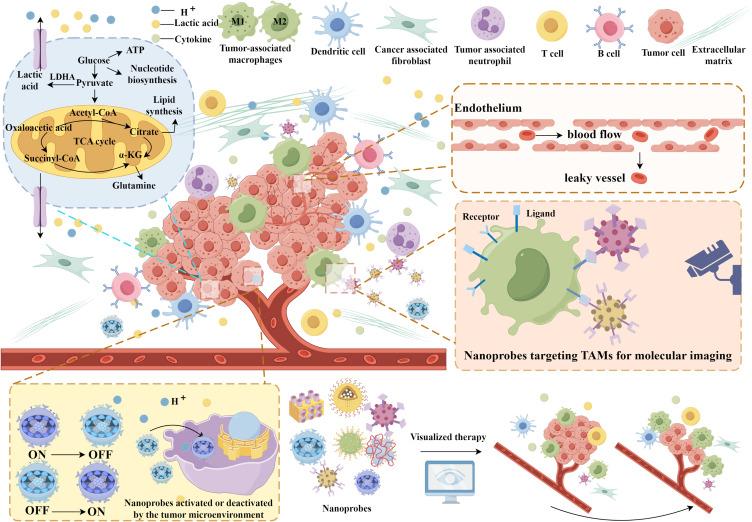
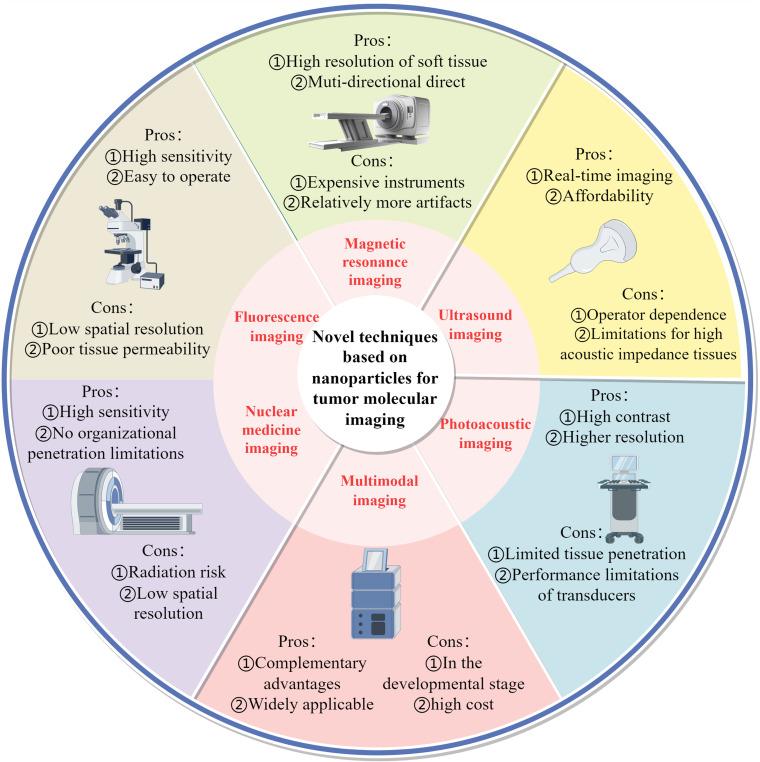
Molecular imaging is an advanced technology that utilizes specific probes or markers in conjunction with cutting-edge imaging techniques to observe and analyze the localization, distribution, activity, and interactions of biomolecules within living organisms. Tumor molecular imaging, by enabling the visualization and quantification of molecular characteristics of tumor cells, facilitates a deeper and more comprehensive understanding of tumors, providing valuable insights for early diagnosis, treatment monitoring, and cancer biology research. However, the image quality of molecular imaging still requires improvement, and nanotechnology has significantly propelled the advancement of molecular imaging. Currently, nanoparticle-based tumor molecular imaging technologies encompass radionuclide imaging, fluorescence imaging, magnetic resonance imaging, ultrasound imaging, photoacoustic imaging, and multimodal imaging, among others. As our understanding of the tumor microenvironment deepens, the design of nanoparticle probes for tumor molecular imaging has also evolved, offering new perspectives and expanding the applications of tumor molecular imaging. Beyond diagnostics, there is a marked trend towards integrated diagnosis and therapy, with image-guided treatment playing a pivotal role. This includes image-guided surgery, photodynamic therapy, and chemodynamic therapy. Despite continuous advancements and innovative developments in molecular imaging, many of these remain in the experimental stage and require breakthroughs before they can be fully integrated into clinical practice.
分子成像是一种利用特定探针或标记物结合先进成像技术来观察和分析生物体内生物分子的定位、分布、活性和相互作用的先进技术。肿瘤分子成像是通过可视化和量化肿瘤细胞的分子特征,促进对肿瘤的更深入和更全面的了解,为早期诊断、治疗监测和癌症生物学研究提供有价值的见解。然而,分子成像的图像质量仍有待提高,纳米技术极大地推动了分子成像的发展。目前,基于纳米颗粒的肿瘤分子成像技术包括放射性核素成像、荧光成像、磁共振成像、超声成像、光声成像和多模态成像等。随着我们对肿瘤微环境的理解不断加深,肿瘤分子成像的纳米颗粒探针的设计也在不断发展,为肿瘤分子成像提供了新的视角和扩展了其应用。除了诊断,还有一种明显的趋势是整合诊断和治疗,图像引导治疗起着关键作用。这包括图像引导手术、光动力治疗和化学动力学治疗。尽管分子成像在不断发展和创新,但其中许多仍处于实验阶段,需要取得突破才能完全整合到临床实践中。


 Zotero 插件