
免疫检查点抑制剂相关神经系统不良事件的临床病程:重点关注慢性毒性。
Clinical Course of Neurologic Adverse Events Associated With Immune Checkpoint Inhibitors: Focus on Chronic Toxicities.
机构信息
From the IRCCS Istituto delle Scienze Neurologiche di Bologna (S.R., R.R., M. Guarino), Italy; Reference Centre for Paraneoplastic Neurological Syndromes and Autoimmune Encephalitis (A.F), Hospices Civils de Lyon, Neurological Hospital, Bron, MeLiS - UCBL-CNRS UMR 5284 - INSERM U1314, Universitè Claude Bernard Lyon 1, France; IRCCS Mondino Foundation (A.M., L.D., E.M.), Pavia; Neurology Unit (A.D., S.M.), Department of Neurosciences, Biomedicine, and Movement Sciences, University of Verona, Italy; Neuromuscular and Rare Disease Centre (L.F.), Neurology Unit, Sant'Andrea University Hospital, Rome, Italy; Department of Neurosciences Drugs and Child Health (S.C., V.D.), University of Florence; Clinical Neurology Unit (I.F., A.V.), Department of Medicine (DMED), University of Udine; Neurology Unit (L.Z.), AULSS8 Berica, San Bortolo Hospital, Vicenza; Department of Neuroscience (M. Garibaldi, A.L.), Mental Health and Sensory Organs (NESMOS), SAPIENZA University of Rome, Sant'Andrea Hospital; Epidemiology and Statistics Unit (F.B., C.Z.), IRCCS Istituto delle Scienze Neurologiche di Bologna; Department of Neurology 2, Careggi University Hospital, Florence, Italy; Neuroimmunology Laboratory (M.Gastaldi), IRCCS Mondino Foundation, Pavia, Italy; and Clinical Neurology (A.V.), Department of Head-Neck and Neuroscience, Azienda Sanitaria Universitaria Friuli Centrale (ASUFC).
出版信息
Neurol Neuroimmunol Neuroinflamm. 2024 Nov;11(6):e200314. doi: 10.1212/NXI.0000000000200314. Epub 2024 Sep 19.
BACKGROUND AND OBJECTIVES
The clinical course and the risk of chronicity of neurologic immune-related adverse events (n-irAEs) associated with immune checkpoint inhibitors (ICIs) are not well documented. This study aimed to characterize the clinical course of n-irAEs and assess the prevalence of chronic events.
METHODS
This nationwide, multicenter, retrospective study included patients with n-irAEs identified at 7 Italian hospitals. The clinical course of n-irAEs was categorized into fulminant (if resulted in death within 12 weeks), monophasic (if resolved within 12 weeks), and chronic (if persisted beyond 12 weeks). Chronic n-irAEs were further subdivided into (if there was indirect evidence of ongoing inflammation [i.e., required ongoing immunosuppression, relapsed on steroid tapering, or exhibited neurologic progression]) and (if patients had neurologic sequelae without ongoing inflammation). Comparisons between groups and time-to-death analyses were performed.
RESULTS
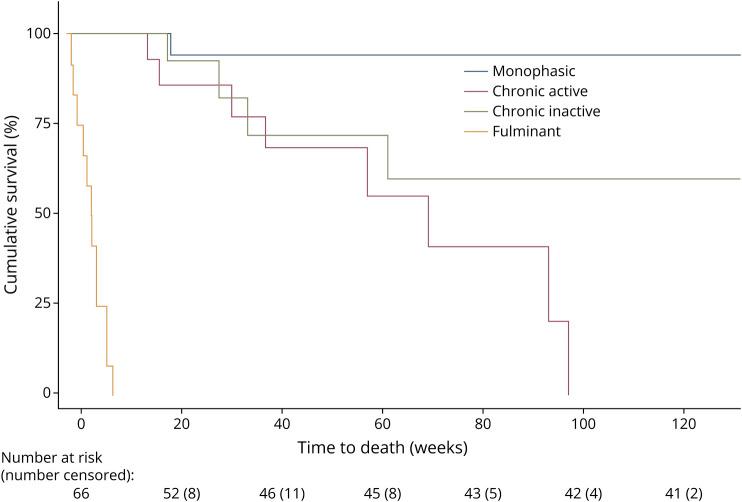
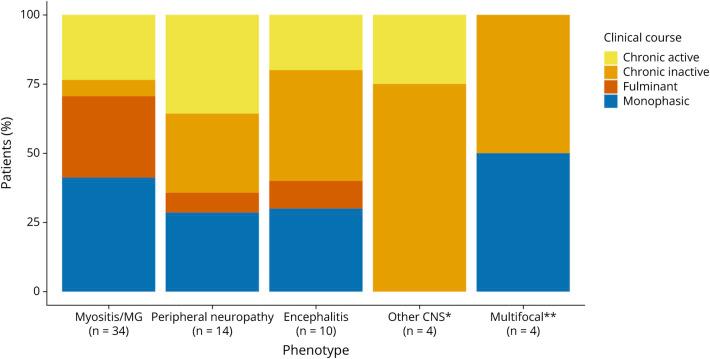
Sixty-six patients were included (median age: 69 years [IQR 62-75]; 53 [80%] men). n-irAEs involved the peripheral nervous system in 48 patients (73%), the central nervous system in 14 (21%), and both in 4 (6%). Twelve patients (18%) had a fulminant course, with the risk being significantly higher in those with concurrent myocarditis (OR 5.4; 95% CI [1.02-28.31]). Among 54 patients with a nonfulminant course, 23 (43%) had a monophasic n-irAE and 31 (57%) had a chronic n-irAE, of which 16 of 31 (52%) were chronic (due to ongoing immunosuppression [69%], relapses at corticosteroid tapering [19%], or neurologic disease progression [12%]) and 15 of 31 (48%) were chronic . In patients with chronic inactive n-irAEs, neurologic sequelae included cerebellar ataxia (33%), neuromuscular weakness (27%), visual loss (13%), sensory disturbances (13%), focal neurologic signs (7%), and cognitive impairment (7%). Compared with patients with monophasic events, those with chronic n-irAEs had a higher rate of severe neurologic disability at the last evaluation ( < 0.01), shorter survival ( < 0.01), and higher overall mortality ( < 0.01), primarily due to cancer progression.
DISCUSSION
More than half of the patients with n-irAEs who survived the acute phase developed a chronic condition. Patients with chronic n-irAEs were at higher risk of death, mainly due to cancer progression. Future studies are needed to further characterize chronic n-irAEs and identify optimal long-term management strategies.
背景与目的
免疫检查点抑制剂(ICIs)相关的神经免疫相关不良事件(n-irAEs)的临床过程和慢性风险尚未得到充分记录。本研究旨在描述 n-irAEs 的临床过程,并评估慢性事件的发生率。
方法
这是一项全国性、多中心、回顾性研究,纳入了在意大利 7 家医院发现的 n-irAEs 患者。n-irAEs 的临床过程分为暴发性(如果在 12 周内导致死亡)、单相性(如果在 12 周内缓解)和慢性(如果超过 12 周持续存在)。慢性 n-irAEs 进一步分为慢性 (如果存在持续炎症的间接证据[即需要持续免疫抑制、在激素减量时复发或出现神经进展])和慢性 (如果患者存在神经后遗症但无持续炎症)。对各组之间进行比较,并进行生存时间分析。
结果
共纳入 66 例患者(中位年龄:69 岁[IQR 62-75];53 例[80%]为男性)。n-irAEs 累及周围神经系统 48 例(73%),中枢神经系统 14 例(21%),同时累及两者 4 例(6%)。12 例(18%)患者为暴发性病程,同时患有心肌炎的患者风险显著更高(OR 5.4;95%CI [1.02-28.31])。在 54 例非暴发性病程患者中,23 例(43%)为单相性 n-irAE,31 例(57%)为慢性 n-irAE,其中 16 例(52%)为慢性 (由于持续免疫抑制[69%]、激素减量时复发[19%]或神经疾病进展[12%]),15 例(48%)为慢性 。在患有慢性非活动性 n-irAEs 的患者中,神经后遗症包括小脑共济失调(33%)、神经肌肉无力(27%)、视力丧失(13%)、感觉障碍(13%)、局灶性神经体征(7%)和认知障碍(7%)。与单相事件患者相比,慢性 n-irAEs 患者在最后评估时更易发生严重神经残疾(<0.01)、生存时间更短(<0.01)且总死亡率更高(<0.01),主要原因是癌症进展。
讨论
超过一半的 n-irAEs 存活患者发展为慢性疾病。患有慢性 n-irAEs 的患者死亡风险更高,主要原因是癌症进展。需要进一步研究以更好地描述慢性 n-irAEs 并确定最佳的长期管理策略。

 Zotero 插件