
常染色体显性多囊肾病发展的多尺度多模态评估。
Multiscale and multimodal evaluation of autosomal dominant polycystic kidney disease development.
机构信息
Bioengineering Department, Universidad Carlos III de Madrid, Madrid, Spain.
Instituto de Investigacion Sanitaria Gregorio Marañon (IiSGM), Madrid, Spain.
出版信息
Commun Biol. 2024 Sep 19;7(1):1183. doi: 10.1038/s42003-024-06868-1.
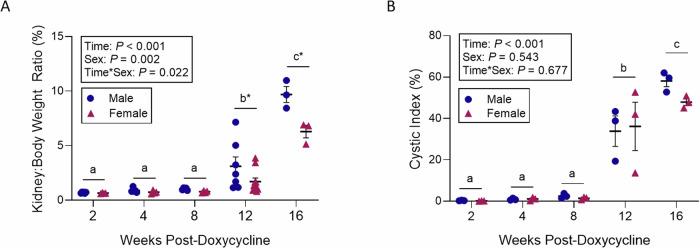
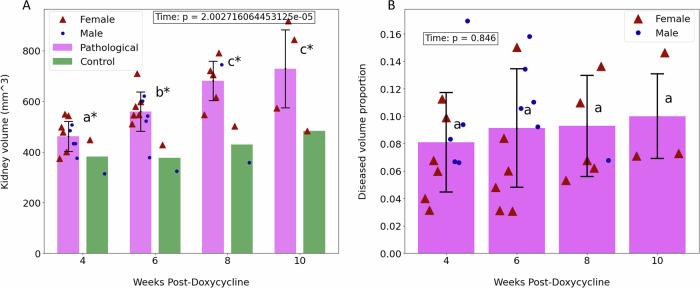
Autosomal Dominant Polycystic Kidney Disease (ADPKD) is the most prevalent kidney genetic disorder, producing structural abnormalities and impaired function. This research investigates its evolution on mouse models, utilizing a combination of histology imaging, Computed Tomography (CT) and Magnetic Resonance Imaging (MRI) to evaluate its progression thoroughly. ADPKD has been induced in mice via PKD2 gene knockout, followed by image acquisition at different stages. Histology data provides two-dimensional details, like the cystic area ratio, whereas CT and MRI facilitate three-dimensional temporal monitoring. Our approach allows to quantify the affected tissue at different disease stages through multiple quantitative metrics. A pivotal point is shown at approximately ten weeks after induction, marked by a swift acceleration in disease advancement, and leading to a notable increase in cyst formation. This multimodal strategy augments our comprehension of ADPKD dynamics and suggests the possibility of employing higher-resolution imaging in the future for more accurate volumetric analyses.
常染色体显性多囊肾病 (ADPKD) 是最常见的肾脏遗传疾病,会导致结构异常和功能受损。本研究利用组织学成像、计算机断层扫描 (CT) 和磁共振成像 (MRI) 的组合,对其在小鼠模型中的演变进行了全面评估。通过 PKD2 基因敲除在小鼠中诱导 ADPKD,然后在不同阶段采集图像。组织学数据提供二维详细信息,如囊性区域比,而 CT 和 MRI 则有助于进行三维时间监测。我们的方法通过多个定量指标来量化不同疾病阶段的受影响组织。在诱导后大约十周时出现一个关键点,标志着疾病进展迅速加速,并导致囊肿形成显著增加。这种多模态策略增强了我们对 ADPKD 动态的理解,并表明未来可能需要使用更高分辨率的成像来进行更准确的体积分析。




 Zotero 插件