
具有FeC修饰的Fe-N共掺杂碳纳米纤维用于水活化诱导的氧还原反应。
Fe-N co-doped carbon nanofibers with FeC decoration for water activation induced oxygen reduction reaction.
作者信息
Li Shaoxiong, Xing Gengyu, Zhao Sheng, Peng Jian, Zhao Lingfei, Hu Feng, Li Linlin, Wang Jiazhao, Ramakrishna Seeram, Peng Shengjie
机构信息
College of Materials Science and Technology, Nanjing University of Aeronautics and Astronautics, Nanjing 210016, China.
Institute for Superconducting and Electronic Materials Australian Institute for Innovative Materials, University of Wollongong Innovation Campus, North Wollongong, NSW 2522, Australia.
出版信息
Natl Sci Rev. 2024 Jun 4;11(10):nwae193. doi: 10.1093/nsr/nwae193. eCollection 2024 Oct.
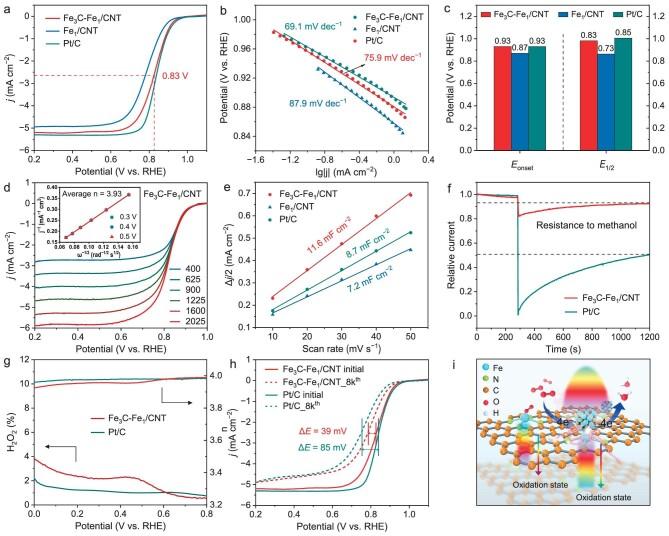
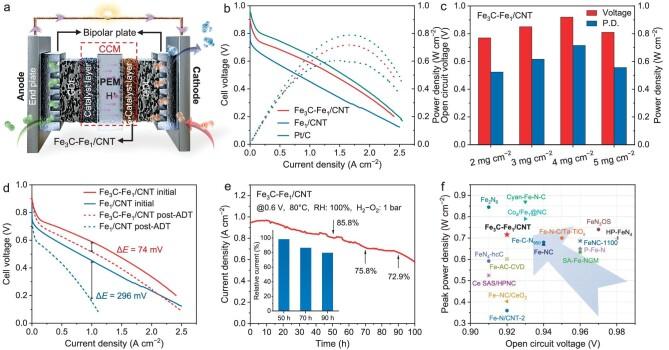
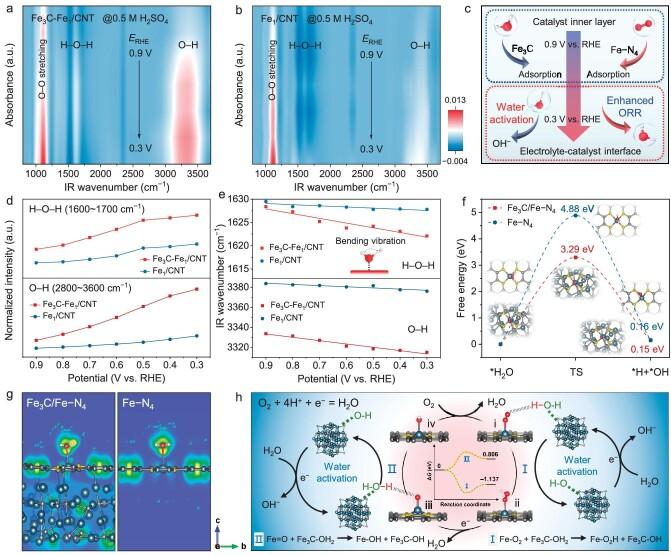
Proton activity at the electrified interface is central to the kinetics of proton-coupled electron transfer (PCET) reactions in electrocatalytic oxygen reduction reaction (ORR). Here, we construct an efficient FeC water activation site in Fe-N co-doped carbon nanofibers (FeC-Fe/CNT) using an electrospinning-pyrolysis-etching strategy to improve interfacial hydrogen bonding interactions with oxygen intermediates during ORR. Fourier transform infrared spectroscopy and density functional theory studies identified delocalized electrons as key to water activation kinetics. Specifically, the strong electronic perturbation of the Fe-N sites by FeC disrupts the symmetric electron density distribution, allowing more free electrons to activate the dissociation of interfacial water, thereby promoting hydrogen bond formation. This process ultimately controls the PCET kinetics for enhanced ORR. The FeC-Fe/CNT catalyst demonstrates a half-wave potential of 0.83 V in acidic media and 0.91 V in alkaline media, along with strong performance in H-O fuel cells and Al-air batteries.
在电催化氧还原反应(ORR)中,带电界面处的质子活性对于质子耦合电子转移(PCET)反应的动力学至关重要。在此,我们采用静电纺丝-热解-蚀刻策略,在铁氮共掺杂碳纳米纤维(FeC-Fe/CNT)中构建了一个高效的FeC水活化位点,以改善ORR过程中与氧中间体的界面氢键相互作用。傅里叶变换红外光谱和密度泛函理论研究确定离域电子是水活化动力学的关键。具体而言,FeC对Fe-N位点的强电子扰动破坏了对称的电子密度分布,使更多自由电子能够活化界面水的解离,从而促进氢键形成。这一过程最终控制PCET动力学以增强ORR。FeC-Fe/CNT催化剂在酸性介质中的半波电位为0.83 V,在碱性介质中为0.91 V,在氢氧燃料电池和铝空气电池中也具有优异的性能。


 Zotero 插件