
按地理位置、种族和社会经济地位划分的癌症康复及运动肿瘤学服务可及性
Proximity to cancer rehabilitation and exercise oncology by geography, race, and socioeconomic status.
作者信息
Schmitz Kathryn H, Demanelis Kathryn, Crisafio Mary E, Kennedy Mary A, Schwartz Anna L, Campbell Anna, Gorzelitz Jessica, Wood Kelley C, Wilson Christopher M, Scalise Raymond L, Vincent Alex
机构信息
Division of Hematology and Oncology, University of Pittsburgh, Pittsburgh, Pennsylvania, USA.
Department of Health and Exercise Science, Colorado State University, Fort Collins, Colorado, USA.
出版信息
Cancer. 2025 Jan 1;131(1):e35515. doi: 10.1002/cncr.35515. Epub 2024 Sep 22.
BACKGROUND
Cancer rehabilitation and exercise oncology (CR/EO) have documented benefits for people living with and beyond cancer. The authors examined proximity to CR/EO programs across the United States with respect to population density, race and ethnicity, socioeconomic status, and cancer incidence and mortality rates.
METHODS
This cross-sectional study was conducted in 2022-2023. Online searches were initiated to identify CR/EO programs. Geocoding was used to obtain latitudinal and longitudinal geospatial coordinates. Demographic data were abstracted from the 2020 5-year American Community Survey. Cancer incidence and mortality data were obtained from the Centers for Disease Control and Prevention. US 2013 Rural-Urban Continuum Code (RUCC) classification was used to define counties as either urban (RUCC 1-3) or rural (RUCC 4-9). Multivariable logistic regression was used to evaluate the association between being far from a program and census-tract level factors.
RESULTS
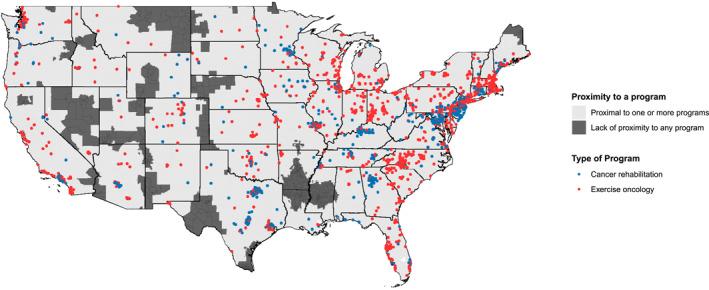
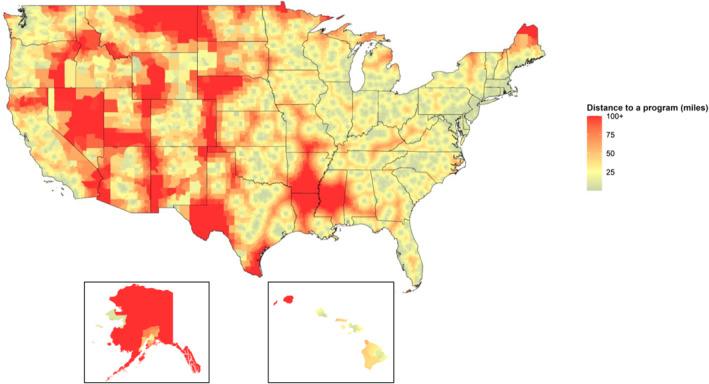
In total, 2133 CR/EO programs were identified nationwide. The distance from a program increased with decreasing population density: rural tracts were 17.68 ± 0.24 miles farther from a program compared with urban tracts (p < .001). Program proximity decreased as the neighborhood deprivation index increased (p < .001). Exercise oncology programs were less common than cancer rehabilitation programs in tracts with a larger proportion of minority residents (p < .001).
CONCLUSIONS
Prior research has documented that underrepresented populations have worse cancer-related symptoms and higher cancer mortality. Herein, the authors document their findings that these same populations are less likely to have proximity to CR/EO programs, which are associated with improved cancer-related symptoms and cancer mortality outcomes. To realize the positive outcomes from CR/EO programming, efforts must focus on supporting expanded programming and sustainable payment for these services.
背景
癌症康复与运动肿瘤学(CR/EO)已被证明对癌症患者及康复者有益。作者研究了美国各地CR/EO项目的分布情况与人口密度、种族和民族、社会经济地位以及癌症发病率和死亡率之间的关系。
方法
这项横断面研究于2022年至2023年进行。通过在线搜索来确定CR/EO项目。利用地理编码获取纬度和经度地理空间坐标。人口统计数据取自2020年美国社区5年调查。癌症发病率和死亡率数据来自疾病控制与预防中心。使用美国2013年城乡连续体代码(RUCC)分类将县定义为城市(RUCC 1 - 3)或农村(RUCC 4 - 9)。采用多变量逻辑回归来评估远离项目与人口普查区层面因素之间的关联。
结果
在全国范围内共确定了2133个CR/EO项目。与项目的距离随着人口密度的降低而增加:农村地区与城市地区相比,离项目的距离远出17.68±0.24英里(p <.001)。随着邻里贫困指数的增加,项目的可及性降低(p <.001)。在少数族裔居民比例较高的地区,运动肿瘤学项目比癌症康复项目更少见(p <.001)。
结论
先前的研究表明,代表性不足的人群有更严重的癌症相关症状和更高的癌症死亡率。在此,作者记录了他们的发现,即这些人群获得CR/EO项目的机会较小,而这些项目与改善癌症相关症状和癌症死亡率结果相关。为了实现CR/EO项目的积极成果,必须致力于支持扩大这些服务的项目范围并实现可持续支付。
 Zotero 插件