
重症监护病房治疗的脓毒症后的功能依赖:来自前瞻性中德脓毒症队列(MSC)的三年随访结果
Functional dependence following intensive care unit-treated sepsis: three-year follow-up results from the prospective Mid-German Sepsis Cohort (MSC).
作者信息
Fleischmann-Struzek Carolin, Born Sebastian, Kesselmeier Miriam, Ely E Wesley, Töpfer Kristin, Romeike Heike, Bauer Michael, Bercker Sven, Bodechtel Ulf, Fiedler Sandra, Groesdonk Heinrich V, Petros Sirak, Platzer Stefanie, Rüddel Hendrik, Schreiber Torsten, Reinhart Konrad, Scherag André
机构信息
Institute of Infectious Diseases and Infection Control, Jena University Hospital/Friedrich-Schiller-University Jena, Jena, Germany.
Integrated Research and Treatment Center, Centre for Sepsis Control and Care (CSCC), Jena University Hospital/Friedrich-Schiller-University Jena, Jena, Germany.
出版信息
Lancet Reg Health Eur. 2024 Sep 12;46:101066. doi: 10.1016/j.lanepe.2024.101066. eCollection 2024 Nov.
BACKGROUND
Surviving sepsis can lead to chronic physical, psychological and cognitive impairments, which affect millions of patients worldwide, including survivors after COVID-19 viral sepsis. We aimed to characterize the magnitude and trajectory of functional dependence and new impairments post-sepsis.
METHODS
We conducted a prospective cohort study including sepsis survivors who had been discharged from five German intensive care units (ICUs), until 36 months post-discharge. Primary outcome was functional dependence, defined as ≥1 impaired activity of daily living (ADL; 10-item ADL score <100), self-reported nursing care dependence or nursing care level. Secondary outcome was post-sepsis morbidity in the physical, psychological or cognitive domain. We used a multistate, competing risk model to address competing events in the course of dependence, and conducted multiple linear regression analyses to identify predictors associated with the ADL score.
FINDINGS
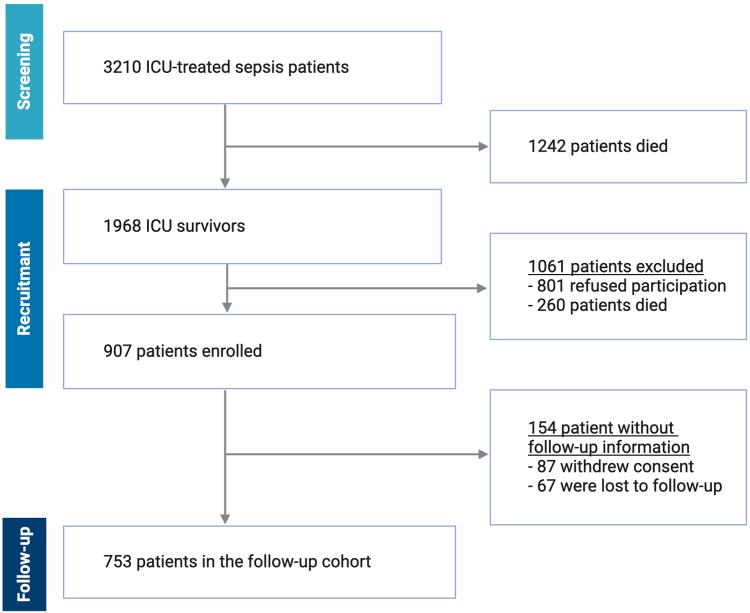
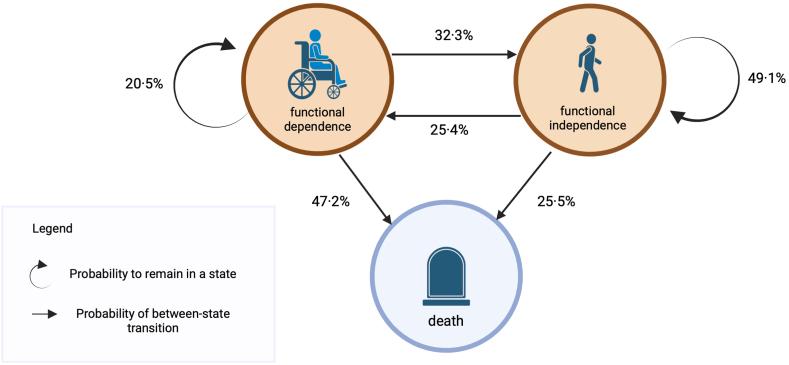
Of 3210 sepsis patients screened, 1968 survived the ICU treatment (61.3%). A total of 753 were included in the follow-up assessments of the Mid-German Sepsis cohort. Patients had a median age of 65 (Q1-Q3 56-74) years, 64.8% (488/753) were male and 76.1% (573/753) had a septic shock. Considering competing risk modelling, the probability of still being functional dependent was about 25%, while about 30% regained functional independence and 45% died within the three years post-sepsis. Patients reported a high burden of new and often overlapping impairments until three years post-sepsis. In the subgroup of three-year survivors (n = 330), new physical impairments affected 91.2% (n = 301) while new cognitive and psychological impairments were reported by 57.9% (n = 191) and 40.9% (n = 135), respectively. Patients with pre-existing functional limitations and higher age were at risk for low ADL scores three years after sepsis.
INTERPRETATION
Sepsis survivorship was associated with a broad range of new impairments and led to functional dependence in around one quarter of patients. Targeted measures are needed to mitigate the burden of this Post-Sepsis-Syndrome and increase the proportion of patients that achieve functional improvements.
FUNDING
This work was supported by the Integrated Research and Treatment Center, Center for Sepsis Control and Care (CSCC) at the Jena University Hospital funded by the German Ministry of Education and Research and by the Rudolf Presl GmbH & Co, Kreischa, Germany.
背景
脓毒症幸存者可能会出现慢性身体、心理和认知障碍,这影响着全球数百万患者,包括新冠病毒脓毒症后的幸存者。我们旨在描述脓毒症后功能依赖和新出现障碍的程度及发展轨迹。
方法
我们进行了一项前瞻性队列研究,纳入了从德国五个重症监护病房(ICU)出院的脓毒症幸存者,随访至出院后36个月。主要结局是功能依赖,定义为日常生活活动(ADL;10项ADL评分<100)至少一项受损、自我报告的护理依赖或护理级别。次要结局是脓毒症后身体、心理或认知领域的发病情况。我们使用多状态竞争风险模型来处理依赖过程中的竞争事件,并进行多元线性回归分析以确定与ADL评分相关的预测因素。
结果
在筛查的3210例脓毒症患者中,1968例在ICU治疗后存活(61.3%)。中德脓毒症队列的随访评估共纳入753例患者。患者的中位年龄为65岁(四分位间距56 - 74岁),64.8%(488/753)为男性,76.1%(573/753)发生脓毒性休克。考虑竞争风险模型,脓毒症后三年内仍存在功能依赖的概率约为25%,约30%恢复了功能独立,45%死亡。患者报告在脓毒症后三年一直承受着新出现且常常重叠的障碍带来的沉重负担。在三年幸存者亚组(n = 330)中,91.2%(n = 301)出现了新的身体障碍,57.9%(n = 191)和40.9%(n = 135)分别报告有新的认知和心理障碍。脓毒症前存在功能受限且年龄较大的患者在脓毒症三年后有ADL评分低的风险。
解读
脓毒症存活与多种新出现的障碍相关,并导致约四分之一的患者出现功能依赖。需要采取针对性措施来减轻这种脓毒症后综合征的负担,并提高实现功能改善的患者比例。
资助
这项工作得到了耶拿大学医院综合研究与治疗中心、脓毒症控制与护理中心(CSCC)的支持,该中心由德国教育和研究部以及德国克赖沙的鲁道夫·普雷斯尔有限公司资助。

 Zotero 插件