
在美国食品药品监督管理局不良事件报告系统数据库中报告的利伐沙班疑似药物不良反应:一项药物警戒研究。
Suspected adverse drug reactions of rivaroxaban reported in the United States food and drug administration adverse event reporting system database: a pharmacovigilance study.
作者信息
Wu Jingying, Wu Jianru, Tang Biyu, Wang Xinru, Wei Fenfang, Zhang Yi, Li Limin, Li Hongqiao, Wang Bei, Wu Wenyu, Hong Xiang
机构信息
Key Laboratory of Environmental Medicine Engineering, Ministry of Education, School of Public Health, Southeast University, Nanjing, China.
Shenzhen Institute of Pharmacovigilance and Risk Management, Shenzhen, China.
出版信息
Front Pharmacol. 2024 Sep 6;15:1399172. doi: 10.3389/fphar.2024.1399172. eCollection 2024.
PURPOSE
This study aimed to characterize the safety profiles of rivaroxaban-associated suspected adverse events by mining the Food and Drug Administration Adverse Event Reporting System (FAERS).
METHODS
A disproportionality analysis of spontaneously reported suspected adverse drug reactions (ADRs) was conducted. The reports in FAERS from 2014 to 2024 were compiled. Frequentist and Bayesian statistics were both applied to calculate drug-AE combinations in system organ classes and preferred-term levels. Reporting odds ratio (ROR), proportional reporting ratio (PRR), the Medicines and Healthcare products Regulatory Agency (MHRA), Bayesian confidence propagation neural network (BCPNN), and multi-item gamma Poisson shrinker (MGPS) methods were analyzed and used to compare the suspected AEs.
RESULTS
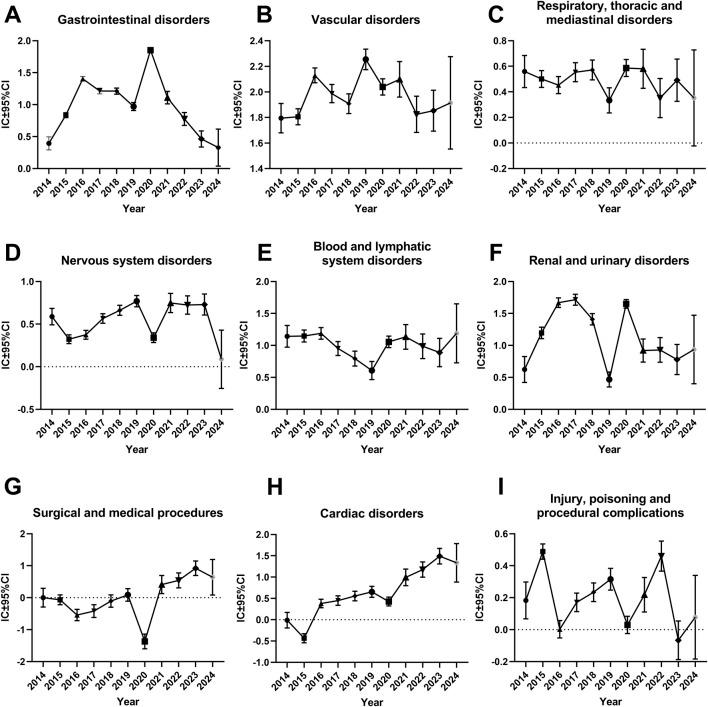
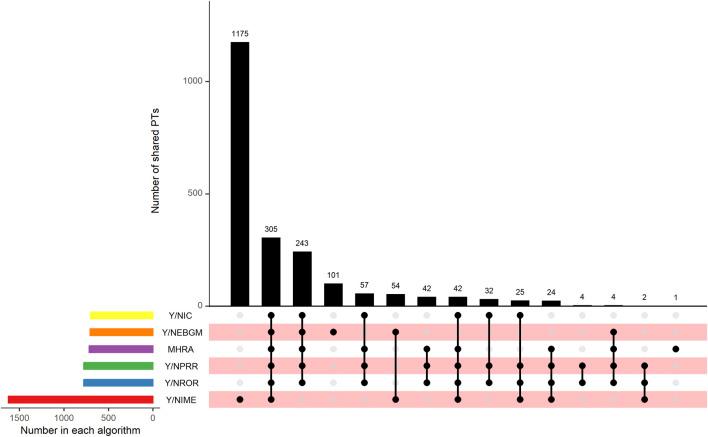
Of 77,384 ADR reports, 66,705 (86.20%) were serious rivaroxaban AE reports. The most common age group was above 65 years. The suspected adverse effects of rivaroxaban emerging for system organ classes (SOCs) primarily included "Gastrointestinal disorders"; "Injury, poisoning, and procedural complications", "Nervous system disorders" and "Vascular disorders". Ranked by EBGM, the top signal strength of suspected AE signals of rivaroxaban under ROR algorithm at the preferred-term (PT) level were "Haemorrhagic arteriovenous malformation" ( = 571, ROR = 756.520, PRR = 754.029, Information Component (IC) = 7.197, Empirical Bayesian Geometric Mean (EBGM) = 146.725), "Gastrointestinal vascular malformation haemorrhagic" ( = 197, ROR = 211.138, PRR = 210.950, IC = 6.614, EBGM = 97.923), and "Diverticulum intestinal haemorrhagic" ( = 722, ROR = 169.898, PRR = 169.210, IC = 6.458, EBGM = 97.920). Moreover, uncommon but significantly suspected AE signals, such as "Coagulation factor X level increased", "Basal ganglia haematoma", and "Proctitis haemorrhagic" were observed. Notably, "Gastrointestinal haemorrhage" ( = 13,436, ROR = 80.477, PRR = 74.460, IC = 5.729, EBGM = 53.042), "Upper gastrointestinal haemorrhage"( = 2,872, ROR = 73.978, PRR = 72.797, IC = 5.706, EBGM = 52.198) and "Internal haemorrhage" ( = 2,368, ROR = 91.979, PRR = 80.899, IC = 5.813, EBGM = 56.212) exhibited relatively high occurrence rates and signal strengths. From 2014 to 2024, the IC values of rivaroxaban-associated suspected AEs for "Surgical and medical procedures" and "Cardiac disorders" showed an annual increasing trend in the time-span analysis. Based on the various visulization plots, a key discovery is that "Gastrointestinal hemorrhage" emerged as the most significant suspected AE across five algorithms. The exciting finding was that the MGPS algorithm revealed a higher risk of suspected AEs under the "Investigations" category. However, the results of the analyses of the other algorithms at the SOC level were not akin to this. Moreover, the results of signal mining for the three main types of indication populations with adverse drug reactions (ADRs), including Atrial fibrillation, Cerebrovascular accident prophylaxis, and Deep vein thrombosis were shown that "Gastrointestinal haemorrhage", "Epistaxis", "Haematuria", "Rectal haemorrhage", and "Upper gastrointestinal haemorrhage" were detected as the most common and significant signals of suspected adverse events.
CONCLUSION
Rivaroxaban has risks of various suspected adverse reactions while providing therapeutic effects and being used widely. Our pharmacovigilance study may provide valuable hints that practitioners should closely monitor occurrences of "Gastrointestinal disorders", "Injury, poisoning, and procedural complications" and "Nervous system disorders", and other events in clinical applications. Consequently, it remains to persist in monitoring rivaroxaban, assessing the associated risks in the future.
目的
本研究旨在通过挖掘美国食品药品监督管理局不良事件报告系统(FAERS)来描述利伐沙班相关疑似不良事件的安全性概况。
方法
对自发报告的疑似药物不良反应(ADR)进行不成比例分析。汇总了2014年至2024年FAERS中的报告。应用频率统计和贝叶斯统计来计算系统器官分类和首选术语水平上的药物-不良事件组合。分析并使用报告比值比(ROR)、比例报告比值(PRR)、英国药品和健康产品管理局(MHRA)、贝叶斯置信传播神经网络(BCPNN)和多项目伽马泊松收缩器(MGPS)方法来比较疑似不良事件。
结果
在77384份ADR报告中,66705份(86.20%)是利伐沙班严重不良事件报告。最常见的年龄组是65岁以上。利伐沙班在系统器官分类(SOCs)中出现的疑似不良反应主要包括“胃肠道疾病”;“损伤、中毒和操作并发症”、“神经系统疾病”和“血管疾病”。按经验贝叶斯几何均值(EBGM)排名,利伐沙班在首选术语(PT)水平下ROR算法的疑似不良事件信号强度排名靠前的是“出血性动静脉畸形”( = 571,ROR = 756.520,PRR = 754.029,信息成分(IC) = 7.197,EBGM = 146.725)、“胃肠道血管畸形出血”( = 197,ROR = 211.138,PRR = 210.950,IC = 6.614,EBGM = 97.923)和“肠憩室出血”( = 722,ROR = 169.898,PRR = 169.210,IC = 6.458,EBGM = 97.920)。此外,还观察到一些不常见但疑似程度较高的不良事件信号,如“凝血因子X水平升高”、“基底节血肿”和“出血性直肠炎”。值得注意的是,“胃肠道出血”( = 13436,ROR = 80.477,PRR = 74.460,IC = 5.729,EBGM = 53.042)、“上消化道出血”( = 2872,ROR = 73.978,PRR = 72.797,IC = 5.706,EBGM = 52.198)和“内出血”( = 2368,ROR = 91.979,PRR = 80.899,IC = 5.813,EBGM = 56.212)的发生率和信号强度相对较高。在2014年至2024年的时间跨度分析中,利伐沙班相关疑似不良事件在“外科和医疗程序”以及“心脏疾病”方面的IC值呈逐年上升趋势。基于各种可视化图表,一个关键发现是“胃肠道出血”在五种算法中均为最显著的疑似不良事件。令人兴奋的发现是,MGPS算法显示在“检查”类别下疑似不良事件的风险更高。然而,在SOC水平上其他算法的分析结果并非如此。此外,对药物不良反应(ADR)的三种主要适应证人群(包括心房颤动、预防脑血管意外和深静脉血栓形成)的信号挖掘结果表明,“胃肠道出血”、“鼻出血”、“血尿”、“直肠出血”和“上消化道出血”被检测为最常见和显著的疑似不良事件信号。
结论
利伐沙班在提供治疗效果并被广泛使用的同时存在各种疑似不良反应的风险。我们的药物警戒研究可能提供有价值的提示,临床医生在临床应用中应密切监测“胃肠道疾病”、“损伤、中毒和操作并发症”以及“神经系统疾病”等事件的发生情况。因此,仍需持续监测利伐沙班,评估其未来相关风险。




 Zotero 插件