
增强癌症免疫疗法:纳米技术介导的免疫疗法克服免疫抑制。
Enhancing cancer immunotherapy: Nanotechnology-mediated immunotherapy overcoming immunosuppression.
作者信息
Chen Yunna, Zhou Qianqian, Jia Zongfang, Cheng Nuo, Zhang Sheng, Chen Weidong, Wang Lei
机构信息
Key Laboratory of Molecular Biology (Brain diseases), Anhui University of Chinese Medicine, Hefei 230012, China.
MOE-Anhui Joint Collaborative Innovation Center for Quality Improvement of Anhui Genuine Chinese Medicinal Materials, Hefei 230012, China.
出版信息
Acta Pharm Sin B. 2024 Sep;14(9):3834-3854. doi: 10.1016/j.apsb.2024.05.032. Epub 2024 Jun 3.
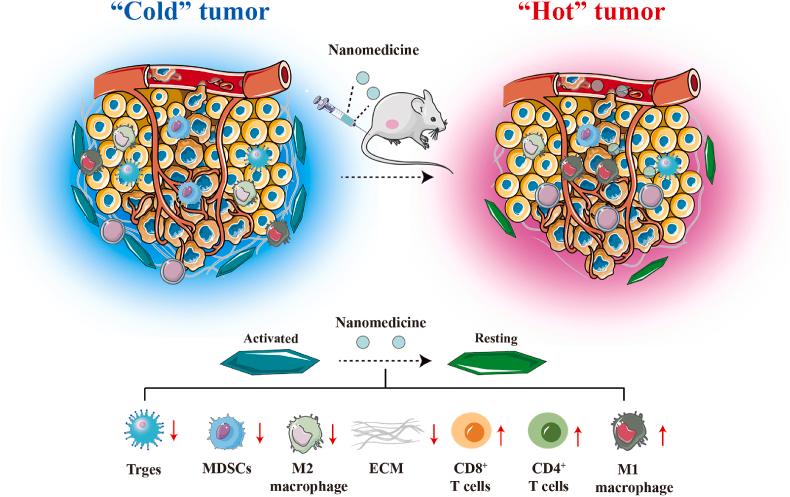
Immunotherapy is an important cancer treatment method that offers hope for curing cancer patients. While immunotherapy has achieved initial success, a major obstacle to its widespread adoption is the inability to benefit the majority of patients. The success or failure of immunotherapy is closely linked to the tumor's immune microenvironment. Recently, there has been significant attention on strategies to regulate the tumor immune microenvironment in order to stimulate anti-tumor immune responses in cancer immunotherapy. The distinctive physical properties and design flexibility of nanomedicines have been extensively utilized to target immune cells (including tumor-associated macrophages (TAMs), T cells, myeloid-derived suppressor cells (MDSCs), and tumor-associated fibroblasts (TAFs)), offering promising advancements in cancer immunotherapy. In this article, we have reviewed treatment strategies aimed at targeting various immune cells to regulate the tumor immune microenvironment. The focus is on cancer immunotherapy models that are based on nanomedicines, with the goal of inducing or enhancing anti-tumor immune responses to improve immunotherapy. It is worth noting that combining cancer immunotherapy with other treatments, such as chemotherapy, radiotherapy, and photodynamic therapy, can maximize the therapeutic effects. Finally, we have identified the challenges that nanotechnology-mediated immunotherapy needs to overcome in order to design more effective nanosystems.
免疫疗法是一种重要的癌症治疗方法,为治愈癌症患者带来了希望。虽然免疫疗法已取得初步成功,但其广泛应用的一个主要障碍是无法使大多数患者受益。免疫疗法的成败与肿瘤的免疫微环境密切相关。最近,为了在癌症免疫疗法中刺激抗肿瘤免疫反应,调节肿瘤免疫微环境的策略受到了广泛关注。纳米药物独特的物理性质和设计灵活性已被广泛用于靶向免疫细胞(包括肿瘤相关巨噬细胞(TAM)、T细胞、髓源性抑制细胞(MDSC)和肿瘤相关成纤维细胞(TAF)),为癌症免疫疗法带来了有前景的进展。在本文中,我们综述了旨在靶向各种免疫细胞以调节肿瘤免疫微环境的治疗策略。重点是基于纳米药物的癌症免疫疗法模型,目的是诱导或增强抗肿瘤免疫反应以改善免疫疗法。值得注意的是,将癌症免疫疗法与其他治疗方法,如化疗、放疗和光动力疗法相结合,可以使治疗效果最大化。最后,我们确定了纳米技术介导的免疫疗法为设计更有效的纳米系统需要克服的挑战。





 Zotero 插件