
禽传染性支气管炎病毒更具侵袭性的GVI-1基因型毒株HX的分离
Isolation of a more aggressive GVI-1 genotype strain HX of the avian infectious bronchitis virus.
作者信息
Yang Fan, Zhou Jun, Huang Hongbin, Cai Shikai, Zhang Yun, Wen Feng, Zhao Mengmeng, Zhang Keshan, Qin Limei
机构信息
School of Animal Science and Technology, Foshan University, Foshan 528231, China.
School of Life Sciences, Sun Yat-sen University, Guangzhou 510000, China.
出版信息
Poult Sci. 2024 Dec;103(12):104285. doi: 10.1016/j.psj.2024.104285. Epub 2024 Sep 1.
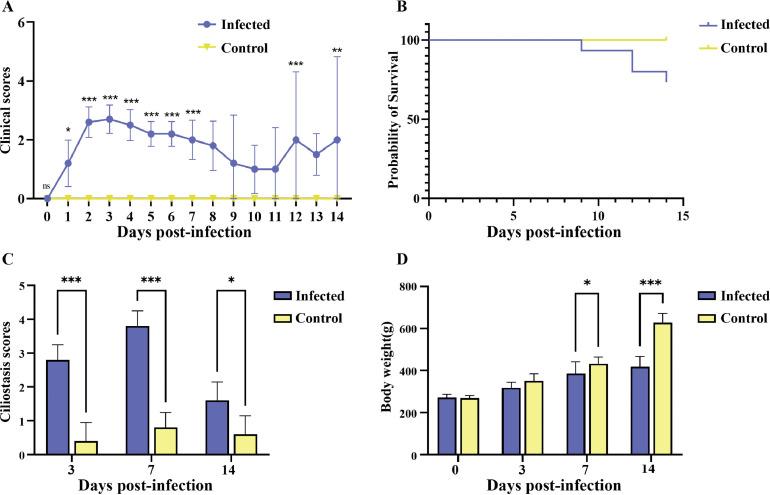
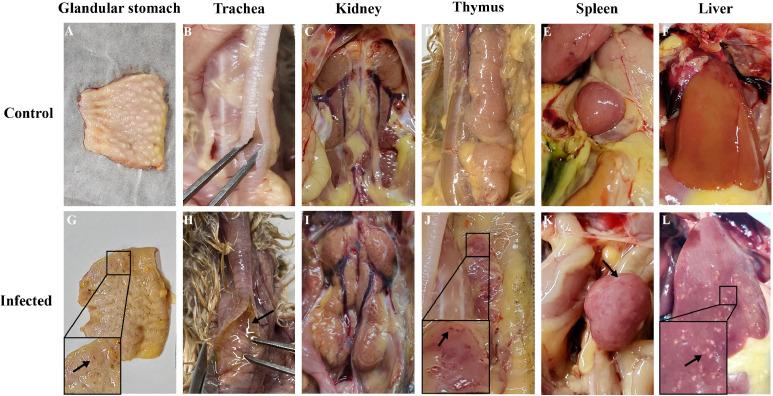
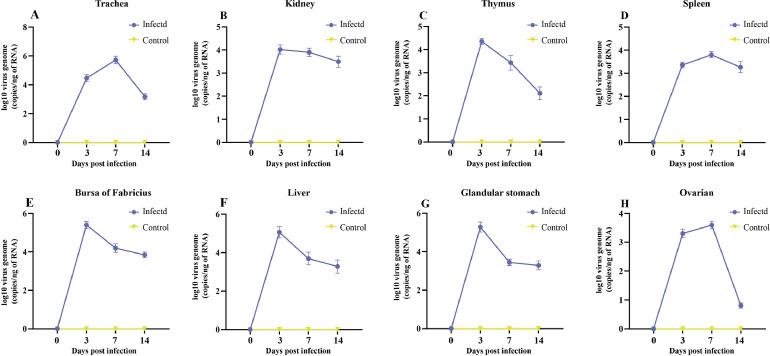
The avian infectious bronchitis virus (IBV) poses a significant economic threat to the global poultry industry. Although in recent years, the GVI-1 lineage of IBV has proliferated throughout China, there is still a lack of comprehensive studies regarding the pathogenicity of this lineage, particularly with respect to infections of the digestive tract and the antigenic characteristics of the S1 gene. In this study, we investigated the effects of infecting 14-day-old chicks with the HX strain of the GVI-1 lineage over a 14-d period postinfection. Assessment of the pathogenicity of the HX strain included clinical observations; monitoring of body weight, organ viral load, viral shedding, and gross anatomy; histopathological analysis, and bioinformatics-based antigenic characterization of the S1 protein. The findings revealed that compared with previously reported GVI-1 lineage strains, the HX strain is characterized by greater virulence, with infection leading to approximately 26% mortality and extensive severe organ damage, including that of the proventriculus and kidneys. Moreover, at 14 d postinfection, 80% of oral swabs and 100% of cloacal swabs from chickens infected with the HX strain tested positive, indicating a prolonged period of viral shedding relative to that previously reported for GVI-1 lineage strains. Bioinformatic analysis of B-cell epitopes on the S1 protein revealed 7 potential antigenic epitopes. Collectively, our findings in this study provide clear evidence to indicate that compared previously reported GVI-1 lineage strains, chicks infected with the IBV GVI-1 lineage strain HX are characterized by heightened rates of mortality, more pronounced organ damage, and an extended period of viral shedding. This comprehensive characterization highlights the pathogenic potential of the GVI-1 lineage and its capacity to induce severe kidney and proventriculus damage, thereby emphasizing the imperative of early initiated preventive measures. Furthermore, on the basis of our analysis of the antigenic properties of the S1 protein, we have identified 7 potential linear B-cell epitopes, which will provide valuable insights for the development of epitope-based vaccines.
禽传染性支气管炎病毒(IBV)对全球家禽业构成重大经济威胁。尽管近年来,IBV的GVI-1谱系在中国广泛传播,但关于该谱系的致病性,特别是消化道感染和S1基因的抗原特性,仍缺乏全面研究。在本研究中,我们调查了用GVI-1谱系的HX株感染14日龄雏鸡后14天内的影响。对HX株致病性的评估包括临床观察;体重、器官病毒载量、病毒排泄和大体解剖的监测;组织病理学分析,以及基于生物信息学的S1蛋白抗原特性分析。研究结果显示,与先前报道的GVI-1谱系毒株相比,HX株的特点是毒力更强,感染导致约26%的死亡率和广泛的严重器官损伤,包括腺胃和肾脏。此外,在感染后14天,感染HX株的鸡的口腔拭子80%和泄殖腔拭子100%检测呈阳性,表明病毒排泄期比先前报道的GVI-1谱系毒株更长。对S1蛋白上B细胞表位的生物信息学分析揭示了7个潜在的抗原表位。总体而言,我们在本研究中的发现提供了明确证据,表明与先前报道的GVI-1谱系毒株相比,感染IBV GVI-1谱系毒株HX的雏鸡死亡率更高、器官损伤更明显、病毒排泄期更长。这种全面的特征突出了GVI-1谱系的致病潜力及其诱导严重肾脏和腺胃损伤的能力,从而强调了早期采取预防措施的必要性。此外,基于我们对S1蛋白抗原特性的分析,我们确定了7个潜在的线性B细胞表位,这将为基于表位的疫苗开发提供有价值的见解。




 Zotero 插件