
竹叶提取物中七种黄酮类化合物的测定及抗氧化分析
[Determination and antioxidant analysis of seven flavonoids in bamboo-leaf extracts].
作者信息
Gu Li-Ling, Yao Xi, An Rong-Miao, Guo Xue-Feng
机构信息
International Centre for Bamboo and Rattan, Key Laboratory of National Forestry and Grassland Administration/Beijing for Bamboo and Rattan Science and Technology, Beijing 100102, China.
出版信息
Se Pu. 2024 Oct;42(10):972-978. doi: 10.3724/SP.J.1123.2024.01008.
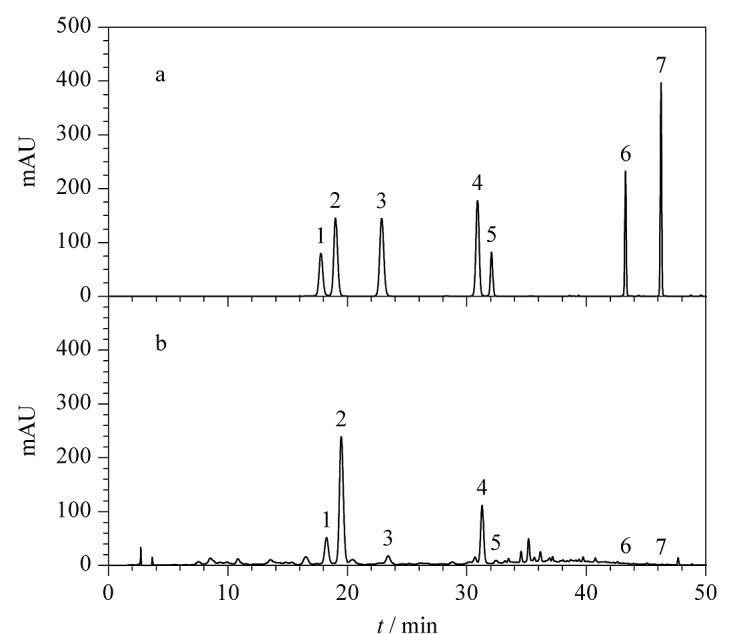
The flavonoid contents of different bamboo-leaf extracts and their relationships to antioxidant activity were investigated in this study by preparing nine samples using two commercially available bamboo-leaf extract products and seven bamboo-leaf extracts such as . A high performance liquid chromatography (HPLC) method was established to determine seven flavonoid components (orientin, isoorientin, vitexin, isovitexin, tricin, luteolin and luteoloside) in these samples, which were separated using a SymmetryShield RP8 column (250 mm×4.6 mm, 5 μm) under gradient-elution conditions using acetonitrile as mobile phase A and 0.5% (v/v) acetic acid aqueous solution as mobile phase B. The antioxidant activities of the samples were evaluated using the 1,1-diphenyl-2-picrylhydrazyl (DPPH) and hydroxyl radical-scavenging assays, with half inhibitory concentration (IC) as an indicator and the butylated hydroxytoluene (BHT) and -butylhydroquinone (TBHQ) antioxidants as positive controls. Pearson correlation was then used to analyze the relationship between flavonoid content and antioxidant activity. The HPLC method was found to be accurate and reliable for determining the flavonoid contents of the bamboo-leaf extracts. The seven flavonoids were well separated, and good linear relationships were exhibited (correlation coefficients ()≥0.9990). Furthermore, the contents of the seven flavonoids in the bamboo-leaf extracts ranged from 14.97 to 183.94 mg/g, with the highest content of 183.94 mg/g recorded for . The bamboo species exhibited significantly different flavonoid contents, with showing the highest orientin, isoorientin, and vitexin levels of 38.45, 101.30, and 9.42 mg/g, respectively. Moreover, the bamboo-leaf extracts exhibited IC values of 78.23-179.41 mg/L for DPPH-radical-scavenging, while values of 203.48-1250.81 mg/L were recorded for hydroxyl radicals. The leaf extract exhibited the strongest antioxidant activity, with the lowest IC values of 78.23 and 203.48 mg/L for DPPH and hydroxyl, respectively; it showed greatly significant for the further development and application of . Finally, the relationships between flavonoid content and the DPPH- and hydroxyl-radical-scavenging activities (based on the IC values) were correlated, which revealed that the orientin and isoorientin contents are closely related to the antioxidant activities of the bamboo-leaf extracts. Consequently, the orientin and isoorientin contents can be used as indicators for evaluating the antioxidant activities of bamboo-leaf extracts.
本研究通过使用两种市售竹叶提取物产品和七种竹叶提取物制备九个样品,研究了不同竹叶提取物中的黄酮类化合物含量及其与抗氧化活性的关系。建立了高效液相色谱(HPLC)法测定这些样品中的七种黄酮类成分(荭草苷、异荭草苷、牡荆苷、异牡荆苷、小麦黄素、木犀草素和木犀草苷),使用SymmetryShield RP8柱(250 mm×4.6 mm,5μm)在梯度洗脱条件下进行分离,以乙腈为流动相A,0.5%(v/v)乙酸水溶液为流动相B。使用1,1-二苯基-2-苦基肼(DPPH)和羟基自由基清除试验评估样品的抗氧化活性,以半数抑制浓度(IC)为指标,以丁基羟基甲苯(BHT)和叔丁基对苯二酚(TBHQ)抗氧化剂作为阳性对照。然后使用Pearson相关性分析黄酮类化合物含量与抗氧化活性之间的关系。结果发现,HPLC法测定竹叶提取物中黄酮类化合物含量准确可靠。七种黄酮类化合物分离良好,呈现出良好的线性关系(相关系数()≥0.9990)。此外,竹叶提取物中七种黄酮类化合物的含量范围为14.97至183.94 mg/g,其中含量最高为183.94 mg/g。不同竹种的黄酮类化合物含量存在显著差异,[具体竹种]的荭草苷、异荭草苷和牡荆苷含量最高,分别为38.45、101.30和9.42 mg/g。此外,竹叶提取物对DPPH自由基清除的IC值为78.23 - 179.41 mg/L,对羟基自由基清除的IC值为203.48 - 1250.81 mg/L。[具体竹种]叶提取物表现出最强的抗氧化活性,DPPH和羟基的IC值分别为78.23和203.48 mg/L,最低;这对[具体竹种]的进一步开发和应用具有重要意义。最后,对黄酮类化合物含量与DPPH和羟基自由基清除活性(基于IC值)之间的关系进行了相关性分析,结果表明荭草苷和异荭草苷含量与竹叶提取物的抗氧化活性密切相关。因此,荭草苷和异荭草苷含量可作为评估竹叶提取物抗氧化活性的指标。
 Zotero 插件