
用于预测甲状腺乳头状癌患者颈部淋巴结转移的增强风险分层列线图。
A nomogram for enhanced risk stratification for predicting cervical lymph node metastasis in papillary thyroid carcinoma patients.
作者信息
Deng Lingxin, Muhanhali Dilidaer, Ai Zhilong, Zhang Min, Ling Yan
机构信息
Department of Endocrinology and Metabolism, Zhongshan Hospital, Fudan University, No.180 Fenglin Road, Shanghai, 200032, China.
Department of General Surgery, Zhongshan Hospital, Fudan University, Shanghai, 200032, China.
出版信息
Discov Oncol. 2024 Sep 27;15(1):476. doi: 10.1007/s12672-024-01370-w.
BACKGROUND
Cervical lymph node metastasis (CLNM) significantly impacts the prognosis of papillary thyroid carcinoma (PTC) patients. Accurate CLNM prediction is crucial for surgical planning and patient outcomes. This study aimed to develop and validate a nomogram-based risk stratification system to predict CLNM in PTC patients.
METHODS
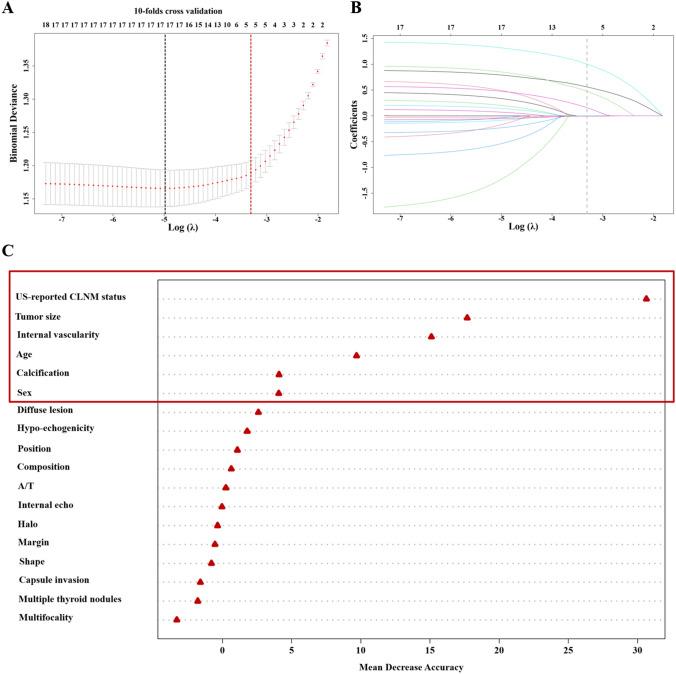
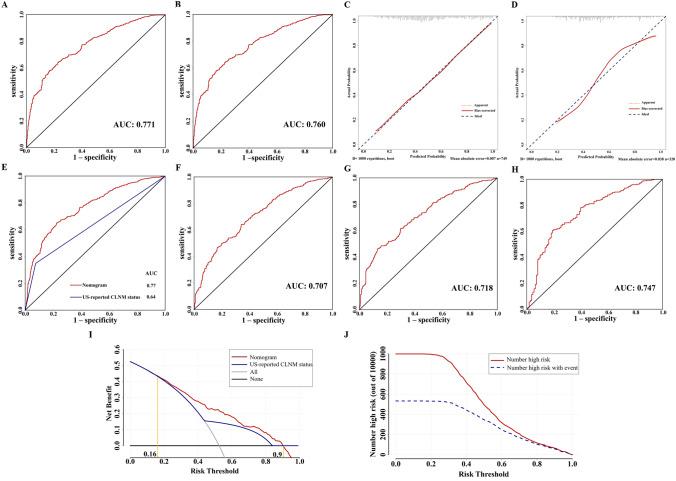
This retrospective study included 1069 patients from Zhongshan Hospital and 253 from the Qingpu Branch of Zhongshan Hospital. Preoperative ultrasound (US) data and various nodule characteristics were documented. Patients underwent lobectomy with central lymph node dissection and lateral dissection if suspicious. Multivariate logistic regression, least absolute shrinkage and selection operator (LASSO) regression, and the random forest algorithm were used to identify CLNM risk factors. A nomogram was constructed and validated internally and externally. Model performance was assessed via receiver operating characteristic (ROC) curves, calibration plots, DeLong's test, decision curve analysis (DCA), and the clinical impact curve (CIC).
RESULTS
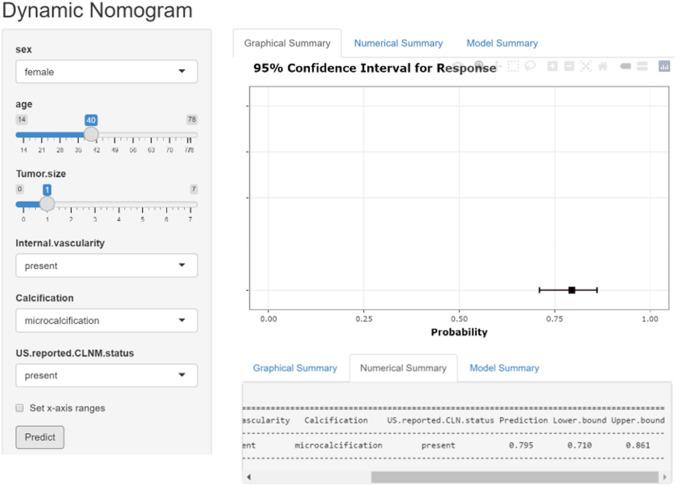
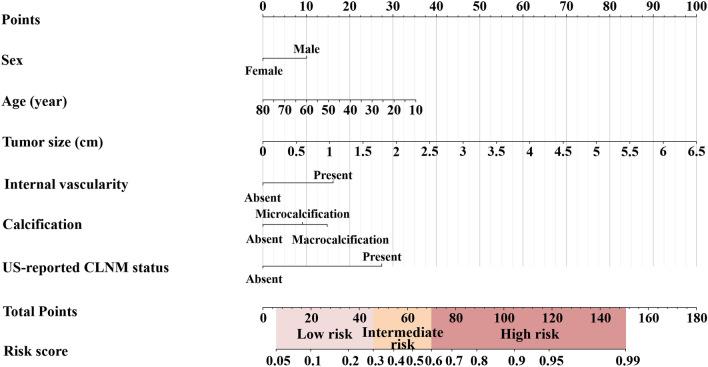
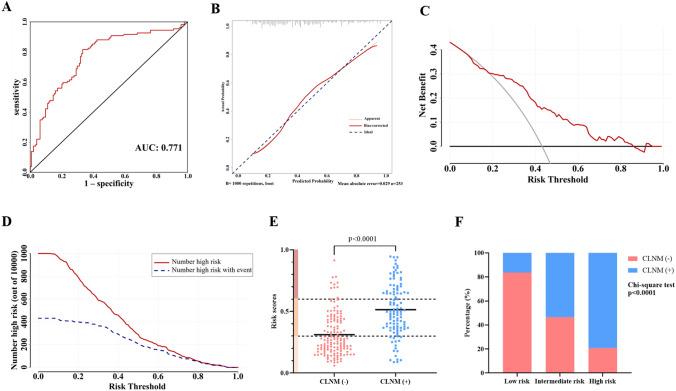
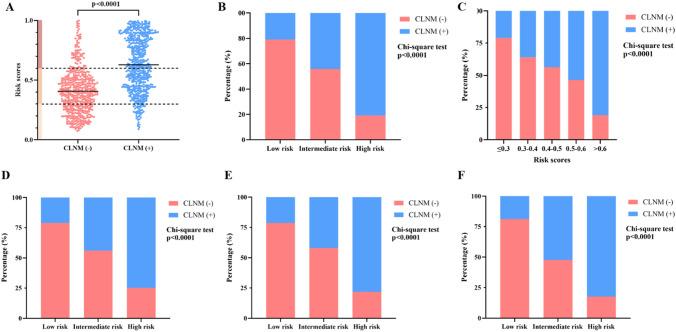
Six independent CLNM risk factors were identified: age, sex, tumor size, calcification, internal vascularity, and US-reported CLNM status. The model's area under the curve (AUC) was 0.77 for both the training and the external validation sets. Calibration plots and Hosmer‒Lemeshow (HL) tests showed good calibration. The optimal cutoff value was 0.57, with a sensitivity of 58.02% and a specificity of 83.43%. Risk stratification on the basis of the nomogram categorized patients into low-, intermediate-, and high-risk groups, effectively differentiating the likelihood of CLNM, and an online calculator was created for clinical use.
CONCLUSION
The nomogram accurately predicts CLNM risk in PTC patients, aiding personalized surgical decisions and improving patient management.
背景
颈部淋巴结转移(CLNM)对甲状腺乳头状癌(PTC)患者的预后有显著影响。准确预测CLNM对于手术规划和患者预后至关重要。本研究旨在开发并验证一种基于列线图的风险分层系统,以预测PTC患者的CLNM。
方法
这项回顾性研究纳入了中山医院的1069例患者以及中山医院青浦分院的253例患者。记录术前超声(US)数据和各种结节特征。患者接受了叶切除术及中央淋巴结清扫术,若有可疑情况则进行侧方清扫术。采用多因素逻辑回归、最小绝对收缩和选择算子(LASSO)回归以及随机森林算法来识别CLNM的危险因素。构建了列线图并在内部和外部进行验证。通过受试者操作特征(ROC)曲线、校准图、德龙检验、决策曲线分析(DCA)和临床影响曲线(CIC)评估模型性能。
结果
确定了六个独立的CLNM危险因素:年龄、性别、肿瘤大小、钙化、内部血管情况以及超声报告的CLNM状态。训练集和外部验证集的模型曲线下面积(AUC)均为0.77。校准图和霍斯默-莱梅肖(HL)检验显示校准良好。最佳截断值为0.57,灵敏度为58.02%,特异度为83.43%。基于列线图的风险分层将患者分为低、中、高风险组,有效区分了CLNM的可能性,并创建了一个在线计算器供临床使用。
结论
该列线图准确预测了PTC患者的CLNM风险,有助于做出个性化的手术决策并改善患者管理。
 Zotero 插件