
2 型糖尿病与椎管狭窄症之间的因果关系:一项孟德尔随机化分析。
The causal association between type 2 diabetes and spinal stenosis: A Mendelian randomization analysis.
机构信息
School of Medicine, Xi'an Jiaotong University, Xi'an, China.
Department of Urology, The First Affiliated Hospital of Xi'an Jiaotong University, Xi'an, China.
出版信息
Medicine (Baltimore). 2024 Sep 27;103(39):e39894. doi: 10.1097/MD.0000000000039894.
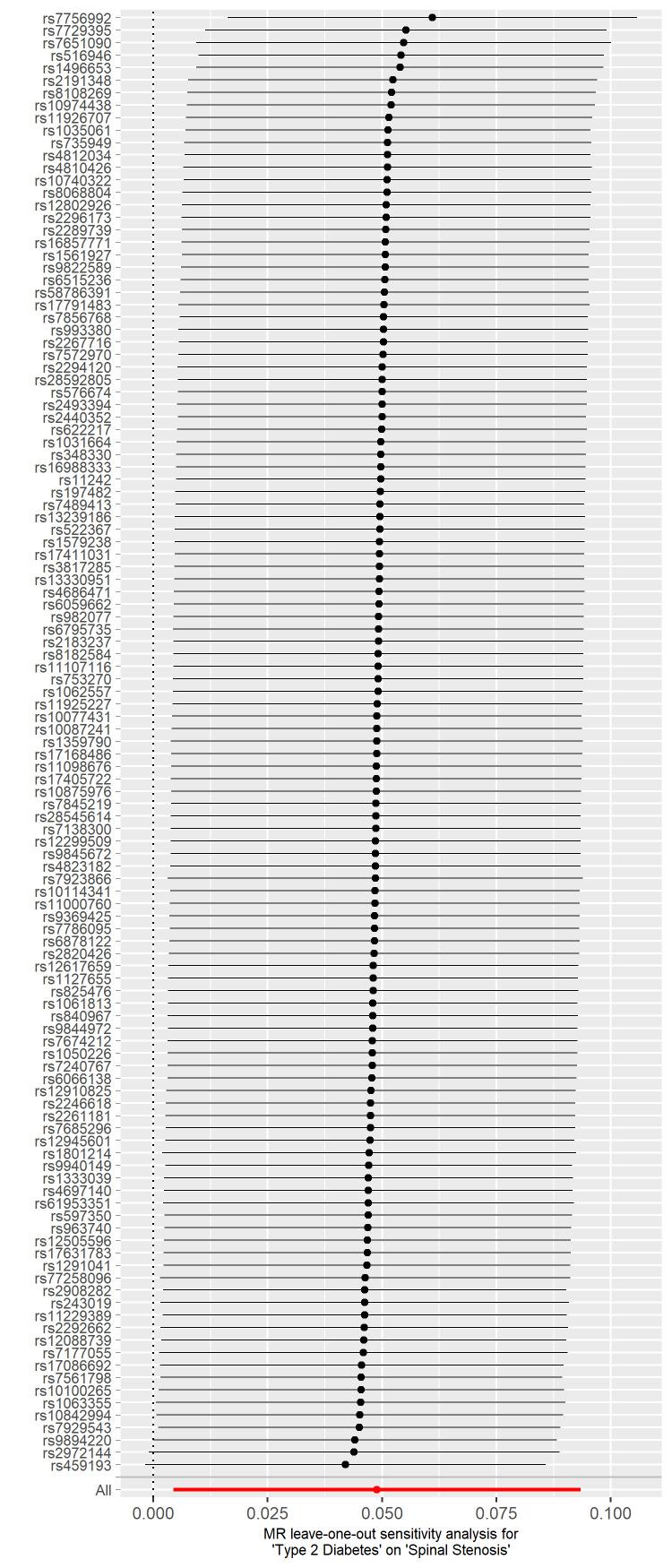
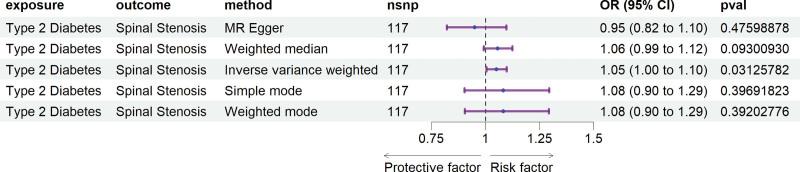
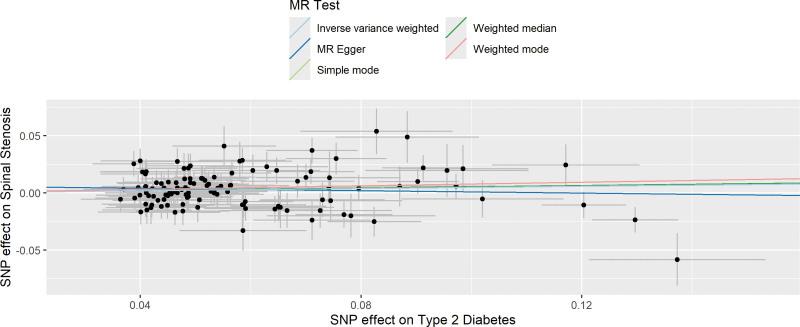
Spinal stenosis is a prevalent degenerative spinal disease and one of the main causes of pain and dysfunction in older adults. Substantial evidence indicates a potentially relevant association between type 2 diabetes mellitus (T2DM) and spinal stenosis. However, the causality between these 2 disorders remains unclear. Therefore, we intended to elucidate this relationship using Mendelian Randomization (MR) analysis in this study. Based on genome-wide association study (GWAS) data on T2DM and spinal stenosis, we performed a bidirectional 2-sample MR analysis to evaluate the causality of T2DM and spinal stenosis. We assessed heterogeneity using Cochran's Q statistic and horizontal pleiotropy using the MR-Egger-intercept. "Leave-one-out" analysis was performed to determine the reliability of causal relationships. In addition, we conducted multivariate MR to clarify the direct influence of T2DM on spinal stenosis after accounting for the effect of body mass index (BMI) on spinal stenosis. Our results indicated that Individuals with T2DM had a heightened risk of spinal stenosis (odds ratio [OR]: 1.050; 95% CI: 1.004-1.098, P = .031). Moreover, no reverse causality existed between T2DM and spinal stenosis. The results of the sensitivity analysis suggest that causality is steady and robust. Multivariate MR results demonstrated that the causality of T2DM on spinal stenosis was not related to BMI (OR, 1.047; 95% CI: 1.003-1.093; P = .032). MR analyses demonstrated a possible positive causal relationship between T2DM and spinal stenosis and that this causality was unrelated to BMI.
脊柱狭窄症是一种常见的退行性脊柱疾病,也是老年人疼痛和功能障碍的主要原因之一。大量证据表明,2 型糖尿病(T2DM)和脊柱狭窄症之间存在潜在的相关关联。然而,这两种疾病之间的因果关系尚不清楚。因此,我们旨在通过本研究中的孟德尔随机化(MR)分析来阐明这种关系。基于 T2DM 和脊柱狭窄症的全基因组关联研究(GWAS)数据,我们进行了双向 2 样本 MR 分析,以评估 T2DM 和脊柱狭窄症之间的因果关系。我们使用 Cochran's Q 统计量评估异质性,使用 MR-Egger 截距评估水平多效性。“逐一剔除”分析用于确定因果关系的可靠性。此外,我们进行了多变量 MR 分析,以在考虑 BMI 对脊柱狭窄症的影响后,阐明 T2DM 对脊柱狭窄症的直接影响。我们的结果表明,T2DM 患者患脊柱狭窄症的风险增加(比值比 [OR]:1.050;95%可信区间:1.004-1.098,P =.031)。此外,T2DM 和脊柱狭窄症之间不存在反向因果关系。敏感性分析的结果表明,因果关系是稳定和可靠的。多变量 MR 结果表明,T2DM 对脊柱狭窄症的因果关系与 BMI 无关(OR,1.047;95%可信区间:1.003-1.093;P =.032)。MR 分析表明,T2DM 和脊柱狭窄症之间可能存在正相关的因果关系,而且这种因果关系与 BMI 无关。



 Zotero 插件