
在德国,长期治疗非癌性疼痛时,超过指南推荐的阿片类药物最大日剂量 - 一项大型回顾性观察研究。
Exceeding the guideline-recommended maximum daily dose of opioids for long-term treatment of non-cancer pain in Germany - a large retrospective observational study.
机构信息
Institute for Healthcare Management and Research, University of Duisburg-Essen, Thea-Leymann-Str. 9, Essen, Nordrhein-Westfalen, 45127, Germany.
DAK-Gesundheit, Hamburg, Germany.
出版信息
BMC Public Health. 2024 Sep 27;24(1):2580. doi: 10.1186/s12889-024-20141-4.
BACKGROUND
High-dose long-term opioid therapy (LTOT) has been associated with increased mortality and hospitalizations. Therefore, the evidence-based German guideline on LTOT for chronic non-cancer pain (CNCP) recommends to only exceed the maximum daily dose (MDD) of opioids in exceptional cases. This study aimed to determine the portion of LTOT patients who exceeded the guideline-recommended MDD and identify predictors of exceeding in administrative claims data.
METHODS
The retrospective observational analysis of opioid prescriptions in patients receiving LTOT for CNCP was based on administrative claims by a large German statutory health insurance company. Patients with at least two quarters of opioid prescriptions between January 2018 and June 2019 were included and followed up for two years. Predictors were identified by logistic regression. In addition, the number of patients still in opioid therapy and the extent of exceeded MDDs were analyzed over time.
RESULTS
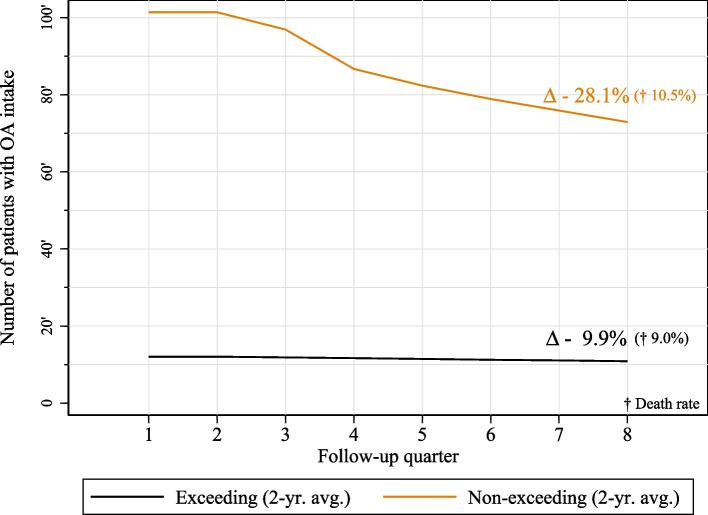
The sample consisted of 113,475 patients. Overall, 10.5% of the patients exceeded the guideline-recommended MDD averaged over the observation period. Strong predictors for exceeding the MDD were receiving opioid prescriptions from > 7 physicians (OR = 7.66, p < .001), receiving predominantly strong opioids (OR = 6.79, p < .001) and receiving opioids for at least one year prior to inclusion (OR = 5.35, p < .001). Within the non-exceeding group, 28.1% discontinued opioid therapy. In contrast, 9.9% of patients in the exceeding group discontinued opioid therapy, whereas the vast majority remained on treatment until the end of the observation period. Furthermore, a slight increase in prescribed doses was observed over time.
CONCLUSIONS
The results indicate that a moderate proportion of patients exceeded the guideline-recommended MDD. However, certain patient groups were more likely to receive high doses. This applied in particular to those who were already on treatment at the time of inclusion and continued to receive opioids until the end of the observation period. Further research should examine whether the continuous opioid therapy among the patients with exceeding the guideline-recommended MDD might be related to specific indications, a lack of therapeutic options or avoidance of withdrawal.
TRIAL REGISTRATION
German Clinical Trials Register (drks.de/search/en). Identifier: DRKS00024854. Registered 28 April 2021.
背景
高剂量长期阿片类药物治疗(LTOT)与死亡率和住院率的增加有关。因此,针对慢性非癌性疼痛(CNCP)的基于循证的德国 LTOT 指南建议,仅在特殊情况下超过阿片类药物的最大日剂量(MDD)。本研究旨在确定超过指南推荐的 MDD 的 LTOT 患者比例,并在行政索赔数据中确定超过 MDD 的预测因素。
方法
这项基于大型德国法定健康保险公司行政索赔的慢性非癌性疼痛接受 LTOT 的阿片类药物处方的回顾性观察分析,纳入了至少在 2018 年 1 月至 2019 年 6 月期间有两个季度阿片类药物处方的患者,并进行了为期两年的随访。通过逻辑回归确定预测因素。此外,还分析了随时间推移仍在接受阿片类药物治疗的患者数量和超过 MDD 的程度。
结果
样本包括 113475 名患者。总体而言,10.5%的患者在观察期内平均超过了指南推荐的 MDD。超过 MDD 的强烈预测因素是从超过 7 名医生处获得阿片类药物处方(OR=7.66,p<.001)、主要使用强阿片类药物(OR=6.79,p<.001)和在纳入前至少使用阿片类药物治疗一年(OR=5.35,p<.001)。在未超过 MDD 的组中,28.1%的患者停止了阿片类药物治疗。相比之下,9.9%的超过 MDD 的组的患者停止了阿片类药物治疗,而绝大多数患者一直接受治疗直至观察期结束。此外,处方剂量随时间略有增加。
结论
结果表明,相当一部分患者超过了指南推荐的 MDD。然而,某些患者群体更有可能接受高剂量。这尤其适用于那些在纳入时已经在接受治疗并一直接受阿片类药物治疗直至观察期结束的患者。进一步的研究应该检查在超过指南推荐的 MDD 的患者中持续的阿片类药物治疗是否与特定的适应证、治疗选择的缺乏或避免戒断有关。
试验注册
德国临床试验注册处(drks.de/search/en)。标识符:DRKS00024854。2021 年 4 月 28 日注册。

 Zotero 插件