
五国青少年饮食习惯与心理健康的关联:一项横断面调查。
Associations between eating habits and mental health among adolescents in five nordic countries: a cross-sectional survey.
机构信息
Department of Health and Caring Science, Western Norway University of Applied Science, Bergen, Norway.
Department of Health Promotion, Norwegian Institute of Public Health, Bergen, Norway.
出版信息
BMC Public Health. 2024 Sep 27;24(1):2640. doi: 10.1186/s12889-024-20084-w.
BACKGROUND
The role of eating habits in adolescent mental health has become a growing area of interest for researchers and health professionals. Recent studies suggest that healthy eating habits may play a role in the development and management of mental health. However, existing literature is largely based on clinical populations, and comparisons are challenged by sociocultural differences and methodological issues. The aim of the present study was to use nationally representative data based on standardized procedures, to explore associations between adolescents eating habits and mental health, considering the importance of age, gender, socioeconomic factors, and country.
METHODS
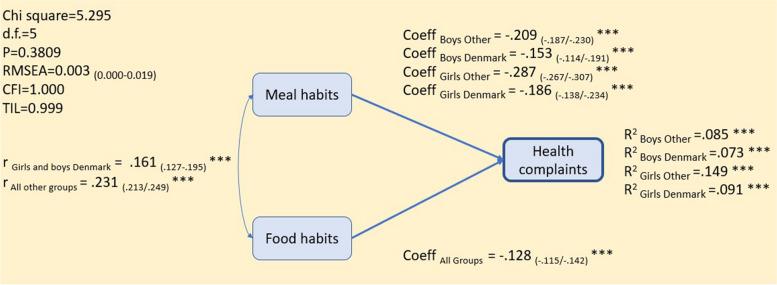
The study was based on data from Nordic adolescents (age 11, 13 and 15 years) who participated in the 2017/2018 Health Behavior in School-aged Children (HBSC) study (n = 22384). General linear modelling and multigroup regression analysis were used to examine the relationship between food habits (intake of fruit, vegetables, sweets, soft drinks), meal habits (intake of breakfast and having family meals together), and mental health (life satisfaction and subjective health complaints). The analyses were weighted and adjusted for age, gender, socio-economic status, and country.
RESULTS
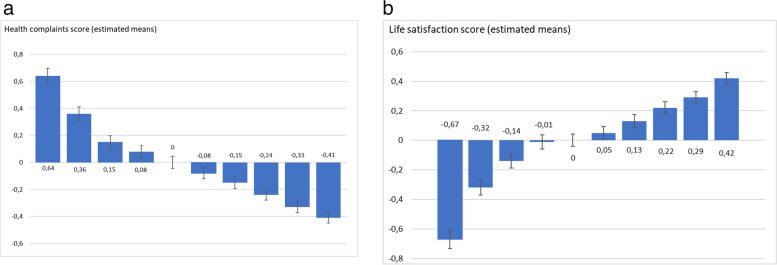
Overall, healthier eating habits were associated with better mental health. The strongest associations were found between meal habits (breakfast consumption and having family meals together) and mental health. Gender and country differences were seen, with weaker associations found among Danish boys.
CONCLUSION
Eating habits should be considered when promoting mental health in the adolescent population. While gender differences and cross-country variations exist, even minor enhancements in eating behaviors could yield meaningful benefits.
背景
饮食习惯在青少年心理健康中的作用已成为研究人员和健康专业人员关注的热点。最近的研究表明,健康的饮食习惯可能在心理健康的发展和管理中发挥作用。然而,现有文献主要基于临床人群,由于社会文化差异和方法学问题,比较存在挑战。本研究旨在使用基于标准化程序的全国代表性数据,探讨青少年饮食习惯与心理健康之间的关联,同时考虑年龄、性别、社会经济因素和国家的重要性。
方法
该研究基于参加 2017/2018 年“青少年健康行为调查”(HBSC)的北欧青少年(11、13 和 15 岁)的数据(n=22384)。采用一般线性模型和多组回归分析,检验了饮食习惯(水果、蔬菜、甜食、软饮料的摄入)、进餐习惯(早餐摄入和一起用餐)与心理健康(生活满意度和主观健康抱怨)之间的关系。分析进行了加权处理,并根据年龄、性别、社会经济地位和国家进行了调整。
结果
总体而言,更健康的饮食习惯与更好的心理健康相关。饮食与心理健康之间的关联最强,其中包括进餐习惯(早餐摄入和一起用餐)。存在性别和国家差异,丹麦男孩的关联较弱。
结论
在促进青少年人群心理健康时应考虑饮食习惯。虽然存在性别差异和跨国差异,但即使是饮食习惯的微小改善也可能产生有意义的益处。

 Zotero 插件