
单次与重复超声处理后尼莫地平从载药嵌段共聚物中的超声诱导释放曲线:在人工脑脊液中的体外分析
Ultrasound-Induced Release Profile of Nimodipine from Drug-Loaded Block Copolymers after Singular vs. Repeated Sonication: In Vitro Analysis in Artificial Cerebrospinal Fluid.
作者信息
Döring Katja, Sperling Swetlana, Ninkovic Milena, Lanfermann Heinrich, Streit Frank, Fischer Andreas, Rohde Veit, Malinova Vesna
机构信息
Department of Neurosurgery, University Medical Center Göttingen, 37075 Göttingen, Germany.
Department of Interventional and Diagnostic Neuroradiology, Hannover Medical School, 30625 Hannover, Germany.
出版信息
Brain Sci. 2024 Sep 10;14(9):912. doi: 10.3390/brainsci14090912.
OBJECTIVE
Nimodipine still represents a unique selling point in the prevention of delayed cerebral ischemia (DCI) following aneurysmal subarachnoid hemorrhage (aSAH). Its intrathecal effect is limited by a low oral bioavailability, leading to the development of nanocarrier systems to overcome this limitation. This study investigated the ultrasound-induced release profile of nimodipine from drug-loaded copolymers in artificial cerebrospinal fluid (CSF) within 72 h after a singular versus repeated sonication.
METHODS
Pluronic F127 copolymers (Sigma-Aldrich, Taufkirchen, Germany)were loaded with nimodipine by direct dissolution. Spontaneous and on-demand drug release by ultrasound (1 MHz at 1.7 W/cm) was determined in artificial cerebrospinal fluid using the dialysis bag method. Nimodipine concentrations were measured at predefined time points within 72 h of sonication.
RESULTS
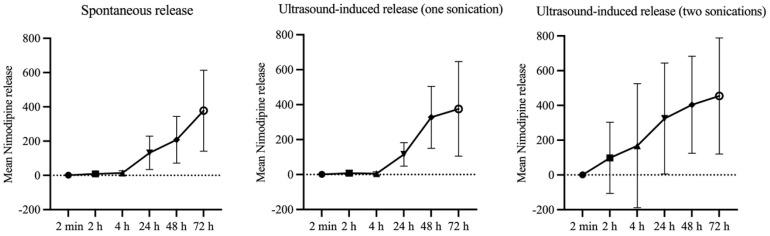
Spontaneous release of nimodipine was enhanced by ultrasound application with significantly increased nimodipine concentrations two hours after a repeated sonication compared to a singular sonication (median 1.62 vs. 17.48 µg/µL, = 0.04). A further trend was observed after four hours (median 1.82 vs. 22.09 µg/µL, = 0.06). There was no difference in the overall nimodipine concentrations between the groups with a singular versus repeated sonication (357.2 vs. 540.3 µg/µL, = 0.60) after 72 h.
CONCLUSIONS
Repeated sonication resulted in an acceleration of nimodipine release from the drug-loaded copolymer in a CSF medium. These findings confirm the proof of principle of an on-demand guidance of nimodipine release from nimodipine-loaded nanodrugs by means of ultrasound, which suggests that evaluating the concept in an animal model may be appropriate.
目的
尼莫地平仍是预防动脉瘤性蛛网膜下腔出血(aSAH)后迟发性脑缺血(DCI)的一个独特卖点。其鞘内效应受口服生物利用度低的限制,促使人们开发纳米载体系统来克服这一限制。本研究调查了单次与重复超声处理后72小时内,尼莫地平从载药共聚物在人工脑脊液(CSF)中的超声诱导释放情况。
方法
通过直接溶解将尼莫地平负载到普朗尼克F127共聚物(德国陶夫基兴市西格玛奥德里奇公司)中。使用透析袋法在人工脑脊液中测定超声(1兆赫兹,1.7瓦/平方厘米)诱导的自发和按需药物释放。在超声处理后的72小时内,在预定时间点测量尼莫地平浓度。
结果
超声处理可增强尼莫地平的自发释放,与单次超声处理相比,重复超声处理两小时后尼莫地平浓度显著增加(中位数分别为1.62微克/微升和17.48微克/微升,P = 0.04)。四小时后观察到进一步的趋势(中位数分别为1.82微克/微升和22.09微克/微升,P = 0.06)。72小时后,单次与重复超声处理组之间的尼莫地平总浓度无差异(分别为357.2微克/微升和540.3微克/微升,P = 0.60)。
结论
重复超声处理导致载药共聚物在脑脊液介质中尼莫地平释放加速。这些发现证实了通过超声对载尼莫地平纳米药物中尼莫地平释放进行按需引导的原理证明,这表明在动物模型中评估该概念可能是合适的。



 Zotero 插件