
基于计算方法探索含索拉非尼的钌配合物作为光动力化疗抗癌药物的作用机制。
Computational Exploration of the Mechanism of Action of a Sorafenib-Containing Ruthenium Complex as an Anticancer Agent for Photoactivated Chemotherapy.
机构信息
Department of Chemistry and Chemical Technologies, University of Calabria, Via P. Bucci, 87036 Rende (CS), Italy.
Department of Chemistry, KU Leuven, Celestijnenlaan 200F, 3001 Heverlee, Belgium.
出版信息
Molecules. 2024 Sep 11;29(18):4298. doi: 10.3390/molecules29184298.
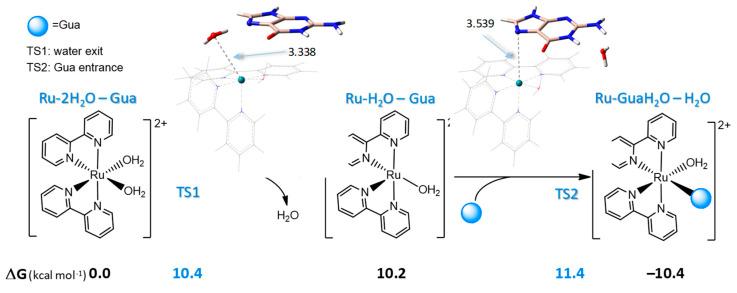
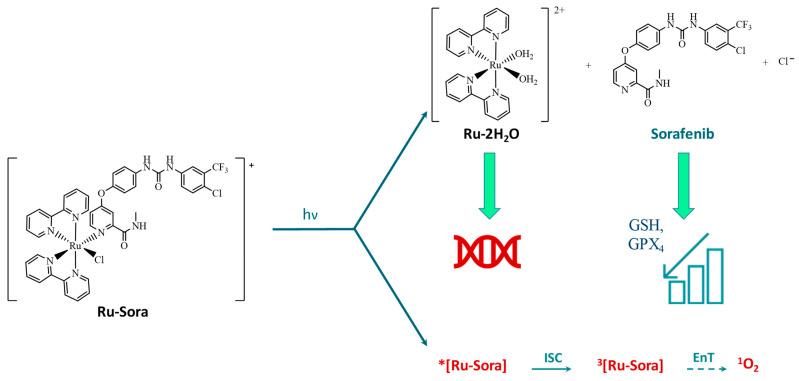
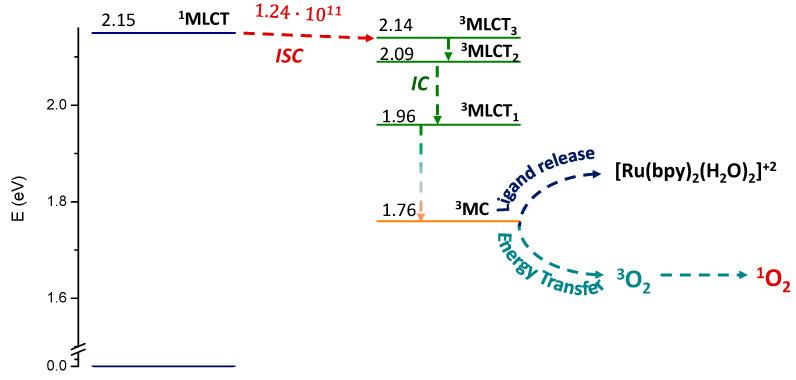
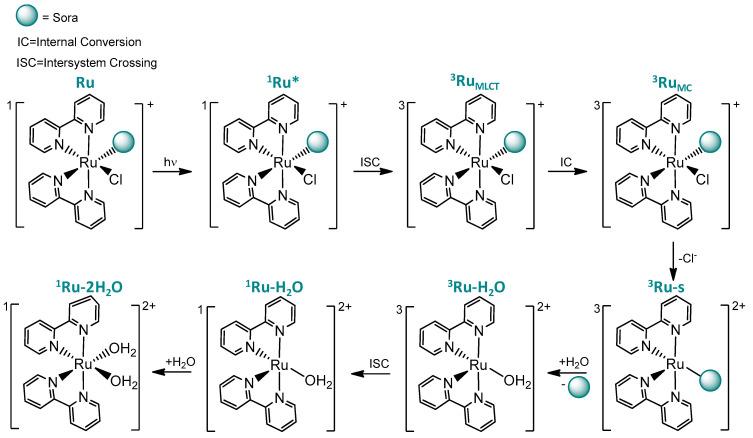
Ruthenium(II) polypyridyl complexes are being tested as potential anticancer agents in different therapies, which include conventional chemotherapy and light-activated approaches. A mechanistic study on a recently synthesized dual-action Ru(II) complex [Ru(bpy)(sora)Cl] is described here. It is characterized by two mono-dentate leaving ligands, namely, chloride and sorafenib ligands, which make it possible to form a di-aquo complex able to bind DNA. At the same time, while the released sorafenib can induce ferroptosis, the complex is also able to act as a photosensitizer according to type II photodynamic therapy processes, thus generating one of the most harmful cytotoxic species, O. In order to clarify the mechanism of action of the drug, computational strategies based on density functional theory are exploited. The photophysical properties of the complex, which include the absorption spectrum, the kinetics of ISC, and the character of all the excited states potentially involved in O generation, as well as the pathway providing the di-aquo complex, are fully explored. Interestingly, the outcomes show that light is needed to form the mono-aquo complex, after releasing both chloride and sorafenib ligands, while the second solvent molecule enters the coordination sphere of the metal once the system has come back to the ground-state potential energy surface. In order to simulate the interaction with canonical DNA, the di-aquo complex interaction with a guanine nucleobase as a model has also been studied. The whole study aims to elucidate the intricate details of the photodissociation process, which could help with designing tailored metal complexes as potential anticancer agents.
钌(II)多吡啶配合物作为潜在的抗癌药物,正在不同的疗法中进行测试,包括常规化疗和光激活方法。本文描述了一种最近合成的双功能 Ru(II)配合物[Ru(bpy)(sora)Cl]的机理研究。它的特点是两个单齿离去配体,即氯离子和索拉非尼配体,这使得形成能够结合 DNA 的二水合配合物成为可能。同时,当释放的索拉非尼可以诱导铁死亡时,该配合物也可以根据 II 型光动力治疗过程充当光敏剂,从而产生最具危害性的细胞毒性物质之一 O。为了阐明药物的作用机制,利用基于密度泛函理论的计算策略进行了研究。对配合物的光物理性质进行了全面研究,包括吸收光谱、ISC 动力学以及所有潜在参与 O 生成的激发态的性质,以及提供二水合配合物的途径。有趣的是,结果表明,需要光来形成单核水合物配合物,在释放氯离子和索拉非尼配体后,而第二个溶剂分子进入金属配位球一旦系统回到基态势能面。为了模拟与典型 DNA 的相互作用,还研究了二水合配合物与鸟嘌呤核苷碱基作为模型的相互作用。整个研究旨在阐明光解离过程的复杂细节,这有助于设计定制的金属配合物作为潜在的抗癌药物。



 Zotero 插件